














Reading the Crypto Market in Mid-2026: BTC and ETH Through the Lens of On-Chain and Macro
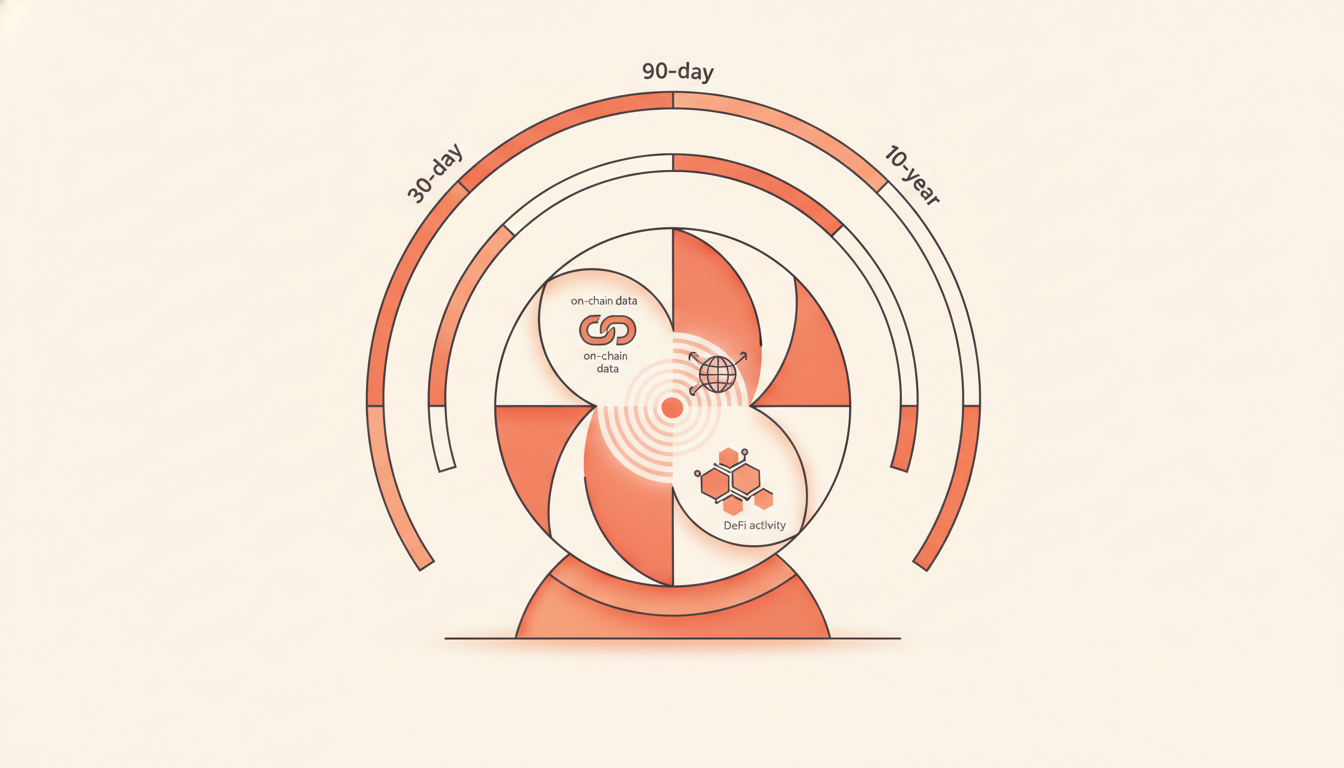
A mid-year read on Bitcoin and Ethereum: what on-chain data, macro context and DeFi activity are saying, across 30-day, 90-day and 1-year time horizons, with a clear framing of uncertainty.
 Marcus Tan
5 min read
Marcus Tan
5 min read
Key takeaways
- In 2026, the correlation between crypto assets and traditional risk markets has become harder to ignore.
- For a 30-day time horizon, Bitcoin’s price action is primarily sentiment-driven.
- Ethereum’s price is more tightly coupled to DeFi and smart-contract ecosystem activity than Bitcoin’s.
- A 1-year horizon is where specific time targets get difficult and honest analysts widen their scenario bands significantly.
A mid-year read on Bitcoin and Ethereum: what on-chain data, macro context and DeFi activity are saying, across 30-day, 90-day and 1-year time horizons, with a clear framing of uncertainty.
YMYL notice: This article is educational market analysis. It is not financial advice. Bitcoin and Ethereum are highly volatile assets. Nothing here is a recommendation to buy or sell.
The macro backdrop matters more than ever
In 2026, the correlation between crypto assets and traditional risk markets has become harder to ignore. Bitcoin and Ethereum have both shown periods of high correlation with the Nasdaq and periods of meaningful divergence, particularly around crypto-specific events (halvings, major protocol upgrades, exchange failures). Analysts who model crypto in isolation miss context; those who treat it purely as a risk-asset proxy miss the native factors.
The Federal Reserve’s interest-rate trajectory remains the single macro variable that most reliably moves crypto in the short term. When U.S. Treasury yields rise, liquidity conditions tighten globally, risk appetite falls, and crypto markets tend to pull back. When they fall, the opposite dynamic often plays out. As of June 2026, the Fed has held rates in a range that has been neither aggressively stimulative nor contractionary, which has contributed to a range-bound macro environment for risk assets broadly.
The U.S. dollar index (DXY) is a secondary signal. A strong dollar historically correlates with weaker crypto prices because most crypto is priced in dollars and a strong dollar tightens global liquidity. A weakening dollar has the inverse effect. You can track DXY on traditional data sources; we link out rather than attempt to replicate macro data.
Bitcoin: 30-day and 90-day view
For a 30-day time horizon, Bitcoin’s price action is primarily sentiment-driven. The tools that matter most on this horizon are the Crypto Fear and Greed Index (extreme fear has historically been a better buying zone than extreme greed) and futures market positioning data (open interest, funding rates, and long/short ratios available from data providers like Coinglass).
For a 90-day horizon, the on-chain picture adds more weight. Two metrics are widely referenced:
- MVRV Z-Score. Market Value to Realised Value Z-Score compares Bitcoin’s market cap to its realised cap and standardises it by historical deviation. High MVRV has historically coincided with cycle tops; low MVRV with bottoms. Glassnode publishes this metric on their public dashboard.
- Exchange net flows. When significant Bitcoin moves from wallets to exchanges, it often signals intent to sell. When it moves off exchanges to private wallets, it suggests accumulation. This signal is noisy on a day-by-day basis but clearer on a 30–90 day trend.
Our model-based bear, base and bull scenarios for Bitcoin at the 30-day and 90-day horizons are on the BTC price page. Model-based scenarios. Not financial advice.
Ethereum through the DeFi lens
Ethereum’s price is more tightly coupled to DeFi and smart-contract ecosystem activity than Bitcoin’s. One proxy for that activity is total value locked (TVL) across DeFi protocols. When TVL is rising, users are allocating capital into Ethereum-based protocols, which generally requires them to hold or use ETH (as gas or collateral). When TVL falls, capital is leaving.
DEX volume on Ethereum and its layer-2 networks is another indicator. Uniswap and Curve generate significant fee revenue that feeds back into their protocol economies; high DEX volume suggests an active ecosystem rather than purely passive holding.
The ETH price page includes the model-based 1-year scenario for Ethereum. For context on how to use it correctly, see the guide to reading predictions.
1-year horizon and what would change the picture
A 1-year horizon is where specific time targets get difficult and honest analysts widen their scenario bands significantly. The structural bull factors for the next 12 months include the continued post-halving supply reduction in Bitcoin, Ethereum’s position as the dominant smart-contract settlement layer, and growing institutional participation via regulated products.
The structural bear factors include: global macro deterioration (a U.S. recession or financial crisis typically hits risk assets hard), regulatory action in major markets (SEC enforcement, EU MiCA implementation friction, Asia-specific bans), and the possibility of a large on-chain exploit or exchange failure of the type that defined 2022.
We do not assign probabilities to these because doing so would be false precision. What we can say is that anyone offering a confident 12-month price target for either Bitcoin or Ethereum should be asked what evidence they have that is not already in the market. Usually there is none, and the target is a narrative convenience rather than an analysis output.
Frequently asked questions
What is the MVRV Z-Score and where can I track it?
MVRV Z-Score measures how far Bitcoin’s market cap is above or below its realised cap, expressed in units of historical standard deviation. It is published by Glassnode. High readings have historically coincided with cycle peaks; low readings with cycle troughs. It is a lagging indicator, not a prediction tool.
How does DeFi TVL affect ETH price?
TVL measures capital allocated to DeFi protocols on Ethereum and other chains. Rising TVL generally reflects growing demand for ETH (as gas and collateral), which tends to be associated with positive price momentum. However, TVL can also be inflated by rehypothecation (the same asset counted multiple times) and is not a direct demand signal.
Are TheWeal’s price scenarios for BTC and ETH forecasts?
No. They are model-based scenarios generated deterministically from historical data, volatility and market regime. They show a range of outcomes, not a prediction of the future. They are explained in our methodology.
What would cause a sharp downside break in both BTC and ETH?
Historically, the sharpest crypto drawdowns have been caused by: macro liquidity crises (risk assets sell globally), large exchange insolvencies (reducing confidence in custody), regulatory shocks (bans, enforcement actions), and on-chain failures (smart-contract exploits, stablecoin depegs). These events are hard to predict and move prices before most investors can react.
Sources
- Glassnode — on-chain metrics for Bitcoin and Ethereum (MVRV, exchange flows, realised price)
- CoinGecko — source for live market data on TheWeal
- TheWeal: Live Bitcoin price page with model-based scenarios
- TheWeal: Live Ethereum price page with model-based scenarios
- TheWeal: Prediction methodology
- TheWeal: Reading a prediction guide

 · James Okafor6 min read

 · Priya Rao4 min read

 · Lena Kovacs4 min read