


The Bitcoin halving is a pivotal event in the cryptocurrency world, and the latest one occurred in April 2024. This article explores what the halving means, its historical context, current developments, and what lies ahead for investors and the broader market.
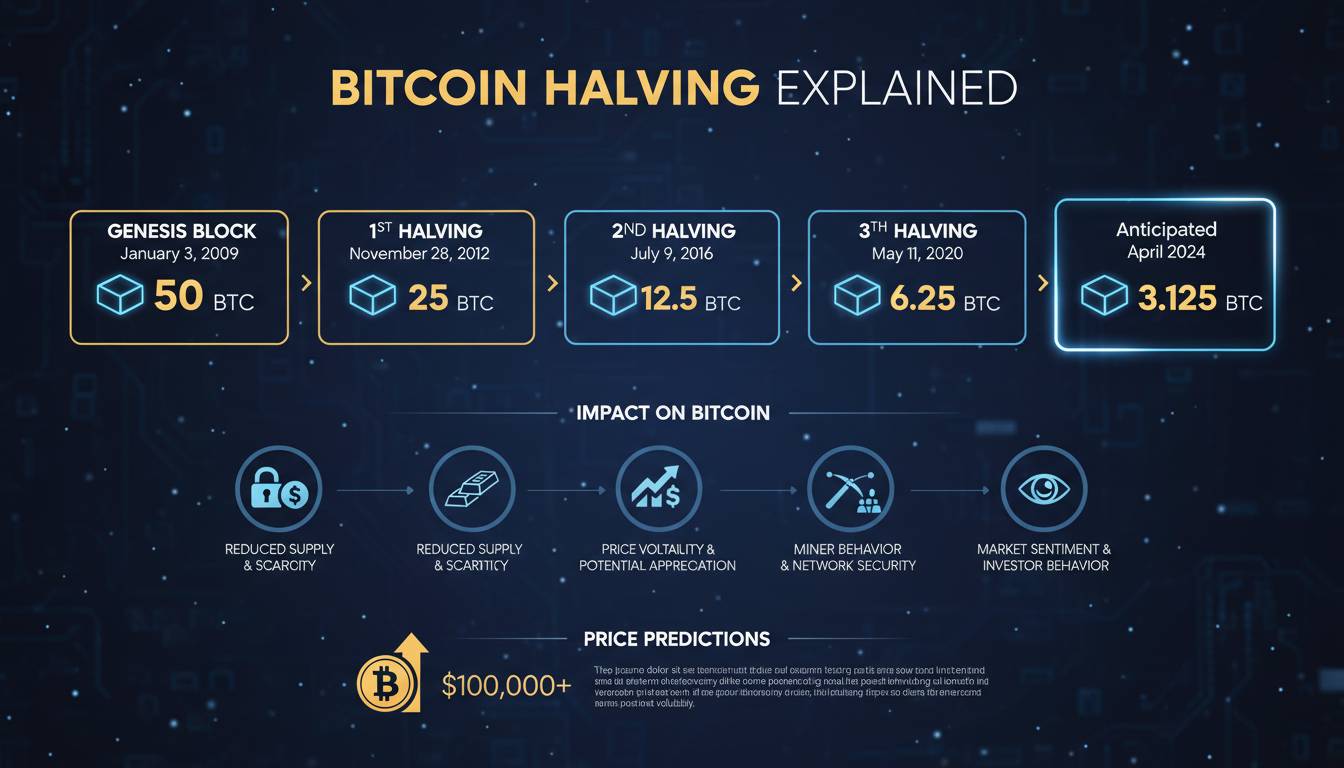
Bitcoin halving is a pre-programmed event that cuts the mining reward in half every 210,000 blocks—roughly every four years. The most recent halving took place on April 19, 2024, reducing the block reward from 6.25 BTC to 3.125 BTC . This mechanism enforces scarcity by slowing the rate of new Bitcoin entering circulation, reinforcing its deflationary design .
What Is Bitcoin Halving and Why It Matters
Bitcoin halving is embedded in the protocol to control inflation and simulate scarcity. Each halving reduces the supply of new Bitcoin, making it harder to mine and theoretically more valuable over time . Historically, halvings have preceded significant price rallies:
- After the 2012 halving, Bitcoin surged from around $12 to over $1,000 within a year .
- The 2016 halving saw prices climb from roughly $650 to nearly $19,000 by late 2017 .
- Following the 2020 halving, Bitcoin rose from about $8,800 to an all-time high above $60,000 in 2021 .
These patterns reflect a supply shock: fewer new coins enter the market while demand remains steady or grows, pushing prices upward .
Timeline and Mechanics of Halvings
Bitcoin halvings occur approximately every four years, triggered by block height rather than calendar dates. The key historical and projected halving events include:
- November 28, 2012: Reward dropped from 50 BTC to 25 BTC
- July 9, 2016: Reward dropped to 12.5 BTC
- May 11, 2020: Reward dropped to 6.25 BTC
- April 19, 2024: Reward dropped to 3.125 BTC
- Projected for March–April 2028: Reward will drop to 1.5625 BTC
The 2028 halving is expected around mid-April, reducing daily Bitcoin issuance from approximately 450 BTC to 225 BTC .
Impact on Miners and Market Dynamics
Halvings directly affect miners by halving their block rewards. This can pressure less efficient operations, potentially leading to industry consolidation . However, several factors help miners adapt:
- Price appreciation often offsets reduced rewards
- Advances in mining hardware improve efficiency by 20–40% every two years
- Transaction fees grow as adoption increases, supplementing miner income
Charles Guillemet, CTO of Ledger, explains that halving creates a liquidity shock: less new supply enters the market while some miners may sell holdings to cover costs, exerting downward pressure. At the same time, scarcity can drive prices upward .
Current Market Context and Price Predictions
The 2024 halving occurred amid a surge in institutional interest, particularly through Bitcoin ETFs launched in the U.S. earlier that year. These ETFs have attracted substantial capital, buying around 2,500 BTC daily—far exceeding the new supply of roughly 900 BTC per day, which will drop to 450 BTC post-halving . This imbalance has contributed to price rallies, with Bitcoin reaching nearly $74,000 in March 2024 .
However, recent market trends show volatility. In early February 2026, Bitcoin fell below $70,000, marking a 20% drop for the year. Hedge fund manager Michael Burry described the situation as a “collateral death spiral,” citing high leverage and falling crypto collateral .
Price Forecasts for 2026
Analysts offer varied outlooks for Bitcoin’s price trajectory:
- NoLimit projects a potential bottom of $45,000–$50,000 by late 2026, based on historical NUPL (Net Unrealized Profit/Loss) cycles .
- ChartMini outlines three scenarios:
- Base case: gradual appreciation to $95,000–$115,000 by late 2026
- Bull case: stronger ETF inflows and macro tailwinds could push prices higher
- Bear case: macroeconomic or regulatory headwinds could suppress gains .
- Epoch Ventures predicts Bitcoin could reach $150,000 in 2026, citing increased corporate holdings and institutional adoption .
Analysis and Future Outlook
Bitcoin halving remains a powerful structural force in the market, reinforcing scarcity and shaping long-term price cycles. The 2024 halving, combined with ETF-driven demand, has altered the dynamics compared to previous cycles .
Yet, uncertainty persists. Market downturns, regulatory shifts, and macroeconomic pressures could temper gains. Analysts like Michael Burry warn of systemic risks, while others point to institutional accumulation as a stabilizing force .
Looking ahead to the 2028 halving, the reduced supply and continued adoption may set the stage for another supply shock. But diminishing returns and evolving market structure suggest that each cycle may yield smaller percentage gains .
Conclusion
Bitcoin halving is a defining feature of the cryptocurrency’s design, enforcing scarcity and influencing market cycles. The April 2024 halving reduced block rewards to 3.125 BTC, triggering supply constraints amid rising institutional demand. While historical patterns suggest post-halving rallies, recent volatility and macro risks underscore the need for cautious optimism.
Price forecasts for 2026 range widely—from a bottom near $45,000 to potential highs of $150,000—reflecting divergent views on adoption, regulation, and market psychology. As the next halving approaches in 2028, investors should monitor supply dynamics, ETF flows, and macroeconomic trends to navigate the evolving landscape.
Frequently Asked Questions
What is a Bitcoin halving?
Bitcoin halving is a protocol-driven event that cuts the block reward for miners by 50% every 210,000 blocks (roughly every four years), reducing the rate of new Bitcoin issuance .
When did the most recent halving occur?
The most recent halving occurred on April 19, 2024, reducing the block reward from 6.25 BTC to 3.125 BTC .
When is the next halving expected?
The next halving is projected for March–April 2028, when the block reward will drop to 1.5625 BTC .
How does halving affect Bitcoin’s price?
Halving reduces supply, creating scarcity. Historically, this has led to price rallies 6–18 months post-halving, though outcomes vary based on demand, market sentiment, and macro conditions .
What are current price predictions for 2026?
Forecasts vary widely:
– NoLimit suggests a potential bottom of $45,000–$50,000 .
– ChartMini projects a base case of $95,000–$115,000 .
– Epoch Ventures sees a possible peak of $150,000 .
Why is there uncertainty despite historical patterns?
Market dynamics have evolved. Institutional adoption, ETF inflows, regulatory shifts, and macroeconomic pressures now play a larger role. Additionally, diminishing returns from each halving and increased market maturity add complexity to predictions .

















Leave a comment