


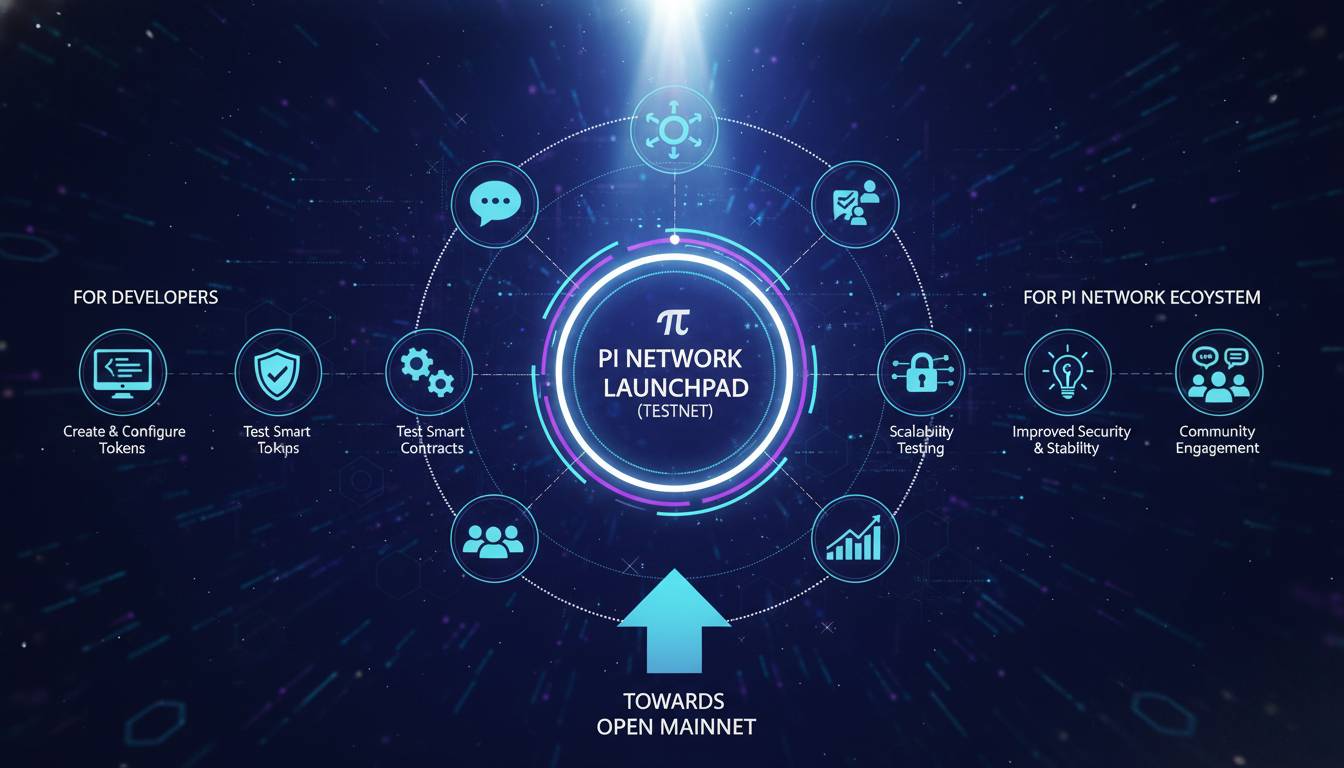
Pi Network’s latest Testnet expansion adds token creation infrastructure to a broader DeFi-style toolkit, giving developers and users a live environment to experiment with new assets before any Mainnet rollout. The move matters because Pi’s official roadmap has shifted from basic wallet and app functions toward a fuller on-chain economy, with token issuance, swaps, and liquidity testing now grouped inside the network’s Testnet stack.
Pi Network said on September 30, 2025 that Pi DEX, AMM liquidity pools, and token creation features were deployed on Pi Testnet, with Mainnet access still restricted during the testing period. The announcement, published by Pi Network on its official blog, framed token creation as a prerequisite for decentralized exchange functions and said all activity would use Test-Pi and test tokens only. That makes the Testnet launchpad story less about immediate trading and more about infrastructure: Pi is building the rails for app-linked tokens, swaps, and liquidity experiments before allowing those functions on Mainnet.
ℹ️
Pi’s token launchpad is a Testnet-only development, not a Mainnet token sale.
Pi Network’s September 30, 2025 announcement says token creation, DEX, and AMM tools are live on Testnet, while Mainnet remains restricted during the testing phase.
Pi Network Milestones Relevant to the Testnet Launchpad
| Date | Event | Why It Matters |
|---|---|---|
| March 14, 2019 | Official Pi Network launch | Start of the network’s mobile-first distribution model |
| April 1, 2021 | Testnet Wallets released | Enabled Test-Pi transfers for developers and early testing |
| March 14, 2023 | Ecosystem Interface launched | Created a curated venue for Testnet Pi apps |
| February 20, 2025 | Open Network launched | Added external connectivity to the Pi blockchain |
| September 30, 2025 | DEX, AMM, and token creation launched on Testnet | Introduced the building blocks behind a token launchpad model |
Source: Pi Network roadmap and official blog posts | accessed March 21, 2026
September 30, 2025 Token Release Created the Core Launchpad Layer
The clearest official basis for describing a Pi “token launchpad” is Pi Network’s September 30, 2025 post announcing Testnet support for DEX functions, AMM liquidity pools, and token creation. In that post, Pi said developers can create test tokens on Pi Testnet and that documentation would follow. It also said these tools are intended to let builders extend Pi Network’s capabilities “in a structured, utility-focused and Web3 way.”
That wording matters. Pi is not presenting Testnet token creation as a meme-coin factory or a public fundraising venue. Instead, the network is tying token issuance to app utility, system-level functions, and eventual rules for Mainnet issuance. Pi explicitly said Mainnet token creation will be subject to additional rules, including expectations around utility, supply, and distribution. In practical terms, the Testnet launchpad is a sandbox for mechanics, not a green light for unrestricted Mainnet token launches.
Historically, this is a notable step because Pi spent much of 2021 through early 2025 focused on enclosed Mainnet migration, KYC, wallet access, and app onboarding. The addition of token creation tools marks a shift from foundational network access toward capital and asset formation inside the ecosystem. Compared with Pi’s earlier milestones such as Testnet wallets in April 2021 or the Ecosystem Interface in March 2023, the September 2025 release is closer to a market-structure upgrade than a simple app update.
How Pi Reached the Testnet Launchpad Stage
April 1, 2021: Testnet Wallets launched, allowing developers and users to hold and move Test-Pi.
March 14, 2023: Pi created the Ecosystem Interface to spotlight Testnet apps and expand user discovery.
February 20, 2025: Open Network launched, adding external connectivity to Pi’s layer-1 blockchain.
September 30, 2025: Pi deployed DEX, AMM, and token creation features on Testnet.
January 21, 2026: Pi App Studio added easier Test-Pi payment integration for app creators.
How Test-Pi and App Tools Are Driving the New Token Sandbox
The launchpad concept only works if developers can build apps around it, and Pi has been expanding that side of the stack too. On January 21, 2026, Pi Network said Pi App Studio added payment integration using Test-Pi, alongside broader access for creators to deploy app iterations. The company said these changes were designed to help more Pioneers experiment and create useful apps, with Test-Pi acting as the initial payment layer.
That update connects directly to the token launchpad narrative. A token creation feature without app-level payments would be mostly speculative. By contrast, Pi’s recent product direction suggests the network wants developers to test how tokens, payments, and app experiences fit together before Mainnet permissions widen. The roadmap also shows Pi has been building this in stages: wallet first, app discovery second, external connectivity third, and token mechanics after that.
Pi’s roadmap provides additional context. It says the Pi Mining app remains a launchpad for peer-to-peer growth, while the Pi Browser’s Ecosystem Interface gives users a curated selection of apps based on development milestones and policy compliance. That curation model may become important if Pi eventually formalizes a broader token launchpad on Mainnet. A curated ecosystem would let the network filter for utility and compliance rather than open the door to unlimited token issuance.
What Is Live Now vs. What Remains Restricted
| Feature | Status | Network |
|---|---|---|
| Token creation | Live for testing | Testnet |
| DEX functions | Live for testing | Testnet |
| AMM liquidity pools | Live for testing | Testnet |
| Test-Pi app payments | Available | Test environment |
| Mainnet token creation | Restricted | Mainnet |
| Mainnet DeFi participation with real Pi | Not yet opened broadly | Mainnet |
Source: Pi Network official blog posts dated September 30, 2025 and January 21, 2026 | accessed March 21, 2026
Why Pi’s Utility-First Rules Could Shape Any Mainnet Token Market
Pi Network’s official language repeatedly emphasizes utility over speculation. In its September 2025 announcement, the network contrasted its token approach with “empty incentive mechanisms” and said Mainnet token creation would face further rules. That is one of the most important signals for developers and users evaluating what this Testnet launchpad means.
If Pi follows that framework, the eventual Mainnet version may look less like a permissionless token bazaar and more like a controlled issuance system tied to apps, services, and distribution plans. That would fit Pi’s broader operating model, which has relied on KYC, migration controls, curated app exposure, and phased feature releases. It would also reduce the risk that Testnet enthusiasm is mistaken for immediate Mainnet monetization.
There is also a safety angle. Pi’s official safety pages warn users about unauthorized token listings and phishing risks, and the network has long distinguished official Pi assets from third-party or derivative listings. That history makes it especially important to separate Testnet token experiments from any claim of official Mainnet token launches or exchange-backed offerings. Users should treat Test-Pi and test tokens as development tools, not as transferable Mainnet assets.
⚠️
Test tokens on Pi Testnet are not Mainnet assets.
Pi Network says all current DEX, AMM, and token activity in this release uses Test-Pi and test tokens for testing purposes only, while Mainnet functionality remains restricted.
2026 Signals Show Pi Is Expanding From Migration to On-Chain Utility
Pi’s February 20, 2026 Open Network anniversary post described the past year as a period of growth in Mainnet migrations, developer activity, application growth, and network participation. It also highlighted Pi App Studio, Pi Network Ventures, and the DEX/AMM/token creation feature set as key developments. That grouping is revealing because it places token infrastructure alongside app creation and ecosystem funding, not as a standalone trading story.
For readers in the United States and other markets, the practical takeaway is straightforward. Pi Network’s Testnet token launchpad is best understood as an ecosystem-building tool. It gives developers a place to test token issuance, liquidity design, and app-linked utility using Test-Pi. It does not yet mean unrestricted Mainnet token launches, and it does not by itself create a new investable asset class inside Pi’s live Mainnet economy.
The next milestone to watch is not a price target but a policy update: when Pi publishes Mainnet token creation rules, documentation, or eligibility standards, the Testnet launchpad will move from experiment to market framework. Until then, the release is significant because it shows where Pi is heading, not because it has already arrived.
Frequently Asked Questions
Did Pi Network launch a token launchpad on Mainnet?
No. Pi Network’s official September 30, 2025 announcement says token creation, DEX, and AMM features are live on Testnet, while Mainnet access remains restricted during the testing period. The current setup uses Test-Pi and test tokens only.
What exactly can developers do on the Pi Testnet now?
Developers can create test tokens and experiment with DEX and AMM functions on Pi Testnet, according to Pi Network’s official blog. The goal is to test swaps, liquidity mechanics, and token-linked app utility before any broader Mainnet rollout.
Why is Pi calling this utility-focused instead of speculative?
Pi Network says Mainnet token creation will be subject to additional rules around utility, supply, and distribution. In its September 2025 post, the network explicitly contrasted its approach with low-utility token models and said it wants tokens tied to real applications and services.
How does Pi App Studio connect to the token launchpad story?
Pi App Studio added Test-Pi payment integration on January 21, 2026, making it easier for creators to build app experiences around Pi-based payments. That matters because token creation becomes more useful when developers can connect assets to actual app functions.
Are Testnet tokens or Test-Pi worth real money?
Pi Network says Test-Pi and test tokens in this release are for testing purposes only and are invalid for Mainnet use or other purposes. Users should not treat them as official Mainnet assets or as substitutes for migrated Pi on the live network.
Disclaimer: This article is for informational purposes only. Information may have changed since publication. Always verify information independently and consult qualified professionals for specific advice.



















Leave a comment