


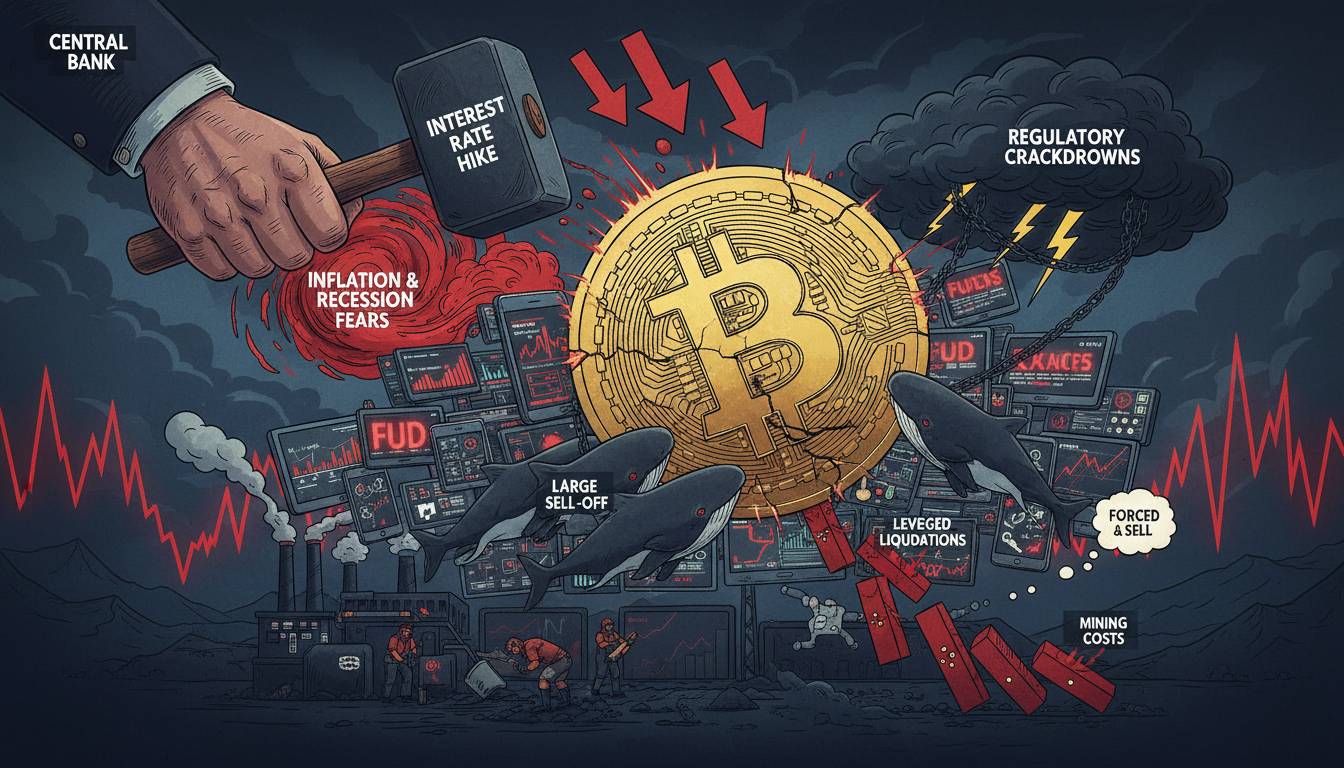
Bitcoin is under pressure on Sunday, March 22, 2026, after a fresh bout of risk-off trading hit leveraged crypto positions and kept buyers cautious near the $70,000 area. The immediate story is not a single headline. It is a combination of failed upside momentum, elevated liquidation risk, and still-fragile institutional flow data that has left BTC struggling to hold recent gains.
Bitcoin traded around the high-$60,000 to low-$70,000 range in March 2026 after a volatile start to the month, with market trackers showing repeated rejections near $70,000 and above. KuCoin, citing CoinGlass liquidation data, reported that BTC had been trapped between roughly $65,000 and $70,500, with large liquidation clusters stacked above spot prices and bearish pressure following February’s 14.82% monthly drop. CoinStats’ March 12 market note also placed Bitcoin near $70,216 after a rebound from about $66,370 on March 9, showing that the market had recovered from early-March lows but had not fully rebuilt momentum.
🔴
Leverage remains a central pressure point.
CoinGlass market pages and March 2026 coverage show BTC liquidation activity running in an elevated range, with repeated long-position wipeouts after failed breakouts.
Bitcoin Selloff Snapshot
| Metric | Latest context | Why it matters |
|---|---|---|
| Trading range | About $65,000 to $70,500 in March 2026 | Shows BTC is stuck below breakout resistance |
| February move | -14.82% monthly decline | Leaves sentiment fragile into late March |
| March rebound point | Recovery from about $66,370 on March 9 | Confirms buyers stepped in, but not decisively |
| Liquidation setup | Large leverage clusters above $70,000 | Failed rallies can trigger fast reversals |
Source: KuCoin citing CoinGlass; CoinStats market note; accessed March 22, 2026
Why a $70,000 Rejection Is Driving Today’s Weakness
The clearest near-term reason Bitcoin is falling today is that the market has not been able to convert rebounds into a clean breakout. In early March, BTC briefly reclaimed $70,000, but sellers erased much of that move, according to KuCoin’s March 2026 market update. That matters because round-number levels in Bitcoin often act as both psychological resistance and leverage magnets. When price stalls there, traders who entered late on leverage are vulnerable.
CoinGlass data pages accessed in March 2026 described BTC liquidation activity as being in an “Extreme” range relative to the seven-day average. Even without a single outsized liquidation event today, that backdrop means the market is structurally fragile. If Bitcoin rises into dense short-term resistance and then slips, long positions can be forced out quickly, adding mechanical selling pressure. That pattern has appeared several times this month.
There is also a historical context. CoinGecko’s March 11 report on the February 6 crash said Bitcoin fell below $65,000 that day after trading at $70,477 just 24 hours earlier. Bitcoin later rebounded toward $70,500, but the report framed that move as a partial recovery from a sharp drawdown rather than a confirmed trend reversal. In other words, the market has been healing, not fully healthy.
March 2026 Bitcoin Timeline
March 9, 2026: CoinStats places a local recovery low near $66,370, showing buyers returned after early-month weakness.
March 12, 2026: Bitcoin trades near $70,216, but remains inside a broader consolidation band.
Mid-March 2026: KuCoin reports BTC trapped between $65,000 and $70,500, with liquidation clusters above resistance.
March 22, 2026: The market remains vulnerable as failed upside attempts keep leverage under stress.
How Liquidations Created a Self-Reinforcing Drop
Bitcoin does not always fall because spot investors suddenly turn bearish. Sometimes it falls because derivatives traders are forced to sell. That mechanism appears central again today. CoinGlass’ BTC liquidation pages, as indexed in March 2026, show real-time monitoring of contract liquidations and classify current activity against recent averages. Multiple March reports citing CoinGlass described long liquidations in the hundreds of millions of dollars across crypto markets during failed rallies and pullbacks.
That matters because liquidation-driven selling is reflexive. A modest price drop can trigger margin calls. Those forced exits push price lower. Lower prices then trigger more exits. When BTC is already trading below a major breakout zone, that chain reaction becomes easier to start.
KuCoin’s March note highlighted about $577 million in liquidation clusters between $65,000 and $70,500, including more than $250 million concentrated above roughly $70,081. Even if those exact clusters shift intraday, the broader message is consistent: too much leverage has built up around nearby levels. That makes Bitcoin more sensitive to relatively small moves than a purely spot-driven market would be.
Liquidation Mechanics Behind a BTC Pullback
| Step | Mechanism |
|---|---|
| 1 | BTC approaches resistance near $70,000 |
| 2 | Leveraged longs add exposure expecting breakout |
| 3 | Price fails and reverses |
| 4 | Forced liquidations accelerate selling |
| 5 | Spot sentiment weakens as volatility rises |
Source: CoinGlass market data and March 2026 market coverage; accessed March 22, 2026
What ETF Flows and Broader Risk Sentiment Say About the Drop
Another reason Bitcoin is going down today is that institutional demand has not provided a strong enough offset to derivatives stress. Search results tied to Farside flow tracking and March 2026 market coverage show that US spot Bitcoin ETF flows have been volatile this month, with periods of outflows followed by partial rebounds. That is important because ETF demand has become one of the main spot-market absorbers of supply since the products launched.
When those flows soften, Bitcoin becomes more exposed to macro and leverage shocks. Coinpaper, citing Farside data in March 2026, said cumulative US spot Bitcoin ETF net inflows were still substantial overall, but monthly flow momentum had swung sharply. That suggests the long-term institutional bid has not disappeared, yet the short-term support is less reliable than during stronger accumulation phases.
Macro conditions also matter. Bitcoin has increasingly traded like a high-beta risk asset during periods of market stress rather than as a fully independent hedge. Several March market summaries linked crypto volatility to broader shifts in risk appetite, rates expectations, and dollar strength. In that setup, Bitcoin can fall even without a crypto-specific negative headline if traders reduce exposure across speculative assets.
💡
The selloff looks more structural than narrative-driven.
March 2026 data points to a mix of weak breakout follow-through, unstable leverage, and inconsistent ETF support rather than one isolated catalyst.
Frequently Asked Questions
Frequently Asked Questions
Why is Bitcoin falling today instead of rising with long-term adoption?
Short-term price action is being driven by market structure, not just adoption. March 2026 data from CoinGlass-linked coverage shows elevated liquidation risk, while market notes from KuCoin and CoinStats show BTC repeatedly failing to hold moves above $70,000.
Is today’s Bitcoin drop caused by ETF outflows?
ETF flows are part of the picture, but not the only cause. March 2026 reporting tied to Farside data shows spot Bitcoin ETF demand has been uneven. That reduces support for BTC when leveraged traders are already under pressure.
What price level matters most right now for Bitcoin?
The $70,000 area remains the key near-term threshold. March 2026 market coverage identified a broader $65,000 to $70,500 range, with heavy liquidation clusters above resistance. A sustained move above that zone would weaken the immediate bearish case.
Are liquidations really strong enough to move Bitcoin?
Yes. CoinGlass tracks real-time futures liquidations, and multiple March 2026 reports describe large long-position wipeouts after failed rallies. In leveraged markets, forced selling can amplify a relatively small initial decline into a sharper drop.
Does this mean the broader Bitcoin trend is broken?
Not necessarily. CoinGecko’s March 11, 2026 report showed Bitcoin had already rebounded significantly from the February 6 drop below $65,000. The current weakness points to a fragile consolidation phase, not by itself a final verdict on the longer-term cycle.
Conclusion
Bitcoin is going down today because the market is still digesting a volatile March rebound inside a fragile trading range. The evidence points to three connected causes: repeated rejection near $70,000, elevated derivatives liquidations, and inconsistent institutional flow support. Until BTC either clears overhead resistance with stronger spot demand or resets leverage more fully, downside swings can remain abrupt.
Disclaimer: This article is for informational purposes only and does not constitute financial or investment advice. Cryptocurrency investments carry significant risk, including the possibility of total loss. Always conduct your own research and consult a qualified financial advisor before making investment decisions.





















Leave a comment