


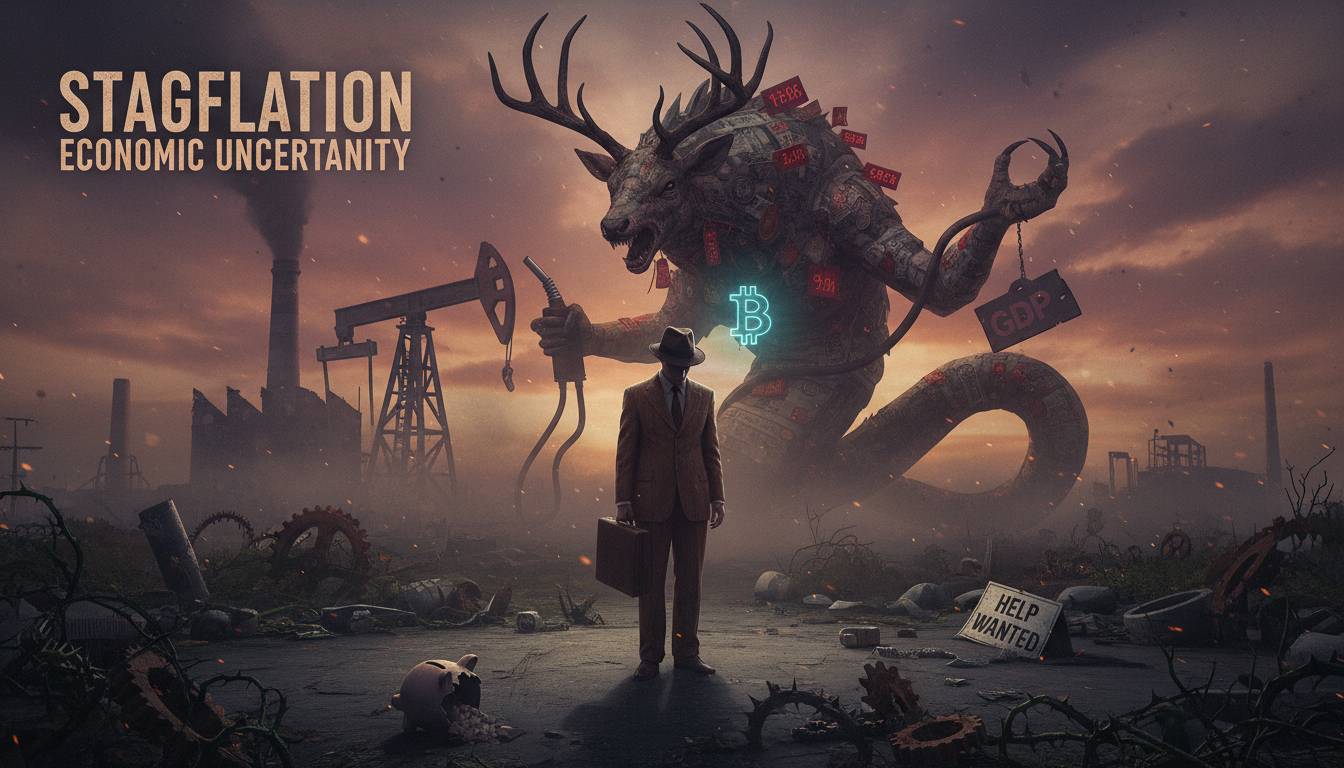
Stagflation is back in the market vocabulary because the mix investors fear most—slower growth, softer hiring and still-elevated inflation—has started to reappear in U.S. data. As of March 18, 2026, the Federal Reserve kept rates unchanged while warning that inflation remains elevated and job gains have stayed low, even as February CPI still ran at 2.4% year over year. For Bitcoin holders, that matters because macro stress can shape liquidity, risk appetite and the case for scarce assets.
For crypto investors, stagflation is not just an economics term from the 1970s. It describes a market environment in which inflation does not cool fast enough, growth loses momentum and central banks have less room to cut rates aggressively. That combination can pressure equities, bonds and consumer confidence at the same time. Bitcoiners need to understand it because Bitcoin now trades in a market that is more connected to macro data, Federal Reserve policy and cross-asset positioning than it was in earlier cycles. Research published in December 2025 found Bitcoin’s correlation with the S&P 500 increased after U.S. spot ETF approval, while its relationship with gold stayed near zero.
⚠️
Stagflation risk is a policy trap.
When inflation stays above target but growth and hiring weaken, the Federal Reserve has less flexibility to ease. The Fed held the federal funds target range unchanged in January 2026, and its next scheduled meeting after that was March 17–18, 2026, according to official minutes.
U.S. Macro Signals Bitcoiners Are Watching
| Metric | Latest reading | Why it matters for BTC |
|---|---|---|
| U.S. CPI | 2.4% y/y in February 2026 | Inflation above the Fed’s 2% target can delay rate cuts |
| Monthly CPI | 0.3% seasonally adjusted in February 2026 | Sticky monthly inflation can keep real yields firm |
| Unemployment rate | 4.4% in February 2026 | Rising slack points to slower growth |
| Bitcoin price | $69,964.94 | Shows BTC remains a large macro-sensitive asset |
| Bitcoin market cap | $1.399 trillion | Institutional scale increases macro linkage |
Source: BLS CPI release, March 11, 2026; BLS-linked employment coverage for February 2026, March 6, 2026; CoinGecko snapshot crawled March 2026.
2.4% CPI and 4.4% unemployment fit the stagflation debate
Stagflation means stagnant or weak economic growth paired with persistent inflation. In plain English, prices keep rising while the economy loses momentum. The February 2026 CPI report showed headline inflation at 2.4% year over year, with the all-items index up 0.3% on a seasonally adjusted monthly basis. Food prices were up 3.1% from a year earlier. Those figures are lower than the 2022 inflation peak, but they still sit above the Federal Reserve’s long-run 2% inflation goal.
At the same time, labor data point to a softer economy. Coverage of the March 6, 2026 employment release, citing Bureau of Labor Statistics data, reported that U.S. unemployment rose to 4.4% in February 2026 and nonfarm payrolls fell by 92,000. That is the kind of combination that revives stagflation talk: inflation not fully beaten, but growth and hiring no longer strong.
How the 2026 stagflation narrative built
January 19, 2026: The IMF said global growth for 2026 is projected at 3.3%, but warned that U.S. inflation would return to target more gradually.
March 6, 2026: February U.S. labor data showed unemployment at 4.4% and payroll contraction, according to reports citing BLS data.
March 11, 2026: BLS reported February CPI at 2.4% year over year and 0.3% month over month on a seasonally adjusted basis.
March 18, 2026: The Fed kept rates unchanged and flagged an uncertain outlook with inflation still elevated and job gains low.
Why March 18, 2026 Fed language matters for Bitcoin liquidity
Bitcoin often benefits when markets expect easier monetary policy, falling real yields or expanding liquidity. Stagflation complicates that setup. If inflation stays sticky, the Fed may hesitate to cut rates even when growth slows. That is exactly why the March 18, 2026 policy message mattered: the central bank held rates steady and Chair Jerome Powell pointed to an uncertain outlook, with inflation still somewhat elevated and job gains low.
The January 28, 2026 FOMC minutes already showed tension inside the committee. Two officials preferred a quarter-point cut, but the committee left the target range unchanged, and the interest rate paid on reserve balances stayed at 3.65%. That split matters because it shows the Fed is balancing weaker activity against unfinished inflation work. In a stagflationary setting, that balancing act can keep financial conditions tighter than risk assets want.
For Bitcoin, tighter-for-longer policy can cut both ways. It can weigh on speculative demand in the short run, especially because BTC now trades more like a large institutional asset than a niche retail instrument. But it can also strengthen the long-run narrative around monetary debasement, fiscal stress and the appeal of a fixed-supply asset if investors lose confidence in traditional policy tools. That is an inference from the macro setup and Bitcoin’s market structure, not a guaranteed outcome.
Bitcoin vs Gold in a Stagflation Conversation
| Asset | Typical stagflation narrative | What current evidence shows |
|---|---|---|
| Bitcoin | Scarce digital asset, possible hedge against fiat risk | Correlation with U.S. equities increased after ETF approval |
| Gold | Traditional inflation and crisis hedge | Bitcoin’s relationship with gold stayed near zero in one 2025 study |
| U.S. equities | Can struggle if margins and growth weaken | Bitcoin has shown stronger alignment with equities post-ETF approval |
Source: arXiv paper posted December 14, 2025.
How post-ETF Bitcoin became more exposed to macro shocks
Bitcoin’s market capitalization stands at about $1.399 trillion, with 24-hour trading volume around $46.2 billion on CoinGecko’s March 2026 snapshot. That scale matters. A market this large is increasingly owned, traded and hedged by institutions that also react to CPI, payrolls, Treasury yields and Fed signals.
That is one reason stagflation matters more to Bitcoiners in 2026 than it did in earlier cycles. If the economy weakens and inflation stays sticky, portfolio managers may reduce risk broadly, pulling money from crypto along with equities. By comparison, if inflation cools faster and growth stabilizes, Bitcoin could benefit from renewed easing expectations. The key point is that macro now reaches Bitcoin faster through ETFs, futures and cross-asset allocation models.
💡
Bitcoin is not trading in a macro vacuum anymore.
Academic research posted in December 2025 found Bitcoin’s correlation with the S&P 500 increased after ETF approval, suggesting BTC may react more like a risk asset during growth scares than many holders assume.
3 paths Bitcoiners should track if stagflation fears deepen
First, watch inflation persistence. The next CPI release is scheduled for April 10, 2026, covering March data. If monthly inflation stays firm, markets may push rate-cut expectations further out.
Second, watch labor deterioration. If unemployment keeps rising from February’s 4.4% level and payroll growth remains weak, recession fears could intensify even without a formal downturn.
Third, watch whether Bitcoin decouples. So far, evidence for a clean stagflation hedge is mixed. Bitcoin’s fixed supply supports the hedge argument in theory, but available research shows stronger equity linkage after ETF approval. That means Bitcoiners should separate the long-term monetary thesis from short-term market behavior.
Frequently Asked Questions
What is stagflation in simple terms?
Stagflation is a mix of weak growth and persistent inflation. In March 2026, that debate resurfaced because February CPI was 2.4% year over year while reported February unemployment reached 4.4%, according to BLS-based releases and coverage.
Why should Bitcoin investors care about stagflation?
Because stagflation can keep the Fed from cutting rates quickly, which affects liquidity and risk appetite. The Fed held rates steady in March 2026 and said inflation remained elevated while job gains were low, a combination that matters for BTC pricing.
Is Bitcoin a proven hedge against stagflation?
No public evidence proves that cleanly. A December 2025 research paper found Bitcoin’s correlation with the S&P 500 increased after ETF approval, while its relationship with gold stayed near zero. That suggests Bitcoin may still trade like a risk asset during macro stress.
What U.S. data should Bitcoiners watch next?
Watch CPI, PCE inflation, payrolls, unemployment and Fed decisions. The BLS said the March 2026 CPI release is scheduled for April 10, 2026, and those data can quickly shift rate expectations and crypto sentiment.
What is Bitcoin’s latest market size in this context?
CoinGecko’s March 2026 snapshot lists Bitcoin at $69,964.94 with a market capitalization of about $1.399 trillion and 24-hour trading volume near $46.2 billion. That scale helps explain why macro conditions now matter more for BTC than in earlier cycles.
Disclaimer: This article is for informational purposes only. Information may have changed since publication. Always verify information independently and consult qualified professionals for specific advice.


















Leave a comment