


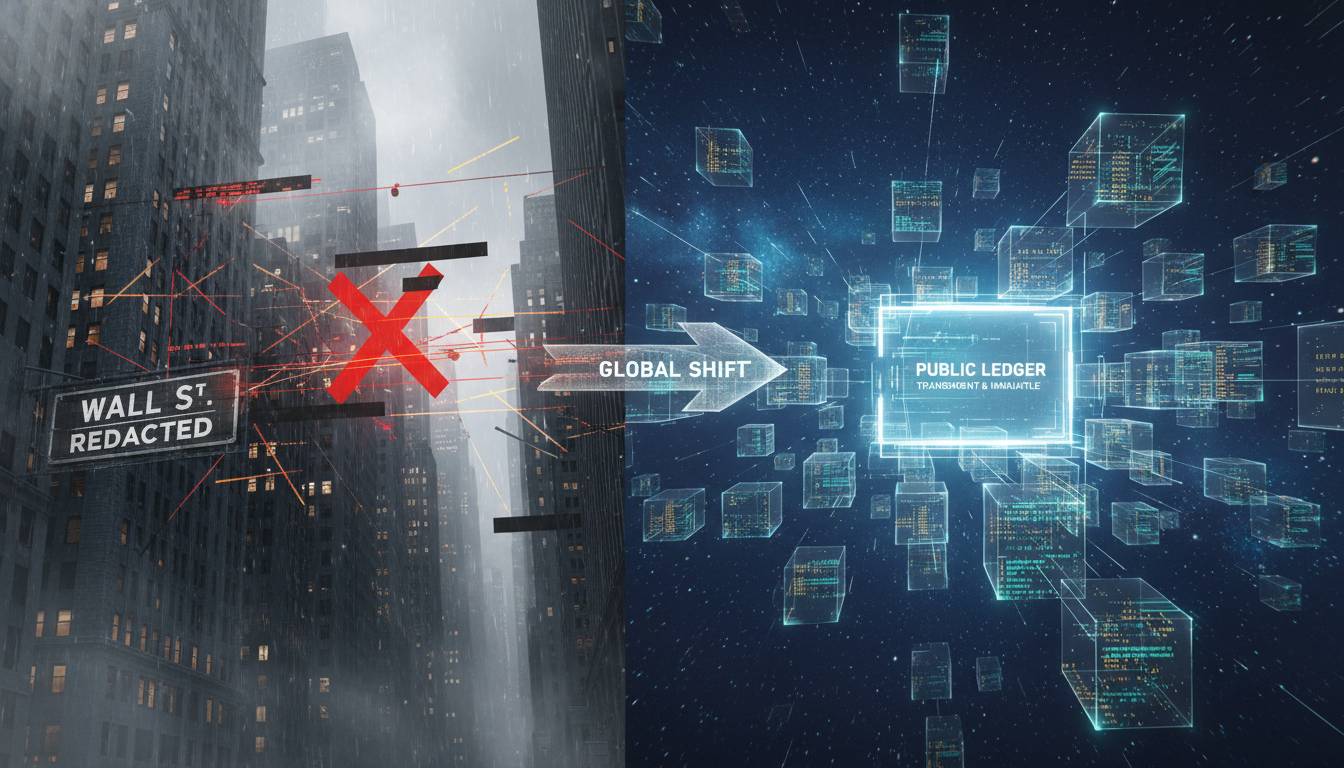
The U.S. Securities and Exchange Commission is weighing a change that could make quarterly reporting optional for public companies, according to reports published in mid-March 2026, a shift that would reduce the frequency of mandatory disclosure in U.S. equity markets just as tokenized Treasury funds and blockchain-based market infrastructure continue to expand. The contrast matters because public blockchains publish transaction records continuously, while traditional markets still rely heavily on periodic filings and delayed reporting.
That tension is becoming harder to ignore. U.S. public companies today file Form 10-Q reports every quarter under the existing SEC framework, with annual reporting through Form 10-K still serving as the core audited disclosure document. Reports in March 2026 said the SEC is preparing a proposal that would make quarterly reporting optional rather than fully abolish it, though the agency had not published a final rule text on SEC.gov at the time of writing. Reuters-linked and Wall Street Journal-linked summaries surfaced on March 16-18, 2026, while earlier reporting in September 2025 showed the SEC was already prioritizing a review of the quarterly cadence.
⚠️
The policy debate is shifting toward less frequent corporate disclosure at the same time tokenized assets are moving more financial activity onto auditable ledgers.
RWA.xyz data page for tokenized U.S. Treasuries showed the sector as of March 12, 2026, while DTCC says its tokenization service is targeted to be production-ready in the second half of 2026.
Disclosure vs. Blockchain Transparency
| System | Primary disclosure method | Update cadence | Visibility |
|---|---|---|---|
| Public companies under current SEC regime | 10-Q and 10-K filings | Quarterly and annual | Periodic, issuer-prepared |
| Tokenized Treasury products on public chains | On-chain transfers plus fund disclosures | Near real time on-chain | Ledger-visible, product-dependent |
| DTCC tokenization roadmap | Traditional controls plus blockchain records | Operational, not yet full production | Institutional infrastructure model |
Source: SEC reporting framework references in market coverage; RWA.xyz as of 03/12/2026; DTCC tokenization page accessed March 2026.
March 2026 reports put the 10-Q cycle in question
The immediate story is regulatory. Multiple March 2026 reports said the SEC is preparing a proposal that would let listed companies report less often, with quarterly filings becoming optional rather than mandatory. Because no final SEC release was available in the search results, the most defensible reading is that this remains a proposal-stage development, not an adopted rule.
If advanced, the change would affect one of the most established transparency mechanisms in U.S. capital markets. Quarterly reports do more than publish earnings. They update investors on liquidity, debt, legal risks, segment performance, and management discussion every roughly 90 days. A move to semiannual reporting would lengthen the period during which investors rely on older issuer data, especially outside earnings calls and current reports on Form 8-K. The SEC has not yet published a formal cost-benefit analysis for such a shift in the material reviewed here.
Timeline of the transparency debate
September 15, 2025: Axios reports the SEC is prioritizing a review of public company reporting rules after political pressure to move away from quarterly earnings reporting.
March 16, 2026: Market summaries on Reddit citing major media reports say the SEC is preparing a proposal to make quarterly reporting optional.
March 18, 2026: Additional summaries repeat that the proposal would make quarterly reporting optional, not fully eliminate it.
$9B tokenized Treasuries sharpen the contrast
The counterpoint comes from public blockchains, where institutional products are gaining measurable scale. RWA.xyz’s tokenized U.S. Treasuries page showed the category live as of March 12, 2026, and secondary reporting based on that dataset placed the market near $9 billion at the start of 2026 and above that level by February. Fensory, citing RWA.xyz, reported $9.2 billion in tokenized U.S. Treasuries on February 15, 2026, while another February report put the broader tokenized real-world asset market near $25 billion.
That does not mean blockchains disclose everything. Public ledgers show transfers, wallet activity, issuance patterns, and settlement timing, but they do not automatically reveal full beneficial ownership, off-chain legal agreements, or portfolio risk. Even so, they create a machine-readable audit trail that updates continuously rather than every quarter. For institutional Treasury products, that can mean visible minting, redemption, and transfer activity alongside traditional fund documents.
Institutional blockchain foothold by the numbers
| Metric | Value | Date | Source |
|---|---|---|---|
| Tokenized U.S. Treasuries market | $9.2 billion | February 15, 2026 | Fensory citing RWA.xyz |
| Total tokenized RWA market | $24.96 billion | February 18, 2026 | Fensory citing RWA.xyz |
| RWA treasury dataset timestamp | As of March 12, 2026 | March 2026 access | RWA.xyz |
| DTCC tokenization service target | Production-ready in H2 2026 | Accessed March 2026 | DTCC |
Source: RWA.xyz, Fensory, DTCC.
Why H2 2026 infrastructure plans matter more than the headline
The deeper issue is not whether blockchains replace SEC filings. It is whether market structure is moving toward systems that generate more native transparency than legacy reporting rules require. DTCC said in April 2025 that it launched a digital collateral management platform built on AppChain technology, and its tokenization page says a broader tokenization service is expected to be production-ready in the second half of 2026. That is a notable signal because DTCC sits at the center of U.S. post-trade infrastructure.
Franklin Templeton’s Franklin OnChain U.S. Government Money Fund, ticker FOBXX, remains another concrete example. Its official product page, updated daily and accessed in March 2026, states that share ownership is maintained and recorded primarily on a blockchain. BlackRock’s BUIDL fund has also become one of the largest tokenized Treasury products, with third-party market trackers placing it among the dominant vehicles in the segment.
In other words, institutional adoption is no longer limited to pilot rhetoric. It now includes live Treasury products, on-chain fund records, collateral experiments, and planned tokenization rails from core market utilities. Against that backdrop, any SEC move that reduces the frequency of mandatory issuer disclosure would stand out more sharply than it would have five years ago.
💡
Public blockchains are not automatically more complete than SEC filings, but they are often more continuous.
That distinction matters for Treasuries, collateral, and tokenized fund shares, where on-chain records can update throughout the day instead of every quarter.
What is driving the SEC’s push for less frequent reporting?
The case for reducing quarterly reporting has usually centered on compliance cost and short-termism. Supporters argue that the 10-Q cycle pushes executives to optimize for near-term earnings and consumes resources that could be directed toward operations and long-term planning. That rationale appeared in September 2025 reporting when the idea of moving to semiannual disclosure gained political backing.
The case against it is straightforward: less frequent mandatory reporting means longer gaps between standardized updates. In a market where private capital is already less transparent than public markets, weakening the cadence of public-company disclosure could make listed equities look less information-rich at the same moment tokenized assets are advertising auditability, programmability, and 24/7 visibility. That does not guarantee capital migrates on-chain, but it strengthens the narrative that blockchain rails can offer operational transparency advantages.
Frequently Asked Questions
Is the SEC eliminating quarterly reporting right now?
No final SEC rule was identified in the reviewed material. Reports published on March 16-18, 2026, said the agency is preparing a proposal that would make quarterly reporting optional, which means the change appears to be under consideration rather than adopted.
Why does this matter for Wall Street transparency?
Quarterly 10-Q filings provide standardized updates roughly every 90 days. If that cadence is reduced, investors would receive fewer mandatory issuer updates, increasing reliance on annual reports, earnings calls, and event-driven disclosures such as 8-K filings.
Are public blockchains actually more transparent than traditional markets?
They are often more continuous, not always more complete. Public chains can expose transaction flows and settlement activity in near real time, but they may not reveal full legal ownership, off-chain agreements, or all risk exposures without added compliance layers and disclosures.
How large is the tokenized Treasury market in 2026?
Fensory, citing RWA.xyz, reported tokenized U.S. Treasuries at $9.2 billion on February 15, 2026. RWA.xyz’s Treasuries page was live with data timestamped as of March 12, 2026, confirming the sector remains one of the largest institutional blockchain use cases.
Which institutions show blockchain adoption is moving beyond pilots?
DTCC says its tokenization service is expected to be production-ready in the second half of 2026, and Franklin Templeton’s FOBXX fund states that share ownership is recorded primarily on a blockchain. Those are concrete examples of regulated institutions using blockchain-based records in live or near-live settings.
Disclaimer: This article is for informational purposes only. Information may have changed since publication. Always verify information independently and consult qualified professionals for specific advice.
















Leave a comment