


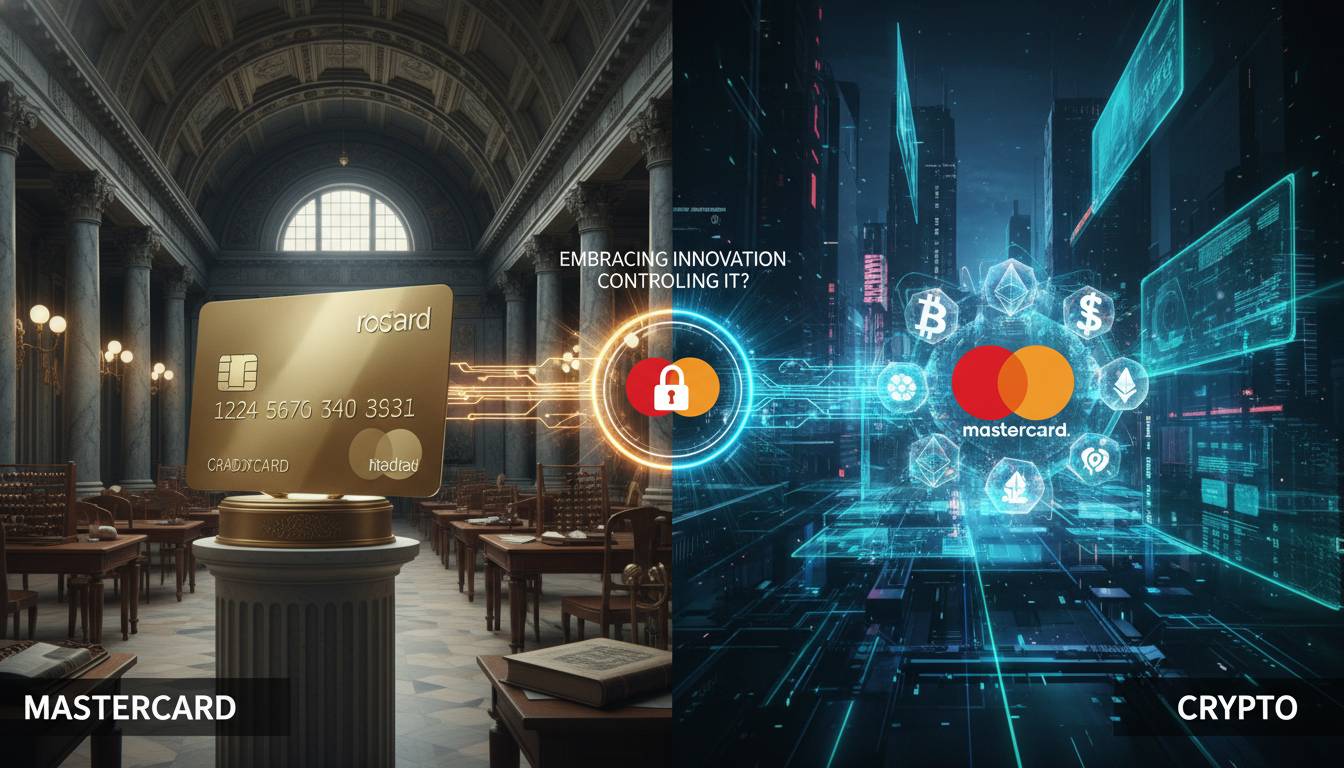
Mastercard is moving deeper into digital assets, but not in the way early crypto advocates once imagined. Rather than championing a fully open, bank-free financial system, the payments giant is building a model in which crypto, stablecoins and tokenized assets can operate inside familiar compliance, fraud-control and card-network frameworks. That raises a central question for investors, fintech firms and regulators alike: Is Mastercard embracing crypto or trying to contain it? The answer, based on the company’s latest launches and partnerships, appears to be both.
Mastercard’s crypto strategy is expanding fast
Over the past two years, Mastercard has accelerated its digital-asset push through a series of product launches, pilot programs and partnerships. In May 2024, the company said its Crypto Credential product went live for peer-to-peer pilot transactions, allowing users on participating exchanges to send crypto using aliases instead of long wallet addresses. The pilot initially connected users across Latin America and Europe, including markets such as Argentina, Brazil, France, Mexico, Portugal and Spain.
In 2025, the strategy broadened from wallet usability into payments infrastructure. Mastercard announced end-to-end stablecoin capabilities in April 2025, saying consumers could spend stablecoins through cards linked to wallets from partners including MetaMask, Kraken, Gemini, Bybit, Crypto.com and Binance at more than 150 million merchant locations that accept Mastercard. The company also said Mastercard Move could support withdrawals from stablecoin balances into bank accounts.
That expansion continued in June 2025, when Mastercard and Chainlink unveiled a system for buying crypto directly on decentralized exchanges using Mastercard cards. Mastercard described the initiative as a way for holders of its 3.5 billion cards to purchase on-chain assets, including bitcoin and stablecoins, through Swapper Finance. Around the same time, the company announced additional stablecoin initiatives with Fiserv and highlighted support for stablecoins including PYUSD, USDC, USDG and FIUSD on its network.
Taken together, those moves show a company that is no longer treating crypto as a niche experiment. Mastercard is building rails that connect cards, wallets, exchanges, merchants and tokenized settlement systems.
Is Mastercard embracing crypto or trying to contain it?
The strongest case that Mastercard is embracing crypto is the breadth of its recent activity. The company is not limiting itself to one narrow use case. It is working on consumer spending, peer-to-peer transfers, stablecoin settlement, on-chain purchases and tokenized financial infrastructure through its Multi-Token Network. Mastercard has also framed stablecoins as a practical payments technology rather than a speculative asset class.
Yet the strongest case that Mastercard is trying to contain crypto lies in how it is doing all of this. Nearly every initiative is built around permissioned access, identity checks, fraud screening, network rules and regulated intermediaries. Crypto Credential, for example, verifies whether a recipient alias is valid and whether the wallet supports the relevant asset and blockchain before a transfer proceeds. That is a usability feature, but it is also a control layer.
The same pattern appears in Mastercard’s stablecoin strategy. The company is not promoting anonymous, censorship-resistant payments outside the traditional system. Instead, it is integrating stablecoins into card issuance, merchant acceptance and settlement processes that resemble conventional payments infrastructure. In an August 2025 statement about its Circle partnership in EEMEA, Mastercard said its goal is to integrate stablecoins into the financial mainstream through infrastructure, governance and partnerships, while relying on tools such as Crypto Credential and Crypto Secure to meet security and compliance standards. That language suggests institutionalization, not decentralization for its own sake.
In practical terms, Mastercard appears to be embracing crypto’s utility while containing its disorder. It wants the speed, programmability and global reach of digital assets, but inside a system where major intermediaries still manage trust, compliance and dispute risk. That is not a contradiction. It is the business model.
Why stablecoins are at the center of the plan
If there is one segment where Mastercard’s intentions are clearest, it is stablecoins. The company’s 2025 announcements repeatedly focus on stablecoin spending, settlement and payouts rather than volatile cryptocurrencies. That reflects a broader industry shift: stablecoins are increasingly viewed as a bridge between blockchain networks and everyday payments.
Mastercard’s April 2025 announcement laid out a full stack:
- wallet enablement and card issuing,
- merchant acceptance,
- on- and off-ramping between fiat and digital assets,
- and cross-border movement through Mastercard Move.
Its May 2025 partnership with MoonPay pushed that strategy further by aiming to turn crypto wallets into functional payment accounts for global transactions. According to Scott Abrahams, executive vice president of Global Partnerships at Mastercard, the company is seeking to “unlock stablecoin utility and ubiquity” and reshape how money moves globally. MoonPay CEO Ivan Soto-Wright said the partnership is designed to bring stablecoin-enabled cards to crypto users worldwide.
Mastercard’s later announcements reinforce the same direction. In June 2025, it said millions of people could already spend stablecoin balances at more than 150 million Mastercard merchant locations through partnerships with firms such as MetaMask, Crypto.com, OKX and Kraken. In March 2026, Mastercard and SoFi said they would enable settlement tied to SoFiUSD, with Mastercard noting that roughly $30 billion is transacted per day in stablecoins and that issuance doubled in 2025 from the prior year.
For Mastercard, stablecoins solve a business problem. They offer blockchain-based transfer and settlement benefits without requiring merchants or consumers to accept the volatility of assets like bitcoin or ether. That makes them easier to fit into existing payment habits and regulatory expectations.
What this means for crypto firms, banks and merchants
For crypto companies, Mastercard’s approach offers scale and legitimacy. Access to a network with billions of cards and more than 150 million acceptance locations can help digital-asset firms reach mainstream users faster than building closed crypto-native ecosystems alone. Partnerships with Mastercard can also help exchanges and wallet providers reassure regulators and consumers that their products include familiar safeguards.
For banks and fintechs, Mastercard’s strategy creates a template for entering digital assets without fully abandoning traditional controls. Its Multi-Token Network and stablecoin settlement initiatives suggest a future in which banks can interact with tokenized deposits, real-world assets and regulated stablecoins through interoperable but managed infrastructure. Mastercard’s materials on MTN describe it as a blockchain linking commercial banks with digital assets that can move securely around the clock.
Merchants may benefit from broader payment choice and potentially faster settlement, especially in cross-border commerce. But they are unlikely to see a radical break from the current card-based model. Mastercard’s crypto products still keep the network in the middle of the transaction flow, preserving its role in authorization, acceptance and risk management.
That is where critics of the strategy may push back. Some crypto advocates argue that when digital assets are routed through card issuers, custodians, compliance screens and branded payment rails, much of the original promise of decentralization is diluted. Supporters counter that mass adoption was never going to happen without consumer protections, identity standards and legal clarity. Mastercard’s recent moves suggest it is betting the second view will win.
The business logic behind Mastercard’s balancing act
Mastercard’s public filings show why the company is careful. Its 2024 Form 10-K lists digital currencies among the evolving areas that could affect its business, alongside broader regulatory and payments-industry changes. For a global payments network, the risk is not only missing a new technology wave. It is also allowing new forms of value transfer to grow outside the systems that support fraud controls, sanctions screening, consumer protections and fee-generating network activity.
That helps explain why Mastercard’s crypto strategy is neither anti-crypto nor fully crypto-native. It is trying to ensure that if digital assets become a major part of commerce, they do so on rails where Mastercard still provides infrastructure and governance. In that sense, “containment” may be less about suppressing crypto than about standardizing it.
There is also a competitive angle. Visa, banks, fintechs and crypto-native firms are all pursuing pieces of the same market: stablecoin payments, tokenized settlement and digital-wallet commerce. Mastercard’s rapid sequence of announcements in 2024, 2025 and early 2026 suggests it does not want to be disintermediated if blockchain-based payments become more common. That is an inference based on the company’s product cadence and positioning, rather than an explicit statement from Mastercard.
Conclusion
So, is Mastercard embracing crypto or trying to contain it? The evidence points to a hybrid strategy. Mastercard is clearly embracing crypto’s most commercially useful features, especially stablecoins, tokenized settlement and easier wallet-based payments. At the same time, it is containing crypto within a framework of identity, compliance, merchant acceptance rules and network oversight.
That approach may frustrate purists who see decentralization as the point of crypto. But it may also be the model most likely to bring digital assets into everyday finance in the United States and beyond. If Mastercard’s recent partnerships are any guide, the company is not trying to stop crypto. It is trying to decide the terms under which crypto becomes mainstream.
Frequently Asked Questions
Is Mastercard embracing crypto or trying to contain it?
Based on its recent launches, Mastercard is doing both: expanding crypto and stablecoin use cases while keeping them inside regulated, compliance-heavy payment frameworks.
What part of crypto is Mastercard focusing on most?
Stablecoins appear to be the main focus, especially for spending, settlement, payouts and cross-border transfers.
Can Mastercard users buy or spend crypto directly?
Yes, through certain partnerships. Mastercard has announced card-linked crypto purchasing on decentralized exchanges and stablecoin spending through partner wallets and exchanges.
Why does Mastercard use tools like Crypto Credential?
The company says these tools help verify recipients, supported assets and blockchains, reducing errors and improving security and compliance.
Does Mastercard support decentralized finance?
It supports access points into DeFi, but generally through intermediated, compliant structures rather than fully open, anonymous systems.
What is the likely next step in Mastercard’s crypto strategy?
If current announcements continue, Mastercard is likely to deepen stablecoin settlement, wallet-linked card programs and tokenized financial infrastructure for banks and fintechs. This is an inference from its recent partnerships and product launches.



















Leave a comment