


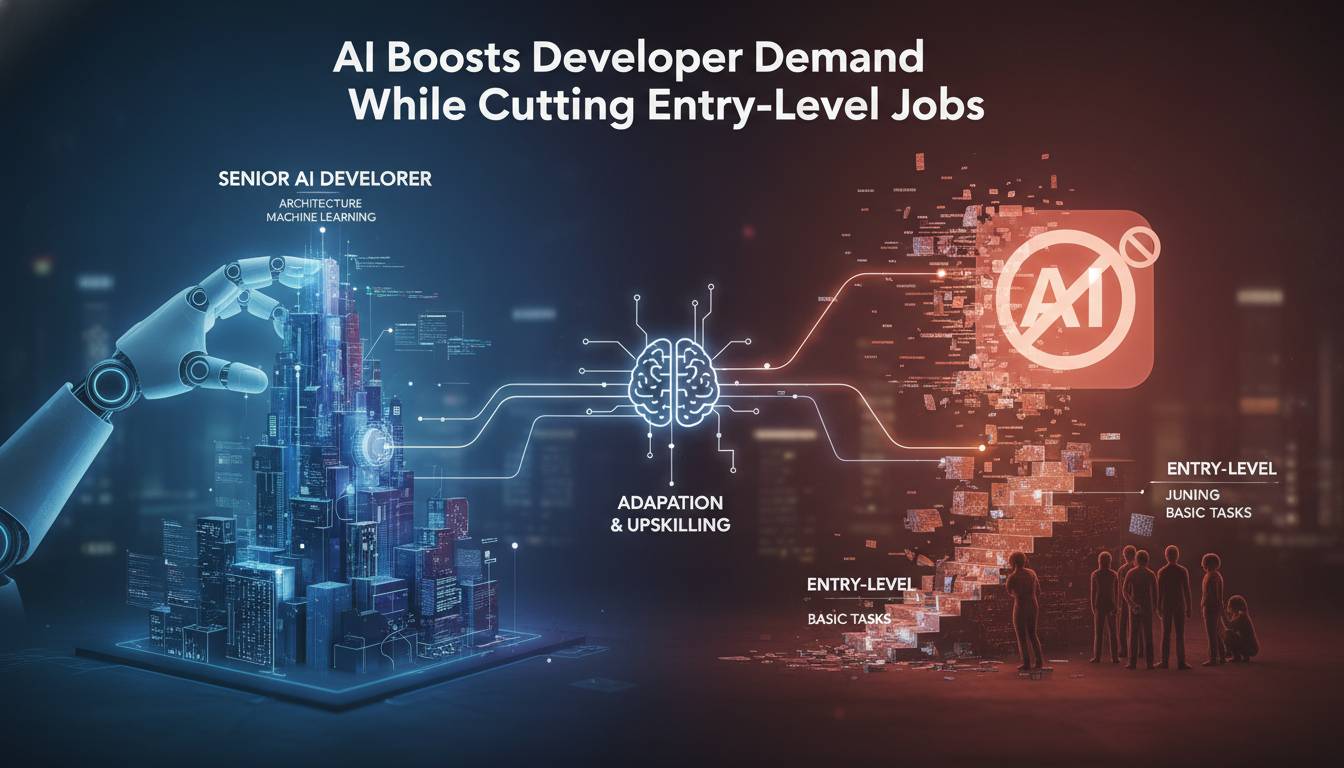
Artificial intelligence is reshaping the software labor market in two directions at once. Employers across the United States are hiring aggressively for developers, engineers, and technical workers who can build, deploy, and manage AI systems. At the same time, many of the routine tasks that once helped junior coders get their first break are being automated or absorbed by AI-assisted workflows. The result is a growing divide: demand for experienced developers is rising, while the path into the profession is becoming less visible and, for many new graduates, harder to access.
A Two-Speed Market for Software Talent
The clearest signal in 2025 is that demand for technical talent has not disappeared. It has shifted. CompTIA reported in July 2025 that demand was strongest for software developers and engineers, systems engineers and architects, tech support specialists, and cybersecurity engineers. Its AI Hiring Intent Index also showed AI-related hiring up 153% from the same period in 2024, underscoring how quickly employers are adding AI fluency to job requirements.
LinkedIn’s Economic Graph has shown a similar pattern. In a 2025 labor market update, LinkedIn said AI hiring remained resilient even as the broader labor market softened, and noted that AI engineers accounted for nearly 2% of all U.S. job postings despite representing less than 1% of U.S. LinkedIn members. Among technical roles, AI engineering jobs represented almost 7% of postings.
That demand is being reinforced by the rapid improvement of coding tools themselves. OpenAI said in April 2025 that GPT‑4.1 delivered major gains in coding and instruction following, while GitHub has continued to publish research showing that Copilot users report higher satisfaction, stronger flow states, and measurable productivity gains. In one GitHub-Accenture study published in May 2024, 90% of developers said they felt more fulfilled using Copilot, and 95% said they enjoyed coding more with its help.
For employers, the message is straightforward: software development remains essential, but the most valuable developers are increasingly those who can work with AI rather than without it.
Why AI Is Boosting Demand for Developers — but Quietly Wiping Out Entry-Level Jobs
The tension in the market comes from how AI changes the economics of software teams. Generative AI tools are especially effective at drafting boilerplate code, writing tests, summarizing documentation, debugging common issues, and accelerating repetitive tasks. Those are precisely the kinds of assignments that have traditionally been handed to junior developers, interns, and recent graduates.
According to the OECD, firms more exposed to AI tend to hire less in jobs that do not require AI skills, even if overall labor demand has not yet collapsed. The organization has also found that AI-related jobs require high-level cognitive, problem-solving, communication, and management skills, suggesting that AI complements more advanced roles even as it pressures lower-complexity work.
That dynamic helps explain why the labor market can look healthy at the top while weakening at the bottom. CompTIA’s June 2025 data still showed openings across experience levels, including 21% for workers with zero to three years of experience. But that does not mean entry-level hiring is keeping pace with demand from graduates.
The New York Fed’s latest data points to a tougher environment for new entrants. In the fourth quarter of 2025, the unemployment rate for recent college graduates rose to about 5.7%, while the underemployment rate climbed to 42.5%, the highest level since 2020. Those figures cover all majors, not just computer science, but they capture a broader truth: early-career workers are entering a labor market with fewer easy on-ramps.
In software, that missing rung matters. Entry-level jobs are not just labor; they are training systems. If AI reduces the need for junior staff to handle first-draft coding and maintenance work, companies may save money in the short term while weakening the pipeline of future senior engineers.
Productivity Gains Are Real, but So Is the Career Ladder Problem
There is little dispute that AI coding tools are improving developer productivity. GitHub has reported that users accept nearly 30% of Copilot suggestions on average, and its research has linked AI assistance to gains in speed, confidence, and code quality. OpenAI and other model providers are also marketing coding-focused systems as tools that can reason across large codebases and automate more of the development lifecycle.
According to GitHub’s research with Accenture, adoption was rapid: more than 80% of participants successfully adopted Copilot, and 67% used it at least five days per week. That kind of usage suggests AI coding assistants are no longer experimental in many enterprise settings.
Yet productivity gains do not automatically translate into more junior hiring. In many organizations, AI allows a smaller number of experienced developers to do more work. A senior engineer using AI can often complete tasks that once required a team structure with one lead and several junior contributors. That does not eliminate the need for developers, but it changes who gets hired and what skills are rewarded.
This is one reason the market increasingly favors developers who can do more than write code. Employers are looking for people who can define system architecture, evaluate model outputs, manage security and compliance risks, integrate APIs, and make judgment calls when AI-generated code is incomplete or wrong. Those are skills that usually come with experience.
What employers now value most
Several trends stand out in 2025:
- AI fluency is becoming a baseline skill for many software roles, not just dedicated AI jobs.
- Routine coding work is being compressed by copilots and coding agents, reducing the volume of beginner-friendly tasks.
- Higher-order skills are gaining value, including architecture, product judgment, communication, and domain expertise.
- The broader graduate market is weakening, making it harder for new entrants to absorb the shock.
What This Means for Companies, Workers, and Schools
For companies, the opportunity is obvious: AI can raise output, shorten development cycles, and help teams ship more with fewer bottlenecks. But there is also a strategic risk. If firms stop hiring and training junior developers, they may create a future shortage of experienced talent. Today’s senior engineers were once entry-level hires who learned through maintenance work, bug fixes, documentation, and supervised coding.
For workers, the message is more mixed. Mid-career and senior developers who adapt to AI tools may become more productive and more valuable. New graduates, however, face a market that increasingly expects experience, AI literacy, and business context from day one.
Educational institutions are also under pressure to respond. Traditional computer science training still matters, but employers are placing more weight on practical skills: using AI tools responsibly, reviewing generated code, understanding systems design, and collaborating across product, security, and data teams. The shift favors candidates who can show applied work, not just coursework.
According to the OECD, AI-related jobs tend to require a combination of specialized technical skills and broader transversal skills such as teamwork, communication, and leadership. That means the next generation of developers may need a wider skill set than the one that defined software hiring a decade ago.
The Outlook: More Developers, Fewer First Jobs
The phrase “AI is boosting demand for developers — but quietly wiping out entry-level jobs” captures a contradiction that is becoming central to the U.S. tech economy. Demand for developers is real, especially for those who can build with AI or work effectively alongside it. But the structure of that demand is changing fast.
There is no clear evidence that AI has broadly erased software jobs across the economy. In fact, many indicators still point to strong demand for technical workers and rising employer interest in AI skills. What is changing is the distribution of opportunity. The market is rewarding experienced developers, AI specialists, and workers with strong judgment, while making it harder for beginners to find the low-risk, lower-complexity roles that once served as the industry’s training ground.
If that pattern continues, the software industry may face a long-term pipeline problem. Companies could gain efficiency now but struggle later to replace senior talent. For policymakers, educators, and employers, the challenge is no longer just how to adopt AI. It is how to preserve a credible first step into the profession while the technology rewrites the job itself.
Conclusion
AI is not reducing the importance of software development. It is increasing it. But it is also changing the shape of software work in ways that favor experienced professionals and compress the entry-level tier. The U.S. labor market now shows both forces at once: stronger demand for developers with AI skills and a tougher launch point for new graduates.
The next phase of the debate will center on whether companies can maintain productivity gains without hollowing out the early-career pipeline. If they cannot, the industry may discover that the quiet disappearance of entry-level jobs is not a side effect of AI adoption, but one of its most consequential costs.
Frequently Asked Questions
Is AI reducing the total number of developer jobs?
Not necessarily. Current data shows strong demand for software developers and rising hiring for AI-related roles, especially in 2025. The bigger shift is in the mix of jobs, with more value placed on experienced and AI-skilled workers.
Why are entry-level software jobs under pressure?
AI tools can now handle many routine tasks that junior developers once performed, such as drafting boilerplate code, writing tests, and summarizing documentation. That reduces the number of beginner-friendly assignments inside software teams.
Are recent graduates facing a weaker job market overall?
Yes. The New York Fed reported that in 2025:Q4, recent college graduates had an unemployment rate of about 5.7% and an underemployment rate of 42.5%, the highest underemployment reading since 2020.
What skills matter most for developers in the AI era?
Employers increasingly value AI fluency, systems design, code review, security awareness, product judgment, and communication skills. Research from the OECD suggests AI-related roles also demand strong cognitive and collaborative abilities.
Will companies regret cutting junior hiring?
Possibly. Entry-level roles are a key part of how firms train future senior engineers. If companies rely too heavily on AI and reduce junior hiring too far, they may weaken their long-term talent pipeline. This is an inference based on current hiring and productivity trends.






















Leave a comment