


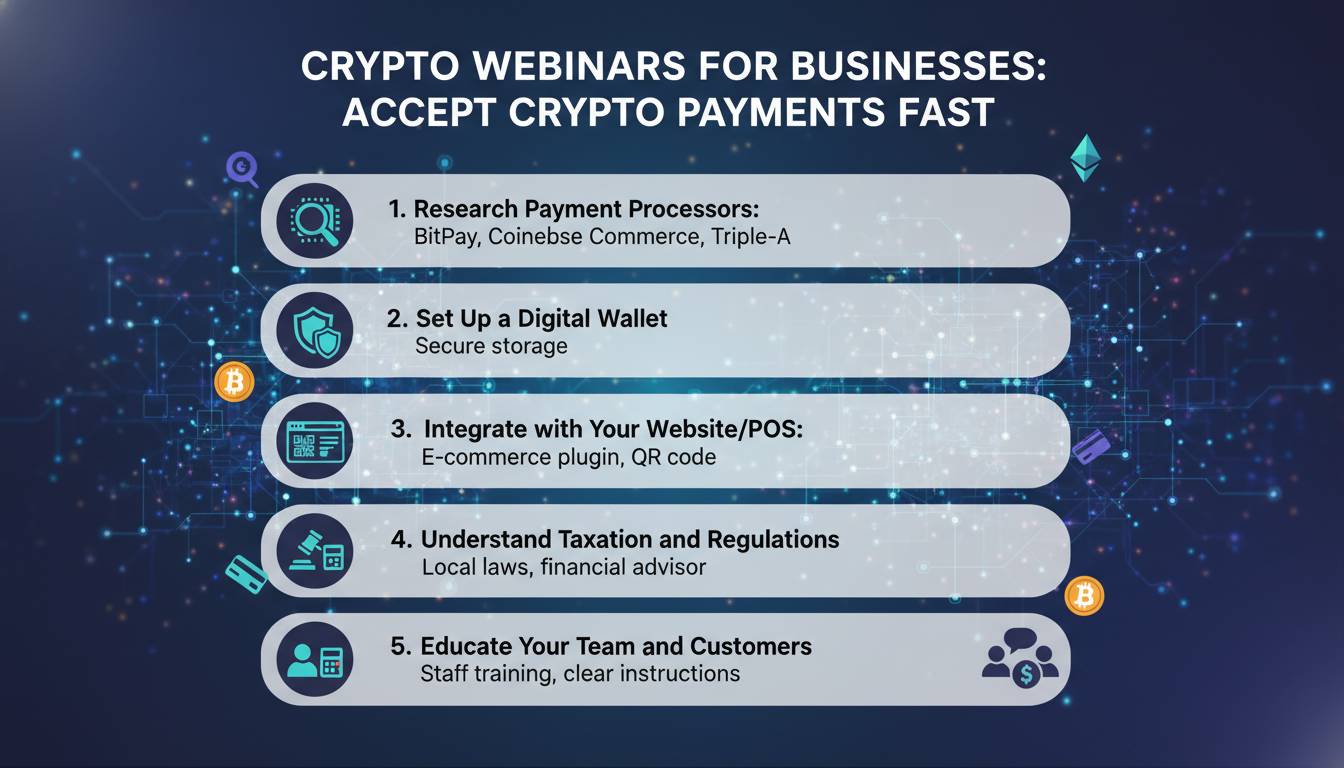
Businesses across the United States are turning to crypto webinars to understand a payment category that has moved from niche to mainstream experimentation. The shift is being driven by new merchant tools, rising interest in stablecoins, and a growing need for faster cross-border settlement. For finance teams, e-commerce operators, and small-business owners, the question is no longer only whether crypto payments matter, but how to adopt them safely, compliantly, and with minimal operational risk.
Why crypto payment education is accelerating
The recent wave of business-focused crypto webinars reflects a practical market need. Companies are not simply looking for a speculative exposure to digital assets. They are trying to understand checkout integration, settlement options, accounting treatment, fraud controls, and customer demand. That is especially true as payment providers increasingly frame crypto, and particularly stablecoins, as a tool for commerce rather than only trading.
Official product documentation shows how quickly the merchant stack is evolving. Coinbase Commerce says merchants can accept hundreds of currencies and settle automatically in USDC, with payments routed through its onchain payment protocol. Stripe documentation also shows that U.S.-based Stripe accounts can enable a crypto payment method that supports stablecoin payments settling as fiat in a Stripe balance. These developments help explain why webinars aimed at businesses now focus less on blockchain theory and more on implementation.
For many companies, webinars have become the preferred format because they compress technical, legal, and operational learning into a single session. A finance leader can hear about treasury controls, while an e-commerce manager learns about checkout design and a compliance officer reviews onboarding requirements. That cross-functional appeal is one reason crypto webinars for businesses are gaining traction in 2026. This is how companies are learning to accept crypto payments in a way that aligns with existing workflows.
Crypto Webinars for Businesses: How Companies Are Learning to Accept Crypto Payments
The most useful webinars tend to focus on four practical themes:
- Payment acceptance: how customers pay with wallets or exchange balances
- Settlement choices: whether merchants receive crypto, stablecoins, or fiat
- Compliance: onboarding, identity checks, and internal controls
- Accounting and tax: how to record receipts, conversions, and gains or losses
Those topics mirror the real decisions companies face when evaluating crypto payments. A merchant may like the marketing value of accepting digital assets, but the finance team often wants same-day conversion into dollars or dollar-backed stablecoins to reduce volatility. Providers have responded by emphasizing guaranteed or simplified settlement models. Coinbase Commerce, for example, highlights automatic settlement in USDC, while Stripe’s documentation emphasizes stablecoin payments that settle as fiat in the merchant’s Stripe balance.
This is where webinars play a strategic role. They help businesses compare models without committing engineering resources too early. A retailer can learn whether a hosted checkout is enough, while a larger enterprise can assess API-based integration. According to Coinbase’s merchant guidance, businesses may also need to prepare legal entity details and supporting documentation during onboarding, which makes education before deployment especially important.
The keyword phrase “Crypto Webinars for Businesses: How Companies Are Learning to Accept Crypto Payments” captures a broader trend: education is becoming part of the payments sales cycle. Providers are not only selling software. They are teaching merchants how to manage risk, communicate with customers, and fit crypto into existing payment operations. That educational layer is helping reduce one of the biggest barriers to adoption: uncertainty.
Stablecoins are at the center of the conversation
A major reason business interest has intensified is the rise of stablecoins in commercial payments. Chainalysis reports that stablecoins are increasingly used for real-world payments and settlement, drawing attention from corporates, financial institutions, and regulators. In North America, Chainalysis says the region accounted for 26% of all crypto transaction activity in the period studied in its 2025 adoption analysis, with notable stablecoin activity at the end of 2024.
Stripe’s public materials also point to the scale of the market. Its U.S. crypto use-case page cites stablecoin payment volume of $5.7 trillion, underscoring why payment companies are investing in merchant-facing crypto products. While that figure does not mean all of the volume is retail commerce, it does show why businesses are paying attention to stablecoin rails as a settlement mechanism.
For webinar audiences, stablecoins solve a communication problem as much as a technical one. It is easier for a CFO to evaluate a dollar-linked asset used for settlement than a volatile token held on the balance sheet. That is why many educational sessions now focus on questions such as:
- Can the business avoid holding volatile crypto?
- How quickly can funds be converted to dollars?
- What are the fees compared with cards or wires?
- How are refunds and disputes handled?
- What controls are needed for wallets and treasury access?
These are not abstract issues. They shape whether a business pilot moves forward. According to Chainalysis, stablecoins have evolved beyond trading instruments to address inefficiencies in payments and settlements. That framing has made them central to the business webinar market.
What businesses want from crypto payment training
The demand for crypto webinars is strongest among companies with one of three profiles: online merchants with international customers, B2B firms handling cross-border invoices, and brands seeking alternative checkout options for digitally native consumers. Each group has different priorities, but the training agenda is increasingly similar.
Operational questions
Businesses want to know how a crypto payment appears inside an existing commerce stack. They ask whether the provider offers plugins, APIs, hosted payment pages, or wallet-based checkout. Coinbase Commerce documentation positions its product as available through API or user interface, which is the kind of detail webinar attendees look for before a pilot launch.
Treasury and volatility questions
Many firms do not want crypto price exposure. Educational sessions therefore focus on instant conversion, stablecoin settlement, and reconciliation. Stripe’s documentation is notable here because it explicitly describes crypto payments that settle as fiat in the merchant’s Stripe balance for eligible U.S. accounts.
Compliance questions
Onboarding and internal governance remain major concerns. Coinbase’s merchant guidelines indicate that businesses may need to provide legal entity information and documentation tied to the purpose of accepting crypto payments for goods or services. That means webinars increasingly include compliance officers, controllers, and legal teams, not just product managers.
Tax and reporting questions
U.S. businesses also need clarity on reporting obligations and accounting treatment. IRS materials continue to update payment and reporting guidance in adjacent digital payment areas, reinforcing the need for businesses to involve tax professionals when designing a crypto acceptance program. Webinars often stop short of giving company-specific tax advice, but they help businesses identify the questions that must be answered before launch.
Risks, fraud, and the limits of adoption
The growth of crypto payment education does not remove the risks. It simply makes them easier to identify. Chainalysis’ 2026 Crypto Crime Report says scams received at least $14 billion on-chain in 2025, with the possibility that the figure could rise as more illicit addresses are identified. That backdrop matters because any business accepting crypto must think carefully about wallet security, customer communication, sanctions screening, and fraud prevention.
This is why many webinars now include a cautionary segment. Businesses are advised to distinguish between legitimate payment processors and unverified schemes promising instant growth through crypto. They are also encouraged to separate customer-facing payment acceptance from treasury speculation. In practice, the safest business use case is often narrow: accept payment through a reputable provider, settle quickly, and maintain clear internal controls. That is a more conservative model than the broader crypto narratives that dominated earlier market cycles.
There is also a demand-side reality. Not every customer wants to pay with crypto, and not every merchant category benefits equally. For many U.S. businesses, crypto payments remain a supplemental option rather than a core revenue channel. Still, for firms with international customers or high-friction settlement needs, the economics can be compelling enough to justify training and pilot programs. That is one reason the webinar format continues to expand.
What comes next for business adoption
The next phase of crypto payment adoption is likely to be shaped by infrastructure, not hype. Merchant tools are becoming more integrated, stablecoins are becoming more central to the value proposition, and educational content is becoming more specialized. Instead of generic “what is crypto” sessions, businesses increasingly want webinars on reconciliation, ERP integration, refund workflows, and U.S. compliance.
That shift suggests a maturing market. According to Chainalysis, stablecoins are attracting increased attention from traditional financial institutions, corporates, and regulators because they address real-world inefficiencies in payments and settlement. If that trend continues, crypto webinars for businesses will likely become less about experimentation and more about procurement, controls, and measurable return on investment.
For now, the strongest takeaway is simple: companies are learning to accept crypto payments through structured education that connects product features with operational reality. The businesses moving first are not necessarily the most speculative. They are often the most process-driven. They want faster settlement, broader customer reach, and lower friction, but they also want documentation, compliance, and predictable accounting. That is exactly why crypto webinars for businesses have become a growing part of the modern payments conversation.
Conclusion
Crypto payment adoption in business is becoming more practical and more selective. Webinars are helping companies evaluate providers, understand stablecoin settlement, and prepare for compliance and tax questions before they go live. The market is still developing, and risks remain significant, especially around fraud and operational controls. But as payment platforms expand merchant tools and stablecoins gain traction in settlement, business education is emerging as one of the clearest signals that crypto payments are moving closer to everyday commercial use.
Frequently Asked Questions
What are crypto webinars for businesses?
They are educational online sessions that help companies understand how to accept cryptocurrency or stablecoin payments, choose providers, manage settlement, and address compliance issues.
Why are stablecoins important for business payments?
Stablecoins are designed to maintain a stable value, usually against the U.S. dollar, which makes them easier for businesses to use for settlement than more volatile crypto assets. Providers and analysts increasingly position them as payment and settlement tools.
Can U.S. businesses accept crypto without holding crypto on the balance sheet?
In some cases, yes. Stripe documentation says eligible U.S. accounts can accept crypto payments that settle as fiat in the Stripe balance, and Coinbase Commerce highlights automatic settlement in USDC.
What do businesses usually learn in these webinars?
Common topics include checkout integration, wallet flows, settlement timing, onboarding requirements, tax considerations, fraud prevention, and internal controls.
Are crypto payments risky for merchants?
They can be. Risks include scams, operational mistakes, compliance failures, and customer confusion. Chainalysis reports large and growing scam activity on-chain, which is why businesses need reputable providers and strong controls.
Who is most likely to benefit from accepting crypto payments?
Businesses with international customers, cross-border payment needs, or digitally native audiences may see the strongest use case, especially when stablecoin settlement reduces friction in traditional payment flows.



















Leave a comment