


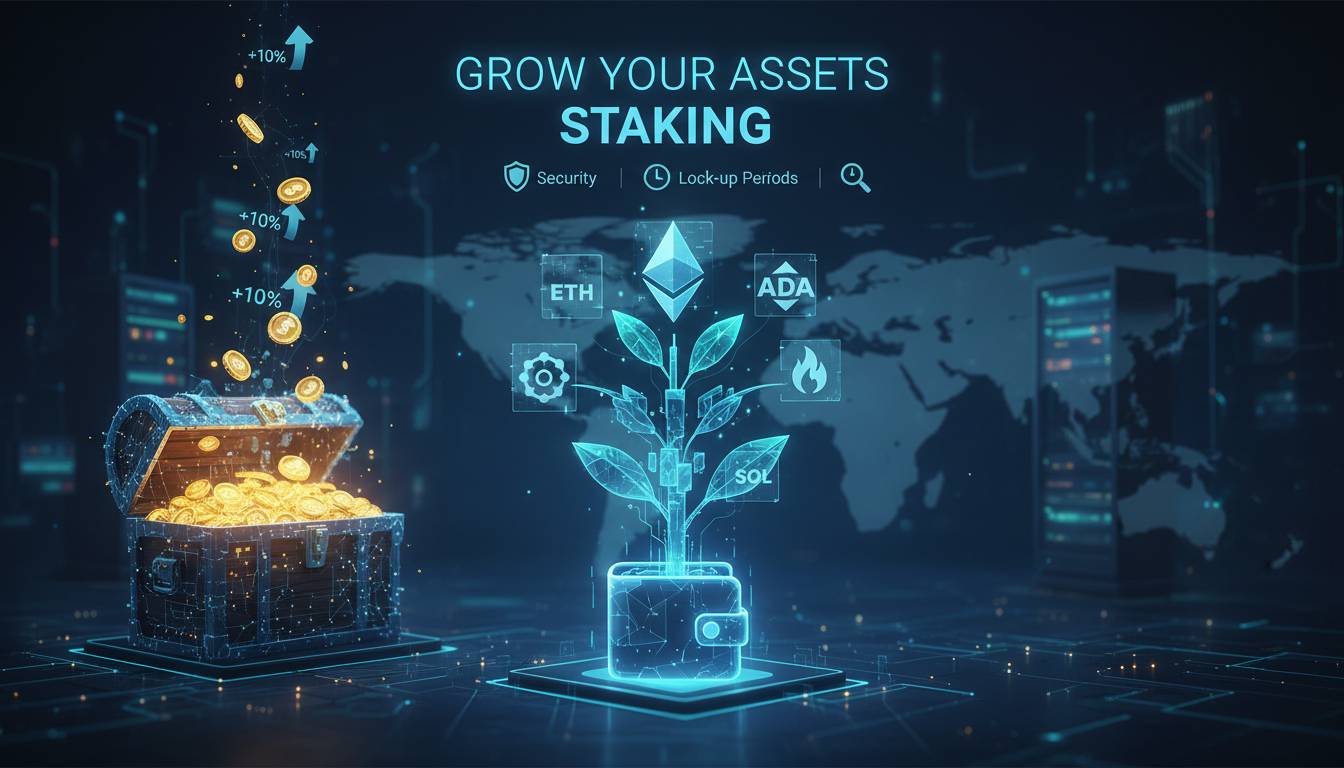
Crypto staking has moved from a niche strategy to a mainstream feature on major U.S. trading platforms. For investors who want to grow digital assets without active trading, the best crypto exchanges to grow your assets with staking now compete on supported coins, fees, reward transparency, lock-up terms, and regulatory posture. In 2026, that competition matters more than ever: staking yields remain variable, U.S. rules are still evolving, and platform differences can materially affect net returns and liquidity.
Why staking remains in focus in 2026
Staking allows holders of proof-of-stake assets to help secure blockchain networks and earn rewards in return. On retail exchanges, the process is usually simplified: the platform handles validator operations, reward distribution, and user interface, while customers accept platform fees and, in many cases, waiting periods for unstaking. Coinbase says reward payouts depend on the asset and that staked assets may be unavailable for trading or transfer until the unstaking process completes.
The U.S. regulatory backdrop has also shifted. In May 2025, the SEC’s Division of Corporation Finance issued a staff statement on certain protocol staking activities, while Commissioner Hester Peirce said the guidance offered added clarity for U.S. stakers and service providers. At the same time, Commissioner Caroline Crenshaw publicly criticized that approach, underscoring that staking policy remains contested rather than settled.
That split matters for investors choosing a platform. The best crypto exchanges to grow your assets with staking are no longer judged only by headline APRs. They are also judged by how clearly they explain fees, whether rewards are paid daily or monthly, how many assets are supported, and whether service availability differs by state or account eligibility.
Best Crypto Exchanges to Grow Your Assets With Staking
For U.S. users, four names stand out in current public disclosures: Coinbase, Kraken, Gemini, and Robinhood. Each offers a different balance of convenience, asset selection, and transparency. None is universally best for every investor.
Coinbase
Coinbase remains one of the most visible staking platforms in the U.S. Its official materials say users can earn staking rewards on supported assets, with displayed APY reflecting recent protocol payouts minus Coinbase’s commission. Coinbase also warns that unstaking can take from hours to weeks depending on the network and that protocol lockups may delay access to funds.
For mainstream investors, Coinbase’s strengths are ease of use, broad brand recognition, and integrated custody. Its trade-off is that net yield depends on platform commission and protocol conditions, so the advertised APY is not fixed. That makes Coinbase more suitable for users who prioritize simplicity and a large-cap asset menu over chasing the highest possible yield.
Kraken
Kraken re-entered the U.S. staking market in January 2025 with a new on-chain staking product for eligible clients in 39 states and two territories, according to the company’s announcement. Kraken’s support documentation says U.S. and rest-of-world clients face a 30% fee on on-chain staking rewards and notes that bonded staking can involve unbonding periods during which assets cannot be traded or withdrawn.
Kraken’s appeal is strongest among users who want a platform with a long staking history and more explicit discussion of staking mechanics and risks. According to Kraken, rewards are not guaranteed, and users can face slashing risk, bonding periods, and price depreciation while assets are staked. For more experienced investors, that level of disclosure may be a strength rather than a drawback.
Gemini
Gemini positions staking as a simpler, steadier product. Its staking page says customers can earn up to 6% APR with monthly rewards, while the company’s support materials note that accrued rewards are updated daily and can be transferred from the staking account to the exchange account. Gemini also says unstaking times vary by asset and network conditions.
For investors who value a cleaner interface and straightforward reward tracking, Gemini may be attractive. The limitation is narrower public disclosure on supported staking assets compared with some rivals, though Gemini confirms staking availability for major tokens including ether and solana in company materials.
Robinhood
Robinhood has expanded its crypto product set to include staking, offering ETH and SOL staking for as little as $1 in crypto, according to its official product page. Its help center says ETH rewards accrue based on the average estimated protocol rate across all staked Robinhood customer ETH, minus staking partner fees and Robinhood Crypto fees.
Robinhood’s advantage is accessibility. For users already holding crypto in the app, staking can be activated without moving funds to a separate exchange. The trade-off is a smaller staking asset lineup than platforms that support a broader range of proof-of-stake tokens.
What investors should compare before staking
Headline reward rates can be misleading if they are viewed in isolation. A stronger comparison framework includes the following factors:
- Net rewards after fees: Binance.US says it deducts a 9.95% to 39.95% service fee from earned staking rewards, while Kraken discloses a 30% fee for certain on-chain staking. Coinbase says displayed APY is shown net of commission.
- Asset selection: Binance.US lists staking support for assets including ETH, SOL, ADA, ATOM, DOT, MATIC, SUI, and others, while Robinhood focuses on ETH and SOL.
- Reward timing: Gemini advertises monthly rewards, while its support page says accrued amounts are updated daily. Coinbase says payout timing depends on the asset.
- Unstaking delays: Coinbase and Kraken both warn that unstaking can take time, especially where protocol unbonding periods apply.
- Regulatory availability: Kraken’s U.S. relaunch was limited to eligible clients in 39 states and two territories, showing that access can vary by jurisdiction.
According to the SEC staff statement issued on May 29, 2025, some protocol staking activities may fall outside securities-law treatment in the circumstances described by staff, but the statement also excludes arrangements where a custodian decides whether, when, or how much of a customer’s assets to stake. That means product design still matters, and investors should read platform terms closely.
The role of Binance.US in the staking market
Although this ranking focuses on the most visible U.S.-accessible names, Binance.US remains relevant because of its broad staking menu. Its help center says users can stake more than 20 assets, including ETH, SOL, ADA, ATOM, DOT, NEAR, and SUI, with service fees ranging from 9.95% to 39.95% depending on the asset.
That breadth can appeal to investors seeking diversification across multiple proof-of-stake networks. Still, the fee range is wide, and investors should compare net reward rates rather than gross estimates. A platform with fewer assets but lower effective friction may produce a better outcome for long-term holders.
Risks that can reduce staking returns
Staking is often marketed as a passive-income strategy, but the risks are real. Exchange disclosures consistently mention that rewards are variable, not guaranteed, and subject to protocol conditions. Kraken explicitly warns of slashing risk and asset price depreciation during staking, while Coinbase notes validator or protocol failure as a risk factor.
There is also a liquidity risk. If a token enters an unstaking queue or a protocol imposes a lock-up, investors may be unable to sell during a market downturn. That issue is especially important for volatile assets such as SOL, ATOM, or smaller-cap staking tokens.
Finally, there is platform risk. Centralized exchanges simplify staking, but they also sit between the investor and the protocol. That can improve convenience while reducing direct control. For some investors, that trade-off is acceptable; for others, self-custody staking or native delegation may be preferable, though those routes usually require more technical knowledge. This final point is an inference based on how custodial exchange staking products are structured and disclosed.
Which platform looks strongest right now?
For U.S. retail users in 2026, the answer depends on priorities rather than a single winner.
- Best for simplicity: Coinbase
- Best for staking-focused users who want detailed disclosures: Kraken
- Best for a streamlined app experience: Gemini
- Best for low-friction access inside a brokerage app: Robinhood
- Best for broad asset variety: Binance.US
According to Coinbase, Kraken, Gemini, Robinhood, and Binance.US, reward rates are variable and depend on the underlying protocol, platform fees, and eligibility. That means the best crypto exchanges to grow your assets with staking are best understood as a category of trade-offs, not a fixed leaderboard.
Conclusion
The best crypto exchanges to grow your assets with staking in the U.S. are those that combine transparent fees, clear reward mechanics, reasonable unstaking terms, and reliable platform access. In the current market, Coinbase, Kraken, Gemini, Robinhood, and Binance.US each offer credible staking options, but they serve different investor needs. The most important takeaway is simple: compare net yield, liquidity, and platform terms before committing assets. In staking, convenience can be valuable, but clarity is what protects returns.
Frequently Asked Questions
What is staking on a crypto exchange?
Staking on an exchange lets users commit eligible proof-of-stake assets through a custodial platform that handles validator operations and distributes rewards, usually after deducting a platform fee.
Which U.S. platforms currently offer staking?
Based on current official materials, Coinbase, Kraken, Gemini, Robinhood, and Binance.US all offer some form of staking or staking rewards for eligible U.S. users, though availability can vary by state and asset.
Are staking rewards guaranteed?
No. Coinbase and Kraken both state that rewards are variable, and Kraken explicitly says it does not guarantee users will earn any reward.
Can I withdraw staked crypto at any time?
Not always. Coinbase, Kraken, Gemini, and Binance.US all note that unstaking can take time and may depend on protocol lockups, unbonding periods, or network conditions.
What matters more: APY or fees?
Both matter, but net return after fees is the more useful measure. A higher advertised reward can still produce a lower outcome if the platform’s commission is materially higher.
Is staking regulation settled in the U.S.?
No. SEC staff issued guidance on certain protocol staking activities in May 2025, but public disagreement among commissioners shows the policy debate is ongoing.















Leave a comment