



Introduction
The cryptocurrency derivatives market experienced a seismic shift in early February 2026, as futures data revealed an unprecedented spike in liquidations. Over a 48-hour period, more than $25 billion in positions were forcibly closed, with single-day events repeatedly exceeding $2 billion. This wave of deleveraging underscores the fragility introduced by excessive leverage and thin liquidity, marking one of the most violent correction phases in recent memory.
1. The Scale of the Liquidation Wave
In early February 2026, the crypto derivatives market endured a cascade of forced liquidations totaling over $25 billion within just 48 hours, impacting more than 580,000 traders globally . The most extreme single-day event occurred on February 5, when liquidations peaked at $2.65 billion, affecting 586,053 accounts . Earlier, on February 1—dubbed “Black Sunday II”—the market saw $2.2 billion in liquidations, with Ethereum alone accounting for $961 million and Bitcoin $679 million . Another source reported a slightly higher figure of $2.56 billion on February 1, with long positions bearing the brunt at $2.42 billion .
These figures reflect a systemic purge of leveraged positions, particularly longs, across major cryptocurrencies and exchanges.
2. Longs Bear the Brunt of the Sell-Off
The liquidation events overwhelmingly targeted long positions. On February 1, approximately 80–85% of liquidations were longs, according to Coinglass and Bybit data . The broader January–February period saw 93% of forced closures coming from long positions . This directional bias underscores the vulnerability of bullish, overleveraged traders during sharp market downturns.
3. Market Mechanics: Thin Liquidity and Macro Triggers
Several factors converged to trigger the liquidation cascade:
- Thin liquidity during weekend and Asia/US session overlaps amplified price moves, accelerating margin calls and stop-loss cascades .
- Macro risk-off sentiment, driven by hawkish Federal Reserve messaging and geopolitical tensions, further pressured leveraged positions .
- ETF outflows added to the selling pressure, particularly in the January 29 event where spot Bitcoin ETFs recorded over $1.1 billion in net outflows .
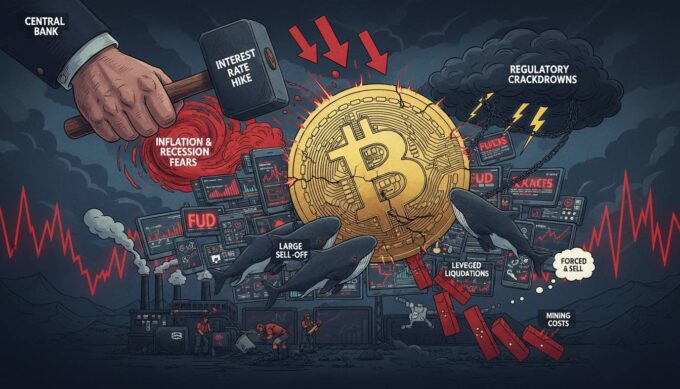
These conditions created a perfect storm for forced deleveraging, with cascading liquidations feeding on themselves.
4. Structural Deleveraging and Open Interest Collapse
Beyond price-driven liquidations, the market experienced structural deleveraging. Open interest across futures and options markets dropped by 20–30%, signaling a broad reduction in leveraged exposure . This suggests that the liquidation wave was not just a reaction to price declines but also a systemic reset of risk across the derivatives ecosystem.
5. Broader Market Impact and Sentiment Shift
The liquidation events had profound effects on market sentiment and capitalization:
- On February 1, Bitcoin dropped 6.5% to around $78,700, while Ethereum plunged nearly 10% to $2,429, triggering $2.2 billion in liquidations and wiping out over 335,000 traders .
- During the week of February 1–7, the crypto market cap fell to $2.34 trillion, with Bitcoin down 16.4% and Ethereum down 22.2% .
- The Fear & Greed Index plunged to extreme fear levels (6/100), reflecting deep market anxiety .
These metrics illustrate how liquidation-driven volatility can rapidly erode market confidence and capitalization.
6. Behavioral Shift: Traders Checking Risk More Often
Interestingly, data from Leverage.Trading shows that U.S.-based retail derivatives traders began checking liquidation risk roughly twice as often as the global average during 2025 . This suggests a growing awareness of leverage risk, with traders becoming more proactive in monitoring their positions ahead of major market stress.
7. Interpretation: A Leverage-Induced Reset
The liquidation spike in early February 2026 represents a classic leverage purge. Excessive positioning, thin liquidity, macro uncertainty, and ETF outflows combined to trigger cascading forced exits. The result was a structural deleveraging event, not just a price correction.
Such events often mark local bottoms, as forced selling exhausts leveraged longs and clears the way for stabilization—especially when accompanied by oversold sentiment and long-term holder accumulation .
8. What Comes Next?
Looking ahead, several factors will shape the market’s trajectory:
- Support zones: Bitcoin’s $76K–$78K and Ethereum’s $2.7K–$2.8K levels will be critical. Holding above these could signal stabilization .
- ETF flows: A reversal from outflows to inflows could provide a liquidity boost and sentiment lift.
- Macro developments: Any shift in Fed policy or geopolitical risk could either reignite volatility or support recovery.
- On-chain signals: Declining exchange balances and accumulation by long-term holders would reinforce a bottoming thesis.
Conclusion
The early February 2026 liquidation wave—marked by over $25 billion in forced closures and multiple $2+ billion single-day events—highlights the systemic risks of excessive leverage in crypto derivatives markets. Long positions were disproportionately affected, and structural deleveraging ensued. While painful, such events often clear the way for renewed stability, especially if key support levels hold and sentiment begins to recover. Traders and institutions alike should remain vigilant, balancing risk exposure and monitoring macro and on-chain indicators closely.
Disclaimer: This article is for informational purposes only and does not constitute financial or investment advice. Cryptocurrency investments carry significant risk, including the possibility of total loss. Past performance does not guarantee future results. Always conduct your own research and consult a qualified financial advisor before making investment decisions.

















Leave a comment