


Introduction
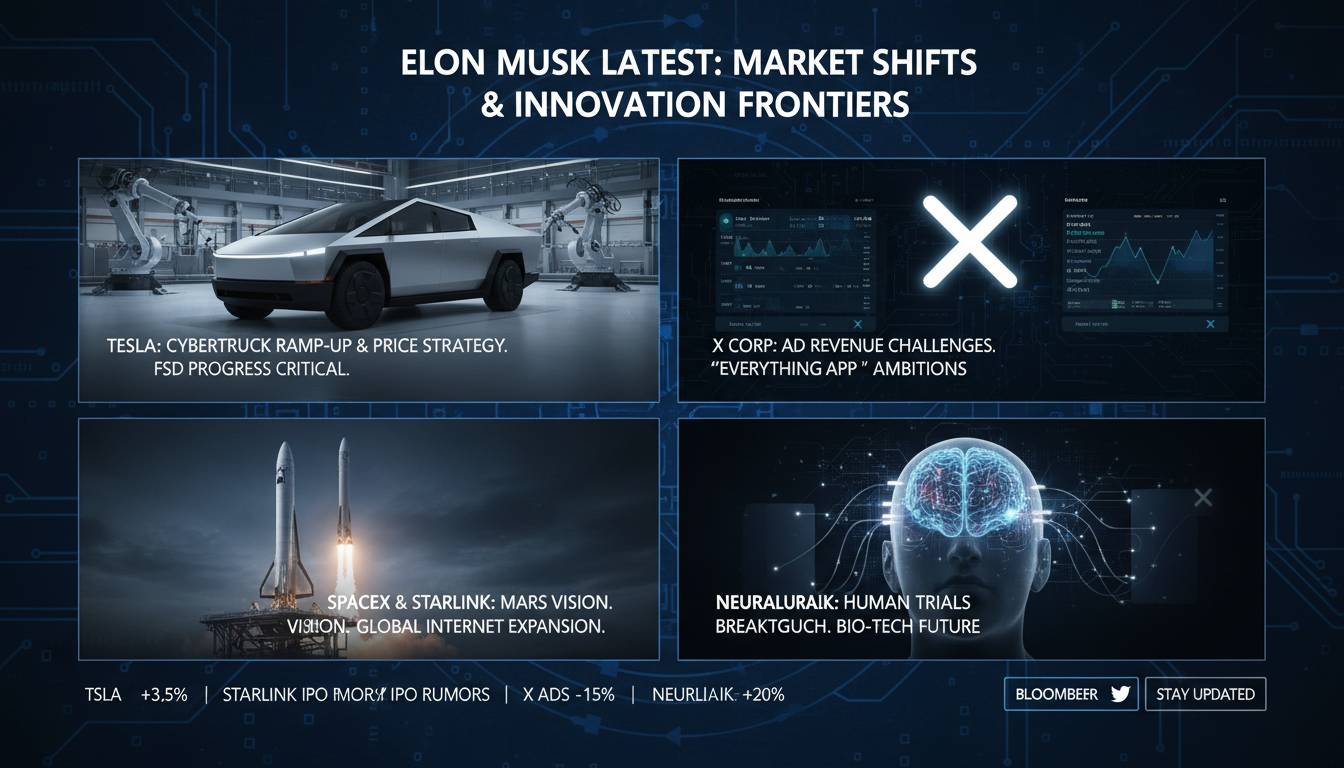
Elon Musk is at the center of a flurry of developments reshaping his sprawling empire—from electric vehicles to space, AI, and politics. Today’s headlines highlight a strategic pivot in SpaceX’s mission, a bold merger with xAI, and shifting investor sentiment. These moves are already rippling through markets, affecting Tesla’s stock, Musk’s net worth, and broader tech valuations.
SpaceX–xAI Merger: A New Innovation Powerhouse
SpaceX has officially acquired Musk’s AI startup xAI in a landmark all-stock deal, creating a private company valued at approximately $1.25 trillion. SpaceX is pegged at $1 trillion, while xAI is valued at $250 billion .
This consolidation brings together rockets, satellite networks, AI, and social media under one roof. Musk frames it as an “innovation engine” that merges AI, space-based internet, and real-time information platforms .
Tesla has also invested $2 billion in xAI through a Series E funding round, reinforcing its strategic alignment with Musk’s AI ambitions .
This merger is a pivotal moment. It signals Musk’s intent to vertically integrate his ventures and position SpaceX–xAI as a future IPO juggernaut .
Moon Factory and Space-Based AI Infrastructure
Musk has unveiled plans to build a factory on the Moon that would manufacture AI satellites using lunar resources and solar power. These satellites would be launched via a mass driver—an electromagnetic catapult—ushering in a new era of space-based AI compute .
He argues that space-based AI infrastructure will soon be more cost-effective than Earth-based systems, leveraging Starship and in-space refueling to support this vision .
This concept, inspired by 1970s space visionaries, is gaining renewed attention as Musk pushes for a lunar industrial ecosystem .
SpaceX’s Lunar Pivot and Starship V3 Launch
SpaceX is shifting its long-term focus from Mars to building a self-sustaining lunar city within the next decade. This marks a strategic change from Musk’s earlier dismissal of the Moon as a distraction from Mars colonization .
The pivot aligns with U.S. government priorities, particularly NASA’s Artemis program, and reflects competitive pressures from rivals like Blue Origin .
Meanwhile, SpaceX is preparing for the first flight of its more powerful Starship Version 3 (V3) in mid-March 2026. V3 is significantly larger and more capable than its predecessor, with new Raptor 3 engines and over 100-ton payload capacity to low Earth orbit .
Tesla’s Strategic Shift and Market Response
Tesla is discontinuing its Model S and Model X lines to repurpose production capacity for Optimus humanoid robots. Musk announced this during Tesla’s Q4 2025 earnings call, signaling a shift toward robotics and AI-driven products .
Tesla also beat Q4 earnings expectations and confirmed its $2 billion investment in xAI, reinforcing its role in Musk’s “Physical AI” strategy .
However, Tesla stock remains volatile. It recently fell 1.6% to $410.63 and is down 8.7% year-to-date in 2026. Investors remain cautious amid concerns about declining EV sales and high valuation metrics .
Musk’s Wealth and Political Moves
Elon Musk’s net worth has surged amid these developments. Forbes estimates his wealth at $852 billion, while Bloomberg places it at $690 billion as of early 2026 .
A recent report suggests there is a 75% probability that Musk could become a trillionaire this year, driven by Tesla’s valuation and SpaceX’s private market gains .
On the political front, Musk has signaled support for Republican candidates in the 2026 U.S. midterms, citing concerns about a Democratic majority. He appears to have shelved plans for a third-party “America Party” for now .
Market Impact and Investor Sentiment
The January 20, 2026 market sell-off hit megacap tech stocks hard, including Tesla, amid tariff threats and broader volatility .
Tesla’s stock is now navigating a complex landscape: transitioning from EVs to AI and robotics, while managing investor skepticism and political distractions .
Musk’s consolidation of his ventures into SpaceX–xAI and the lunar AI vision are reshaping investor expectations, but execution risks remain high.
What’s Next for Markets
Markets will be watching several key developments closely:
– The success of Starship V3’s mid-March test flight.
– Progress on the SpaceX–xAI integration and potential IPO timeline.
– Tesla’s transition to Optimus production and AI integration.
– Musk’s political influence and its impact on investor sentiment.
Conclusion
Elon Musk is orchestrating a sweeping realignment of his empire. The SpaceX–xAI merger, lunar AI infrastructure plans, and Tesla’s pivot to robotics signal a bold new direction. Markets are reacting with cautious optimism, balancing excitement over innovation with concerns about execution and valuation. Investors should monitor upcoming milestones—Starship V3’s launch, Tesla’s AI rollout, and the SpaceX–xAI IPO—as they will shape the trajectory of Musk’s influence and market impact.



















Leave a comment