


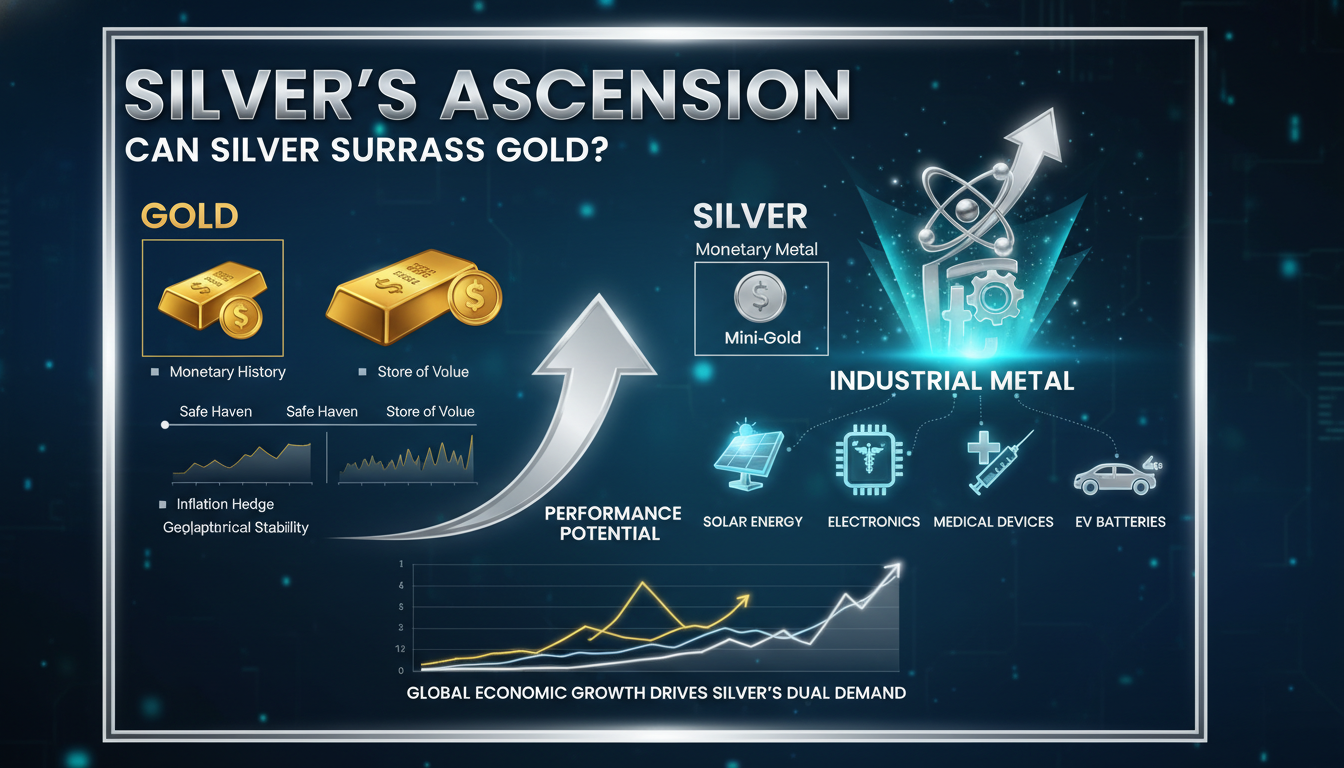
The question “Silver Price Prediction: Will Silver Outperform Gold?” isn’t just technical jargon—it reflects a real tug-of-war playing out in global markets. As of early February 2026, silver has been on a roller-coaster ride, sometimes outpacing gold, sometimes trailing behind when volatility spikes. But beneath the price charts lie structural shifts, geopolitical tremors, and industrial evolution that could tilt the scales. This narrative explores whether silver is streaking ahead or simply catching up, weaving expert forecasts, market dynamics, and the real world into a nuanced conversation.
The 2025–2026 Silver Surge
Silver staged an astonishing rally in 2025, doubling in price and far outpacing gold’s roughly 60% rise . That surge didn’t happen in isolation—it was fueled by tight supply conditions, explosive demand (particularly from green energy), and a wave of speculative buying . Deutsche Bank flagged the tightest industrial silver availability on record, with lease rates highest since 2002 .
As we rolled into 2026, silver continued to flex its muscles: in January, a 185% year-on-year gain pushed the metal to new highs over $95 per ounce . Analysts like Tom Bradshaw are even predicting an extreme upside—up to $375 by 2028—though such targets fall into the speculative realm .
Beyond Hype: Structural Drivers of Silver Demand
Dual-Purpose Demand
Silver isn’t just a shiny safe-haven—it’s a critical industrial metal. Used in solar panels, EVs, semiconductors, and more, its demand has one foot in speculative investing and the other in tangible growth sectors . For instance, every GW of new solar capacity eats up millions of ounces of silver—a reality that becomes meaningful as U.S. solar installations ramp up in 2026 .
Supply Inelasticity
Here’s where silver differs sharply from gold: most silver is a byproduct of mining for other metals (like copper or lead), not mined on its own account . That means even when prices spike, production can’t respond quickly, keeping supply tight. In contrast, new gold mines can more readily come online to meet demand. Production growth for silver was a mere 1–2% in 2024–2025 .
Macro Tailwinds and Technical Setups
A dovish U.S. Federal Reserve outlook—expectations of further rate cuts—appears to be making gold and silver shine brighter. Analysts forecast one more rate cut by mid-2026, potentially boosting non-yielding assets . Technical models are humming too: Fibonacci retracements suggest targets in the $72–88 per ounce range , with institutional investors sounding bullish over consolidation near the $48–50 range .
Expert Predictions: Who Sees Silver Winning?
Mainstream Banks & Analysts
- Bank of America sees silver averaging around $56.25 in 2026, with a peak touching $65 .
- CoinPriceForecast projects silver could end 2026 near $70 .
- HSBC’s more conservative view hovers in the $50–$53 range .
Market Strategists & Commentators
- APMEX’s Brett Elliott warns that for gold to overtake silver’s performance, it would need to hit $7,000 while silver overtakes at $86—emphasizing silver’s current edge .
- Jeff Clark (The Gold Advisor) sees both metals rising, with possible targets of $5,000 for gold and $75 for silver by 2026 or 2027 .
Bull Cases & Speculative Forecasts
- LongForecast.com offers jaw-dropping ranges—$71 to $117 by end of 2026, with a possible close near $247 . But such ranges likely reflect extreme scenarios informed by modeling assumptions more than baseline forecasts.
- Tom Bradshaw’s $375 prediction by 2028 is even more aggressive and places him at the speculative fringe .
Risks and Market Volatility
Silver’s volatility isn’t just talk—it’s built into its DNA. For example, recent weeks saw rapid reversals: silver dropped 30% one Friday, then rallied 10% the next day. These swings reflect sensitivity to geopolitical shifts and Fed-related moves .
Even bullish market players like Zhongcai Futures—who shorted silver—made a staggering $519 million betting on a pullback . That kind of institutional positioning can accelerate reversals in both directions.
Tying It Together: Will Silver Outperform Gold?
Here’s where the narrative gets mixed—but intriguing:
- Quantitatively, silver has already outpaced gold in 2025 by a wide margin, and many forecasts peg further gains in 2026—often more aggressive than gold’s trajectory .
- Structurally, silver benefits from its industrial demand and supply rigidity—underpinnings that gold doesn’t have to the same degree .
- Technically, charts show momentum and breakout potential for silver, with historical Fibonacci targets offering directional clarity .
- But, volatility and geopolitical swings constantly test that thesis. Any Fed hawkish pivot, sudden demand slowdown (e.g., solar or EVs), or speculative bubble burst could shift momentum back to gold .
“Silver’s surge isn’t just speculation—it reflects its unique role at the intersection of investment and industry. That duality, combined with inelastic supply, makes silver a potential outperformer in the right conditions.”
— Market analyst insight, synthesizing trends across major banks and strategists
Conclusion
Silver’s recent price surge and structural market characteristics have lifted it into rarefied territory—outperforming gold in 2025 and potentially continuing that trajectory in 2026. Anchored by industrial demand, limited supply, and favorable monetary conditions, silver may yet carve out a notable lead.
But the path forward is far from smooth. Market reversals, geopolitical surprises, and macroeconomic shifts could undermine momentum at any time. For investors, the allure of silver lies in its asymmetric potential—but that comes with the cost of volatility and risk.
In short: silver currently holds the performance edge, backed by strong fundamentals. But only a combination of sustained macro tailwinds and real-world demand will confirm whether this outperformance endures.
FAQs
What are realistic silver price targets for 2026?
Many forecasts place silver in the $56–$65 average range, with peak expectations around $70. Conservative estimates start near $50, while bullish scenarios stretch past $80.
Why might silver outperform gold?
Silver benefits from strong industrial demand—especially in clean energy sectors—and limited production flexibility. That makes it more reactive in bullish cycles compared to gold.
What are the key risks to silver’s rally?
Volatility rooted in speculative positioning, shifts in central bank policy, weak demand, or sudden supply changes could derail gains. Large short positions (e.g., Zhongcai) also can trigger swings.
Can technical analysis guide silver’s next move?
Yes—technical models like Fibonacci extensions suggest targets of $72 and $88 per ounce. But traders should pair them with fundamentals and risk management.
Should investors favor silver or gold in 2026?
That depends on risk tolerance. Silver offers higher upside potential if industrial demand and policy align—but also comes with amplified swings. Gold remains a classic safety play.















Leave a comment