


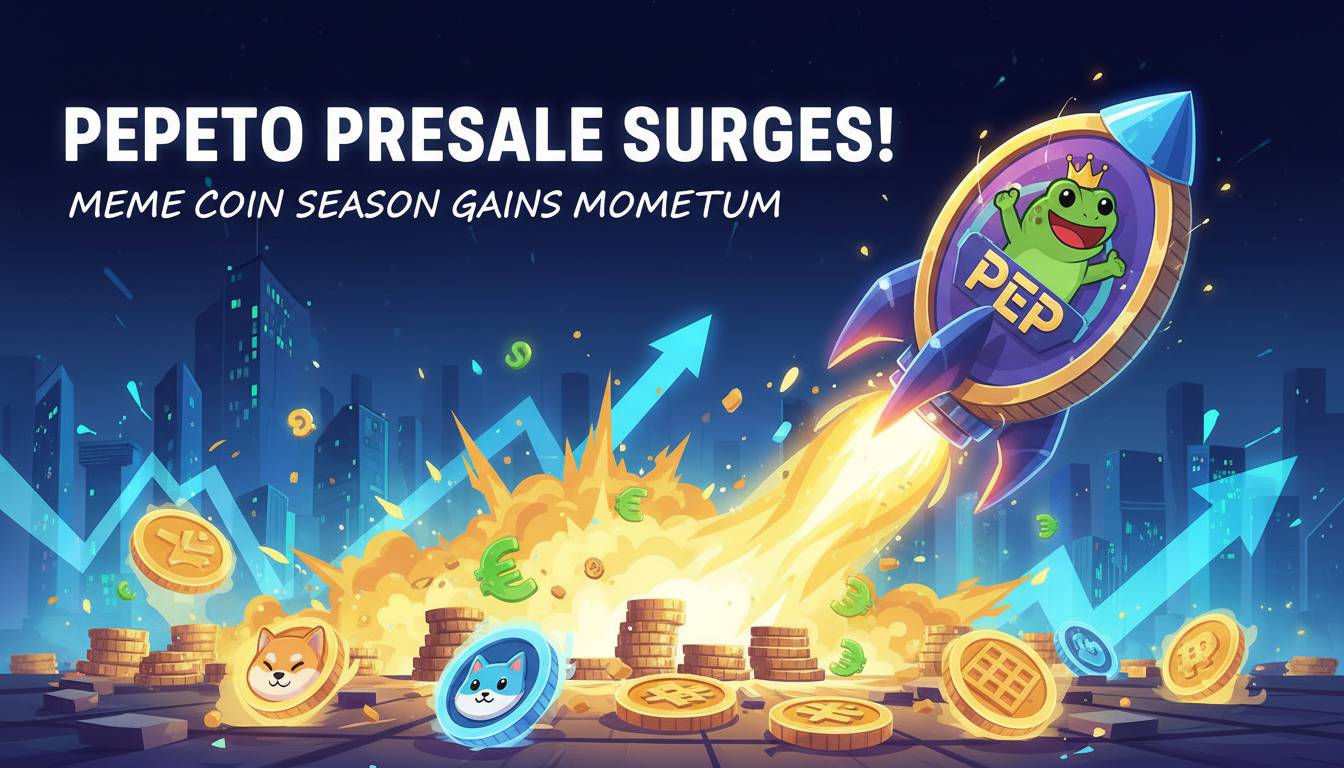
The meme coin market is again drawing investor attention as Pepeto’s presale campaign accelerates, Dogecoin and Pepe post renewed trading activity, and Bitwise expands support for Bitcoin’s open-source ecosystem. Together, those developments point to a broader shift in crypto sentiment in early 2026: speculative appetite is returning, but so is institutional backing for core blockchain infrastructure. That combination is shaping a market where hype-driven tokens and foundational Bitcoin development are advancing at the same time.
Pepeto Presale Fills Before Binance Listing as DOGE and PEPE Signal Meme Season Is Coming and Bitwise Backs Bitcoin Developers
Pepeto has emerged as one of the more visible presale narratives in the meme coin segment, with multiple recent promotional announcements stating that the project has raised millions of dollars and that individual presale stages have sold out quickly. A March 11, 2026 release said Pepeto had raised $7.93 million, while a March 9, 2026 release said one presale stage sold out in under 48 hours. Earlier announcements in late February and early March cited milestones of $7.308 million and $7.58 million respectively.
Even so, investors should distinguish between verified exchange announcements and project marketing. Publicly available search results reviewed for this article show claims around future exchange listings, including references to major exchange ambitions, but they do not establish an independently confirmed Binance listing date from Binance itself. One third-party guide notes that Pepeto is expected to list on five exchanges after the presale ends, with announcements to come during the presale phases.
That distinction matters because presale demand often rises on the expectation of a major listing, not on a completed listing event. In crypto markets, that can amplify both upside speculation and downside risk. Pepeto’s visibility has increased, but the available public record remains dominated by press releases, guides, and community discussion rather than primary exchange confirmation.
DOGE and PEPE revive the meme coin trade
The broader meme coin backdrop helps explain why projects like Pepeto are attracting attention. Pepe is trading at about $0.000003 with a 24-hour trading volume above $284 million, according to CoinMarketCap data indexed in recent search results. CoinMarketCap’s project page also notes Pepe’s long-standing positioning as a meme-driven token seeking broader exchange adoption and community-led growth.
Dogecoin remains the category’s benchmark asset, and recent market commentary suggests it has continued to act as a sentiment barometer for speculative crypto trading. Binance Research’s March 2026 market insights noted that DOGE fell 22.7% for the month despite a notable 14% single-day surge, underscoring how volatile meme assets remain even during periods of renewed interest. Separate market commentary from early 2026 described Dogecoin and Pepe as among the strongest performers during short bursts of meme coin rotation.
Several indicators support the view that meme coin activity has strengthened since the start of the year:
- CoinCentral reported that memecoin market capitalization rose 23% as 2026 began.
- CoinTelegraph reported that memecoins added roughly $3 billion in market cap in a single day during one rally led by PEPE.
- Recent market commentary cited PEPE gains of more than 60% over a seven-day period during one early-2026 rebound.
Those figures do not prove a full-scale “meme season,” but they do show that capital is rotating back into high-beta, community-driven tokens. In crypto markets, that often happens when traders become more comfortable taking risk beyond Bitcoin and Ethereum.
Why Pepeto is benefiting from the shift
Pepeto appears to be benefiting from two overlapping trends: renewed appetite for meme coins and investor interest in presale-stage tokens that promise exchange catalysts. The project has been marketed as an Ethereum-based meme coin with staking and broader ecosystem ambitions. Third-party coverage has also described plans involving exchange infrastructure and cross-chain features, though those claims should be treated as project-level assertions unless independently verified through official technical documentation and exchange statements.
For traders, the appeal is straightforward. Presales offer lower entry pricing than post-listing markets, at least in theory, and meme coins can move sharply when social momentum builds. But that same structure creates substantial execution risk. Community posts on Reddit have raised concerns about presale mechanics, token delivery timing, and transparency, highlighting the need for caution when evaluating any early-stage token sale. Those posts are anecdotal rather than conclusive, but they reflect the skepticism that often surrounds meme coin presales.
For that reason, the current Pepeto story is best understood as a high-interest speculative event rather than a settled market success. The presale momentum is visible in public announcements, but the long-term outcome will depend on whether the project delivers token claims, exchange listings, liquidity, and sustained user demand after launch.
Bitwise backs Bitcoin developers as institutions deepen involvement
While meme coins capture retail attention, Bitwise’s latest move highlights a different side of the crypto market: institutional support for Bitcoin’s underlying infrastructure. On March 4, 2026, Bitwise Asset Management announced its second annual donation to Bitcoin open-source developers, saying it would donate $233,000 from profits tied to its BITB product. The firm said it manages more than $15 billion in client assets.
That announcement is significant because Bitcoin’s network depends heavily on open-source contributors who often work outside traditional corporate funding models. Support from asset managers can help sustain maintenance, security, and protocol-level research. In a market often dominated by token price speculation, Bitwise’s donation serves as a reminder that long-term ecosystem health depends on developer resources as much as investor enthusiasm.
According to Bitwise, the donation is directed toward Bitcoin open-source developers who help secure and maintain the network. That framing aligns with a broader industry trend in which firms benefiting from Bitcoin adoption increasingly contribute to the public goods layer that supports the asset.
What this means for investors and the wider market
The coexistence of meme coin speculation and institutional Bitcoin support is not contradictory. In fact, it may be one of the defining features of the current crypto cycle. On one side, traders are chasing momentum in DOGE, PEPE, and newer names like Pepeto. On the other, firms such as Bitwise are reinforcing the infrastructure that underpins the market’s largest digital asset.
For stakeholders, the implications differ:
- Retail traders may see more short-term opportunities in meme coins, but also face elevated volatility and project risk.
- Presale participants may benefit if listings and liquidity materialize, but they remain exposed to execution and transparency concerns.
- Institutional investors may view Bitcoin-related developer funding as a sign of maturing market infrastructure.
- The broader crypto sector may gain from a cycle in which speculative capital returns while core network development continues to receive support.
A balanced reading of the market suggests that enthusiasm is rising, but selectivity remains essential. Meme coin rallies can be powerful, yet they are often short-lived. By contrast, developer funding tends to have slower, less visible, but more durable effects on the ecosystem.
Conclusion
Pepeto’s fast-moving presale narrative, stronger trading interest in DOGE and PEPE, and Bitwise’s fresh donation to Bitcoin developers together capture the split personality of the crypto market in March 2026. Speculation is back in force, especially in meme coins, but institutional players are also putting capital behind the infrastructure that supports long-term adoption.
For now, the strongest verified takeaway is not that any single meme coin has already won the cycle. It is that risk appetite is returning, meme assets are again commanding attention, and serious firms continue to invest in Bitcoin’s foundations. Whether Pepeto converts presale momentum into lasting market relevance will depend on execution, transparency, and confirmed exchange progress in the weeks ahead.
Frequently Asked Questions
What is Pepeto?
Pepeto is an Ethereum-based meme coin project that has been promoted through a presale campaign and ecosystem claims including staking and exchange-related ambitions. Public coverage of the project is currently driven largely by press releases and third-party guides.
Has Binance confirmed a Pepeto listing?
Based on the publicly available sources reviewed here, there is no independently confirmed Binance listing announcement from Binance itself. Some third-party materials discuss future exchange plans, but that is not the same as an official listing confirmation.
Why are DOGE and PEPE important to meme coin sentiment?
Dogecoin and Pepe are among the most recognized meme coins and often act as proxies for speculative appetite in the sector. Recent trading activity and market-cap gains in these tokens have been cited as signs of renewed meme coin momentum.
What did Bitwise announce about Bitcoin developers?
On March 4, 2026, Bitwise said it would donate $233,000 from BITB profits to Bitcoin open-source developers. The firm described the move as its second annual donation supporting the programmers who help maintain the Bitcoin network.
Does rising meme coin activity mean a full meme season has started?
Not necessarily. Recent gains in DOGE, PEPE, and broader meme coin market capitalization suggest stronger speculative interest, but meme cycles are volatile and can reverse quickly. A sustained trend would require continued volume, liquidity, and broader market participation.
What is the main risk in meme coin presales?
The main risks include limited transparency, uncertain token delivery timelines, unconfirmed listing expectations, and sharp price swings after launch. Investors typically need to verify official project communications and treat promotional claims with caution.


















Leave a comment