


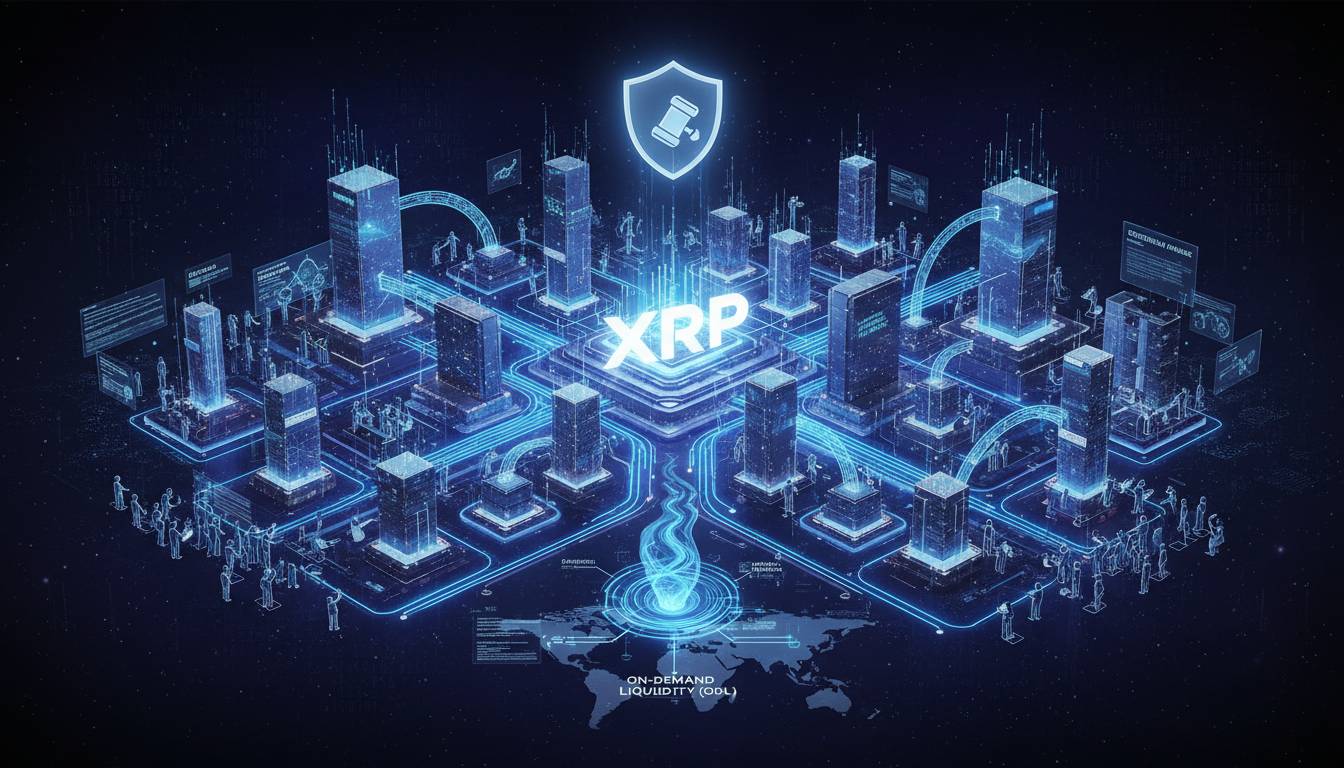
Ripple is pushing a broader strategy to position XRP and the XRP Ledger at the center of institutional decentralized finance, moving beyond payments into collateral, settlement, custody, and tokenized asset markets. The company’s recent acquisition of prime broker Hidden Road, the expansion of RLUSD, and new infrastructure on XRPL together show how Ripple plans to turn XRP into the collateral layer of institutional DeFi. The effort is still developing, and important regulatory and market risks remain, but the direction is now clearer than it was a year ago.
Ripple’s Institutional DeFi Strategy Comes Into Focus
For years, Ripple’s public identity centered on cross-border payments. In 2025 and early 2026, that narrative widened. Ripple began describing XRPL as infrastructure for institutional DeFi, with XRP serving not only as a bridge asset but also as a core liquidity and settlement component in tokenized finance. Ripple’s own materials now frame XRP as an asset that can sit underneath trading, collateral movement, and onchain financial operations for institutions.
The clearest signal came on April 8, 2025, when Ripple announced its $1.25 billion acquisition of Hidden Road, a multi-asset prime broker. Ripple said Hidden Road would migrate post-trade activity to the XRP Ledger, a move designed to lower costs and demonstrate XRPL’s suitability for institutional DeFi. Ripple also said the deal would allow it to inject significant capital into Hidden Road’s clearing and financing platform, giving the company a direct route into institutional market structure rather than relying only on external partners.
That matters because prime brokers sit close to the plumbing of modern markets. They help institutions manage financing, collateral, clearing, and execution across asset classes. By owning that layer, Ripple is not simply promoting XRP as a token; it is trying to embed XRP and XRPL into the workflows institutions already use. According to Ripple, this is part of a plan to make digital asset infrastructure look more like institutional-grade financial infrastructure.
How Ripple Plans to Turn XRP Into the Collateral Layer of Institutional DeFi
The phrase “collateral layer” is important because Ripple’s strategy does not appear to rely on XRP alone as posted collateral in every transaction. Instead, the company is building a stack in which XRP, XRPL, and Ripple-issued products each play a role in collateral mobility, settlement finality, and liquidity access. In practice, that means XRP may function as the native asset securing network activity and liquidity, while RLUSD and tokenized real-world assets provide institution-friendly collateral instruments on top.
Ripple’s April 2025 Hidden Road announcement emphasized RLUSD as collateral across prime brokerage products. Ripple said RLUSD would become the first stablecoin used for efficient cross-margining between digital assets and traditional markets within Hidden Road’s framework. That suggests Ripple sees stablecoin collateral as the near-term institutional entry point, with XRP and XRPL supplying the underlying rails, liquidity, and interoperability needed to move that collateral efficiently.
At the same time, Ripple continues to argue that XRP remains central at the protocol level. In a February 5, 2026 post on institutional DeFi, Ripple said XRP’s role becomes more intertwined in institutional finance “either as the asset being moved, the bridge facilitating exchange, or the reserve currency backing network security.” That language is notable because it describes XRP less as a speculative token and more as a foundational market utility asset.
In practical terms, Ripple’s plan appears to rest on four pillars:
- Prime brokerage integration: Bringing institutional clients, financing, and collateral workflows into Ripple Prime, formerly Hidden Road.
- Stablecoin-based collateral: Using RLUSD for cross-margining and settlement across digital and traditional markets.
- Tokenized asset issuance on XRPL: Supporting Treasuries, commercial paper, and other real-world assets that can be used in onchain finance.
- Interoperability and DeFi tooling: Expanding bridges, sidechains, and lending features so institutions can use XRPL without being locked into one environment.
Why Hidden Road Changes the Equation
Hidden Road is central to the story because it gives Ripple direct exposure to institutional trading infrastructure. Ripple said the acquisition makes it the first crypto company to own and operate a global, multi-asset prime broker. That is a meaningful distinction in a market where many crypto firms have offered exchange access or custody, but fewer have controlled a prime brokerage platform spanning foreign exchange, digital assets, derivatives, swaps, and fixed income.
On November 3, 2025, Ripple announced the U.S. launch of digital asset spot prime brokerage under Ripple Prime. The company said U.S.-based institutional clients could execute OTC spot transactions across dozens of digital assets, including XRP and RLUSD, and cross-margin those positions with other digital asset exposures, including OTC swaps and CME futures and options. That is one of the strongest public indications that Ripple is trying to make XRP part of a broader institutional collateral and trading ecosystem rather than a standalone asset.
According to Michael Higgins, International CEO of Ripple Prime, the U.S. launch complements Ripple’s existing OTC and cleared derivatives services and is meant to provide institutions with a more comprehensive trading offering. His statement points to a familiar institutional logic: collateral becomes more useful when it can move across products, venues, and balance-sheet silos. Ripple’s thesis appears to be that XRPL can help reduce that friction.
Tokenized Treasuries, Commercial Paper, and the XRPL Opportunity
Ripple’s institutional DeFi push also depends on having credible assets onchain. That is why tokenized real-world assets have become a major part of the company’s messaging. On January 28, 2025, Ripple announced that Ondo Finance would bring tokenized U.S. Treasuries to XRPL, with minting and redemption available using RLUSD. Ripple described XRPL as tailored to institutional requirements, citing tokenization, trading, escrow, compliance, and asset movement as core features.
Later, Ripple announced that Guggenheim Treasury Services, through the Zeconomy platform, issued digital commercial paper on XRPL. Ripple said the product had already recorded more than $280 million in volume to date and described it as a yield-bearing onchain asset that could be used as collateral in trading strategies. That is significant because institutional DeFi will likely depend less on purely crypto-native collateral and more on short-duration, high-quality financial instruments that treasury desks already understand.
If Ripple succeeds, XRP may benefit in two ways. First, more tokenized assets on XRPL can increase network activity and demand for XRP-linked liquidity. Second, XRP can become more deeply embedded in exchange, settlement, and bridging functions even when the posted collateral itself is a stablecoin or tokenized Treasury. That is an important distinction for investors and institutions evaluating how Ripple plans to turn XRP into the collateral layer of institutional DeFi.
Infrastructure Still Matters: Sidechains, Lending, and Interoperability
Institutional adoption depends on more than asset issuance. It also requires technical features that support compliance, privacy controls, and compatibility with existing developer ecosystems. Ripple has been building that stack through the XRPL EVM Sidechain, interoperability partnerships, and proposed lending standards.
Ripple’s institutional DeFi roadmap has highlighted lending specifications such as XLS-65d and XLS-66d. According to Ripple, these proposals are designed to support pooled assets, permissioned access, and fixed-term uncollateralized lending with off-chain underwriting and first-loss capital protection. Those features are aimed at institutional credit markets, where legal agreements and risk controls matter as much as code.
Ripple has also expanded interoperability. In June 2025, the company announced Wormhole integration for XRPL mainnet and the XRPL EVM Sidechain, adding cross-chain messaging and asset transfers for DeFi, real-world assets, and institutional onchain finance. Ripple said XRPL already had support from Axelar as well. For institutions, interoperability can make collateral more useful because it reduces the cost of moving assets between ecosystems.
Market Tailwinds and the Limits of the Thesis
Ripple’s strategy is arriving as the market for regulated XRP exposure has broadened. CME Group announced on April 24, 2025 that it planned to launch XRP futures on May 19, 2025, pending regulatory review, and CME documents later confirmed the contracts’ listing. Regulated futures do not guarantee institutional DeFi adoption, but they do add price discovery, hedging tools, and market structure that institutions typically want before using an asset more broadly.
Still, there are clear limits to the current thesis. Ripple’s own announcements are forward-looking and naturally promotional. Much of the institutional DeFi vision depends on adoption that is not yet proven at scale in public data. It also depends on regulation, counterparty trust, and whether institutions prefer public blockchains, permissioned systems, or hybrid models.
There is also a conceptual nuance. Today, Ripple’s most explicit collateral product for institutions is RLUSD, not XRP itself. That means the stronger factual claim is that Ripple is building an institutional DeFi stack on XRPL in which XRP is foundational, while RLUSD and tokenized assets may be the more direct forms of collateral in many use cases. Whether XRP becomes the dominant collateral asset, rather than the underlying liquidity and settlement layer, remains an open question.
What Comes Next
The next phase will likely be measured by execution rather than announcements. Investors and institutions will watch whether Ripple Prime expands collateral services, whether Hidden Road’s migration to XRPL materially changes costs or settlement times, and whether tokenized assets on XRPL gain meaningful secondary-market activity. They will also watch whether lending and sidechain features move from roadmap language into sustained production use.
Ripple has assembled many of the pieces: custody, stablecoins, prime brokerage, tokenization, and interoperability. The company’s argument is that these pieces can work together to make XRP and XRPL core infrastructure for institutional DeFi. The strongest evidence so far is not a single product launch, but the way these components are being connected into one stack.
Conclusion
Ripple is no longer pitching XRP only as a payments asset. It is building a broader institutional finance strategy in which XRP, XRPL, RLUSD, and Ripple Prime support collateral movement, settlement, and tokenized asset markets. The acquisition of Hidden Road, the use of RLUSD for cross-margining, the arrival of tokenized Treasuries and commercial paper on XRPL, and the expansion of interoperability tools all point in the same direction.
How Ripple plans to turn XRP into the collateral layer of institutional DeFi is therefore less about one dramatic switch and more about building institutional market plumbing around the asset. If that strategy works, XRP could become a deeper part of how collateral, liquidity, and settlement move across digital and traditional markets. If it does not, XRP may still remain important to Ripple’s ecosystem, but not in the central collateral role the company is now aiming to define.
Frequently Asked Questions
What is Ripple trying to do with XRP in institutional DeFi?
Ripple is trying to position XRP and the XRP Ledger as core infrastructure for institutional onchain finance, including settlement, liquidity routing, and support for collateral workflows.
Is XRP already being used directly as institutional collateral?
Ripple’s clearest public collateral use case today is RLUSD within prime brokerage products. XRP appears to play a broader foundational role in liquidity, exchange, and network operations rather than being the sole posted collateral in all cases.
Why is Hidden Road important to Ripple’s plan?
Hidden Road, now Ripple Prime, gives Ripple a prime brokerage platform that connects financing, execution, clearing, and cross-margining for institutional clients. That makes it easier for Ripple to integrate XRP, RLUSD, and XRPL into institutional workflows.
What kinds of assets are being brought onto XRPL?
Ripple has highlighted tokenized U.S. Treasuries through Ondo Finance and digital commercial paper issued through Zeconomy for Guggenheim Treasury Services. These are the kinds of assets institutions may be more comfortable using in onchain finance.
What are the biggest risks to this strategy?
The main risks include regulation, limited real-world adoption, competition from other blockchains and permissioned systems, and uncertainty over whether institutions will prefer XRP itself or stablecoins and tokenized securities as primary collateral.
What should readers watch next?
Key indicators include growth in Ripple Prime services, evidence of Hidden Road activity moving onto XRPL, adoption of RLUSD in cross-margining, and broader use of tokenized assets and lending tools on the network.


















Leave a comment