


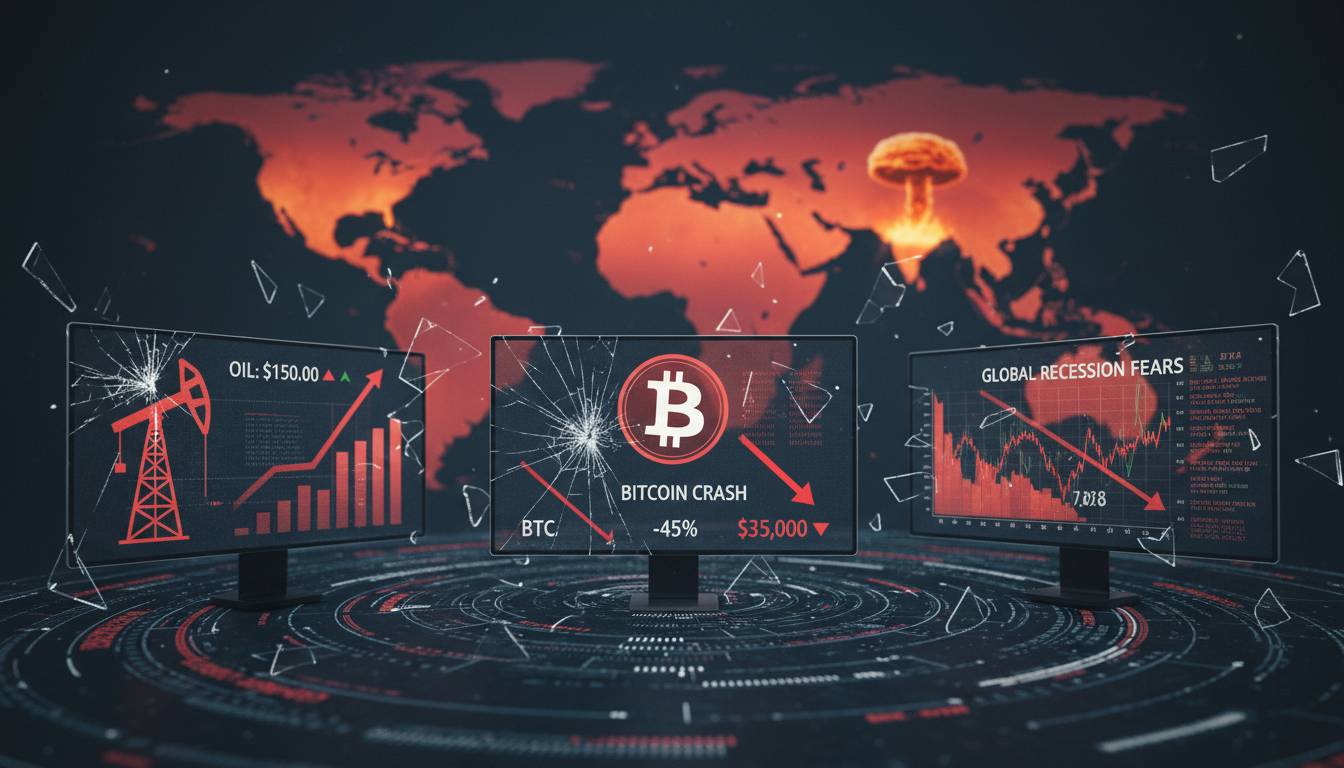
A widening conflict involving Iran is jolting global markets, reviving fears of an oil shock and a broader selloff in risk assets. The immediate trigger is the threat to energy flows through the Strait of Hormuz, the world’s most important oil chokepoint. Analysts say a severe disruption could send crude sharply higher, with some extreme scenarios pointing to $150 a barrel, while Bitcoin and other cryptocurrencies could face steep losses if inflation rises and central banks keep policy tighter for longer.
Why the Iran conflict matters for oil markets
The market’s focus is not only on Iran’s own exports, but on the Strait of Hormuz, the narrow waterway used to move a large share of the world’s seaborne crude. Recent reporting shows that roughly 15 million to 20 million barrels a day normally pass through the strait, making it a critical artery for producers including Saudi Arabia, Iraq, Kuwait, the United Arab Emirates and Qatar. Any sustained disruption there would hit physical supply, shipping costs and insurance premiums at the same time.
That is why the phrase “Iran conflict could push oil to $150 and crash Bitcoin up to 45%” has gained traction. It reflects a tail-risk scenario rather than a base-case forecast. Current prices are far below that level, but the market is rapidly repricing geopolitical risk. AP reported on March 1 that Brent crude traded around $79.41 a barrel after the latest escalation, up 9% from the prior Friday. Axios then reported on March 6 that Brent was trading near $89, roughly $16 above levels seen before the strikes began.
In normal conditions, official forecasts remain much lower. The U.S. Energy Information Administration said in its July 2025 outlook that it expected Brent to average below $70 in 2025 and about $58 in 2026, though it also acknowledged that Middle East unrest had increased uncertainty and volatility. That gap between official baseline forecasts and wartime scenarios explains why traders are treating $150 as an extreme outcome tied to a prolonged supply shock, not a central expectation.
Iran conflict could push oil to $150 and crash Bitcoin up to 45%
The $150 oil scenario generally depends on a much more serious breakdown in regional energy logistics than what markets have seen so far. Goldman Sachs has modeled a partial closure of the Strait of Hormuz as capable of pushing Brent above $110 a barrel. Other market commentary has outlined even higher estimates under a longer and broader disruption, especially if spare capacity cannot be deployed quickly and strategic reserves only partly offset lost flows.
According to Arne Rasmussen of Global Risk Management, the “absolute nightmare” for oil markets is a closure of the Strait of Hormuz. That view is widely shared because the chokepoint handles not just crude, but also liquefied natural gas and refined products. If tankers cannot move safely, the result is not simply higher oil prices. It can also feed into gasoline, diesel, shipping and petrochemical costs across the global economy.
For U.S. consumers, the impact is already visible. Axios reported that the national average gasoline price rose 10.8% over four days, citing Schwab analyst Kevin Gordon. Kiplinger said it expects the national average to reach at least $3.25 in the coming weeks if the conflict continues to pressure energy markets. Those moves matter because a fresh energy spike can complicate the Federal Reserve’s inflation fight and tighten financial conditions across equities, bonds and crypto.
Why Bitcoin is vulnerable in an oil shock
Bitcoin is often marketed as “digital gold,” but in acute geopolitical shocks it has frequently traded more like a high-volatility risk asset. When oil jumps, investors begin to price in higher inflation, firmer bond yields and a reduced chance of near-term rate cuts. That combination tends to pressure speculative assets, especially those that rely on abundant liquidity and strong risk appetite.
There is already evidence of that pattern. During the June 2025 Israel-Iran escalation, Reuters-based market coverage cited by CNBC and other outlets said oil was expected to rise immediately, while Bitcoin fell as traders moved toward traditional safe havens. CoinDesk also reported that Bitcoin’s options skew weakened as oil surged on Middle East tensions, signaling greater demand for downside protection.
The “up to 45%” Bitcoin decline should be understood as a stress-case scenario. It is not a consensus forecast from a single official institution. Some market commentary published in early March 2026 argues that if oil surges far enough to keep the Fed from easing, Bitcoin could fall sharply from current levels. Forbes, citing scenario analysis from InvestingHaven, said a full energy shock with oil above $100 could push Bitcoin below $45,000. That would imply a very large drawdown from higher trading ranges seen earlier in the cycle.
What analysts and market data are saying now
Recent market data show a split between short-term stress and longer-term debate. On one side, crypto has sold off as geopolitical risk rises. AP reported in April 2025 that Bitcoin fell below $75,000 during a broader market rout. More recently, several market reports have tied Bitcoin weakness to fears that energy-driven inflation will delay monetary easing.
On the other side, some digital-asset researchers argue that once forced liquidations clear, Bitcoin could recover if investors begin to see it as a hedge against financial fragmentation. CoinShares said on March 6 that crude and volatility had repriced sharply higher while equities weakened, but it also argued that Bitcoin was beginning to behave less like a fragile risk trade and more like a maturing macro hedge. That is a minority view in the middle of an active shock, but it shows why the market debate remains open.
For now, the balance of evidence favors caution. Oil has already risen materially, shipping through the Gulf is under pressure, and the inflation implications are immediate. Bitcoin, by contrast, still appears highly sensitive to liquidity conditions and macro sentiment during periods of sudden stress.
Who is most exposed
Several groups face direct risk if the conflict worsens:
- Oil-importing economies: Countries in Asia are especially exposed because they rely heavily on Gulf crude and LNG flows through Hormuz.
- U.S. households: Higher crude prices can quickly feed into gasoline and transport costs.
- Crypto investors: Bitcoin and altcoins may face liquidation pressure if yields rise and risk appetite weakens.
- Central banks: A new energy shock could delay rate cuts and complicate inflation management. This is an inference based on the reported rise in oil and gasoline prices and the market discussion around delayed easing.
What comes next
The next phase depends on whether the conflict remains contained or disrupts energy infrastructure and shipping for an extended period. If tanker traffic resumes more normally and no major production facilities are lost, oil could retreat from current highs and the most extreme $150 forecasts would likely remain hypothetical. If the Strait of Hormuz is materially blocked, however, the market could move from a risk premium to a full supply crisis.
That distinction is crucial for Bitcoin as well. A contained conflict may produce only temporary volatility. A prolonged oil shock, by contrast, could tighten global financial conditions enough to trigger a much deeper crypto drawdown. The headline claim that Iran conflict could push oil to $150 and crash Bitcoin up to 45% is therefore best read as a warning about the outer edge of market risk, not a prediction that has already been validated.
Conclusion
The Iran conflict has become a major market driver because it threatens the infrastructure and shipping routes that keep global energy flowing. Oil has already climbed sharply in early March 2026, and analysts agree that the Strait of Hormuz is the key variable to watch. While $150 oil remains an extreme scenario, it is no longer being dismissed outright in the event of a prolonged disruption. At the same time, Bitcoin faces a different but related threat: if higher energy prices keep inflation elevated and delay rate cuts, crypto could suffer a severe risk-off selloff. For investors, the message is clear: geopolitics is once again setting the tone for both commodities and digital assets.
Frequently Asked Questions
Could oil really reach $150 a barrel because of the Iran conflict?
Yes, but most analysts treat that as an extreme scenario tied to a severe and prolonged disruption in the Strait of Hormuz, not the current base case. More moderate stress scenarios have generally pointed to Brent above $100 or $110.
Why would higher oil prices hurt Bitcoin?
Higher oil prices can raise inflation expectations and reduce the likelihood of central bank rate cuts. That tends to pressure risk assets, including cryptocurrencies, by tightening liquidity and weakening investor appetite for volatility.
Is Bitcoin acting like a safe haven in this crisis?
So far, evidence is mixed. In recent geopolitical shocks, Bitcoin has often fallen alongside other risk assets, though some crypto researchers argue it may recover later as a macro hedge.
How important is the Strait of Hormuz?
It is one of the world’s most critical energy chokepoints, carrying roughly 15 million to 20 million barrels of oil a day, plus significant LNG volumes. That is why any threat there has an outsized effect on prices.
Are U.S. consumers already feeling the impact?
Yes. Recent reporting shows gasoline prices have already moved higher as oil markets price in supply risk from the conflict.
Is the 45% Bitcoin crash a forecast or a scenario?
It is best understood as a downside scenario discussed in market commentary, not a confirmed consensus forecast. The size of any decline would depend on how far oil rises, how long the disruption lasts and how the Federal Reserve responds.




















Leave a comment