


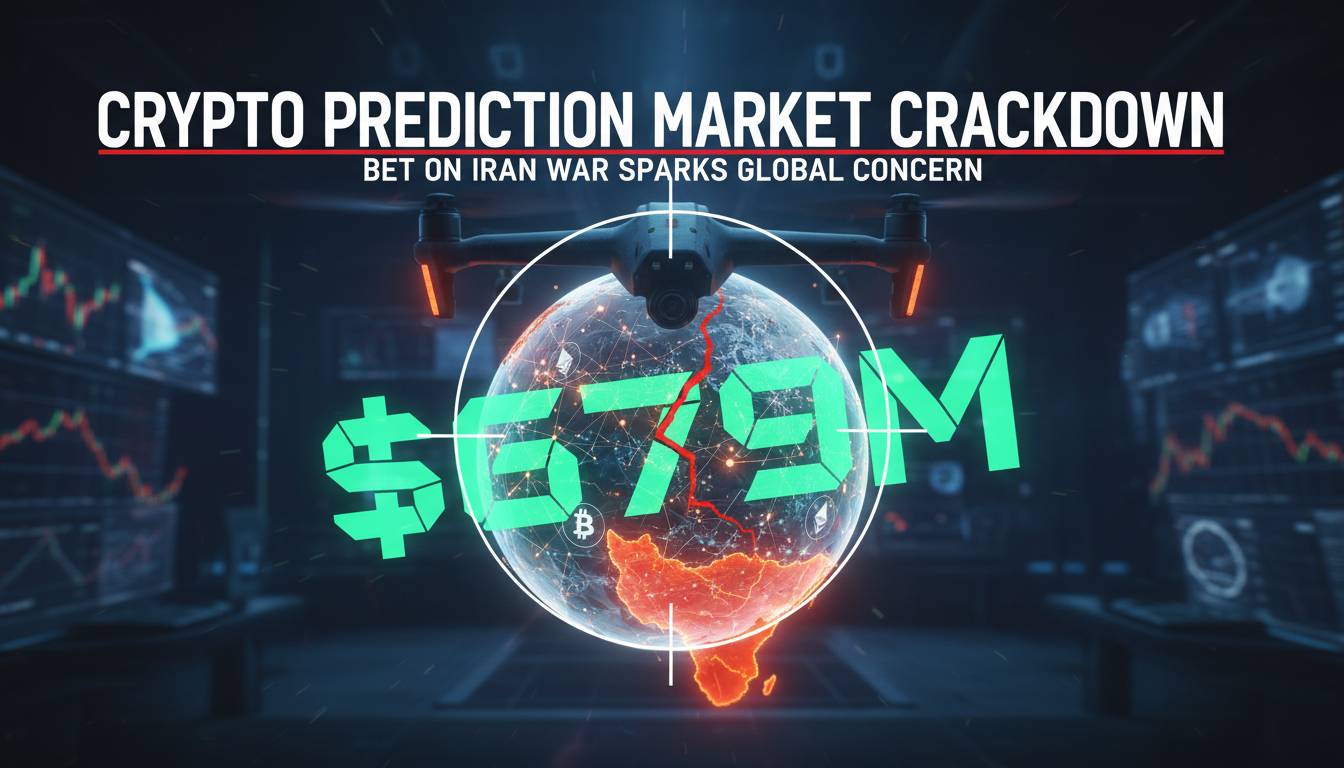
A surge in trading tied to a potential U.S.-Iran conflict is intensifying scrutiny of crypto-based prediction markets in Washington, where regulators are weighing how far event-driven contracts should be allowed to go. The flashpoint is a set of Iran-related markets on Polymarket that drew hundreds of millions of dollars in volume, including one contract on whether the United States would strike Iran. The episode has renewed debate over whether these products are legitimate information tools, speculative derivatives, or a form of online betting that demands tighter oversight.
A high-volume Iran market draws attention
The market at the center of the controversy is Polymarket’s “US strikes Iran by…?” contract, which the platform described as having traded about $364 million as of late February 2026. Other Iran-related contracts on Polymarket included questions about a ceasefire and whether the United States would invade Iran, showing how geopolitical risk has become a major category for crypto-native prediction trading. Polymarket’s public listings indicate that these contracts resolve based on official statements or clearly defined military actions, a structure designed to make outcomes measurable.
The user-supplied figure of $679 million appears to refer to combined volume across multiple Iran-linked markets rather than a single contract. Based on Polymarket pages currently accessible, at least one Iran strike market alone exceeded $364 million, while related contracts on invasion and ceasefire added substantial additional turnover. That suggests the broader Iran-war complex plausibly approached the $679 million mark, though public pages reviewed do not show one single market at exactly that figure.
The scale matters because prediction markets have historically been niche. In this case, a geopolitical crisis narrative attracted retail traders, crypto users, and political observers at a level that pushed the category into mainstream regulatory view. The more these markets resemble mass-participation wagering on war, the harder it becomes for Washington to treat them as a narrow derivatives innovation.
Why Washington is moving on crypto prediction markets
Federal oversight of event contracts in the United States sits primarily with the Commodity Futures Trading Commission. The agency defines an event contract as a derivative whose payoff depends on a specified event, such as an economic indicator, earnings result, weather event, or other measurable occurrence. That framework has become the legal foundation for the modern prediction market industry, but it has also created a persistent fight over where hedging and information discovery end and prohibited gaming begins.
Washington’s latest response is not a blanket ban, but it is unmistakably a crackdown in the sense of closer enforcement, litigation, and jurisdictional assertion. On February 25, 2026, the CFTC’s Division of Enforcement issued an advisory after two public enforcement cases involving misuse of nonpublic information and fraud tied to prediction markets traded on KalshiEX, a CFTC-registered exchange. The agency said the cases involved improper trading and highlighted the need for surveillance and compliance in event-contract markets.
Days earlier, on February 17, 2026, the CFTC filed an amicus brief in the Ninth Circuit reaffirming what it called its exclusive jurisdiction over U.S. commodity derivatives markets, including prediction markets. Chairman Michael S. Selig said registered exchanges were facing an “onslaught” of lawsuits and defended event contracts as tools that can help businesses hedge risk and provide public information. That position shows Washington is not unified around prohibition; instead, the current fight is over who regulates these markets and which categories should be allowed.
$679M bet on Iran war sparks Washington crackdown on crypto prediction markets
The phrase “$679M bet on Iran war sparks Washington crackdown on crypto prediction markets” captures the political optics of the moment, even if the legal reality is more nuanced. Regulators are reacting not only to the size of the wagers but also to the subject matter. Contracts tied to war, elections, assassinations, and other sensitive public events have long raised concerns that markets could distort incentives, encourage manipulation, or blur the line between finance and gambling.
That concern is not new. In 2012, the CFTC prohibited certain political event contracts at Nadex, and in 2024 Bloomberg reported that the agency was considering broader restrictions on election-related event contracts and possibly some contracts tied to sports and calamities. In 2025, the CFTC also announced a public roundtable to build a record on prediction market regulation, including sports-related event contracts.
At the same time, the policy direction has not been one-way. In a February 2026 speech, Chairman Selig said he had directed staff to withdraw the 2024 event-contract rule proposal that would have prohibited political and sports-related event contracts, signaling a more permissive stance toward responsible innovation. That makes the current environment unusually complex: enforcement is rising, jurisdictional battles are intensifying, but parts of the federal government are also trying to preserve a legal path for prediction markets.
The split between Polymarket and regulated U.S. venues
One reason the Iran-war markets are so sensitive is that Polymarket and Kalshi occupy different regulatory positions. Kalshi is a CFTC-regulated designated contract market, while Polymarket is widely known as a crypto-native platform that has faced U.S. regulatory action in the past over off-exchange event contracts. Public comments submitted to the CFTC in prior proceedings have repeatedly cited Polymarket as an example in debates over whether offshore or crypto-based venues are operating outside the intended U.S. framework.
That distinction matters for Washington policymakers. If large geopolitical markets migrate to crypto platforms outside the clearest U.S. regulatory perimeter, officials may feel pressure to tighten access rules, payment rails, or enforcement cooperation. If similar products move onto regulated exchanges, the debate shifts toward surveillance, position limits, insider trading controls, and contract design.
According to the CFTC, recent enforcement cases show that even regulated venues face risks tied to fraud and misuse of nonpublic information. That warning is likely to resonate more strongly when the underlying event is not crop yields or inflation, but military action involving the United States and Iran.
What it means for traders, platforms, and policymakers
For traders, the immediate risk is that access to certain contracts could become more restricted, especially where markets touch politics, war, or other socially sensitive events. For platforms, the challenge is proving that event contracts serve a legitimate economic or informational purpose and can be monitored for manipulation. For policymakers, the central question is whether prediction markets improve price discovery and public understanding, or whether they normalize speculative betting on crises.
Several issues are likely to shape the next phase of the debate:
- Jurisdiction: Whether federal derivatives law preempts state gambling-style restrictions.
- Market integrity: How exchanges detect insider trading, self-dealing, and coordinated manipulation.
- Contract scope: Whether war, elections, sports, and calamities should be treated differently from economic or weather events.
- Crypto access: Whether blockchain-based platforms can meet the same compliance expectations as registered U.S. exchanges.
The policy outcome will matter beyond crypto. Event contracts are increasingly marketed as forecasting tools, and their defenders argue that prices can aggregate dispersed information faster than polls or punditry. Critics counter that liquidity and attention do not automatically equal truth, especially in emotionally charged markets tied to conflict.
Conclusion
The controversy around a roughly $679 million wave of Iran-related prediction trading has become a defining test for U.S. oversight of crypto event markets. Washington is not moving toward a simple yes-or-no answer. Instead, regulators are drawing sharper lines around fraud, jurisdiction, and the types of contracts that should be permitted, while still debating whether prediction markets deserve a durable place in modern finance.
For now, the message from Washington is clear: when crypto prediction markets scale into headline-sized wagers on war, they stop being a niche experiment and become a national regulatory issue. Whether that leads to tighter restrictions, clearer legalization, or a split market between regulated and offshore venues will depend on decisions now unfolding at the CFTC and in the courts.
Frequently Asked Questions
What is the $679M bet on Iran war story about?
It refers to heavy trading across Iran-related prediction markets, especially on Polymarket, where contracts tied to possible U.S. military action and ceasefire scenarios attracted very large volumes. Publicly accessible market pages support hundreds of millions of dollars in turnover, though the exact $679 million figure appears to reflect multiple related markets combined.
Is Washington banning crypto prediction markets?
Not outright. The current U.S. response centers on enforcement, court fights over jurisdiction, and debate over which event contracts should be allowed. Some federal actions support continued development of prediction markets under CFTC oversight, while others target fraud and improper contract categories.
Why are Iran-war markets more controversial than other contracts?
War-related contracts raise ethical and regulatory concerns because they involve national security, public harm, and the possibility that market incentives could intersect with real-world crises. Regulators have long treated some categories, such as political event contracts, as especially sensitive.
What role does the CFTC play?
The CFTC is the main federal regulator for U.S. derivatives markets, including event contracts. It oversees registered exchanges, brings enforcement actions, and is currently defending its jurisdiction over prediction markets in court.
How is Polymarket different from Kalshi?
Kalshi is a CFTC-regulated designated contract market in the United States. Polymarket is a crypto-native prediction platform that has been central to debates over offshore or off-exchange event contracts and how U.S. law should apply to them.
What happens next for crypto prediction markets?
The next phase is likely to be shaped by CFTC enforcement, court rulings on federal versus state authority, and decisions about whether sensitive categories such as war, elections, and sports should face special restrictions.



















Leave a comment