



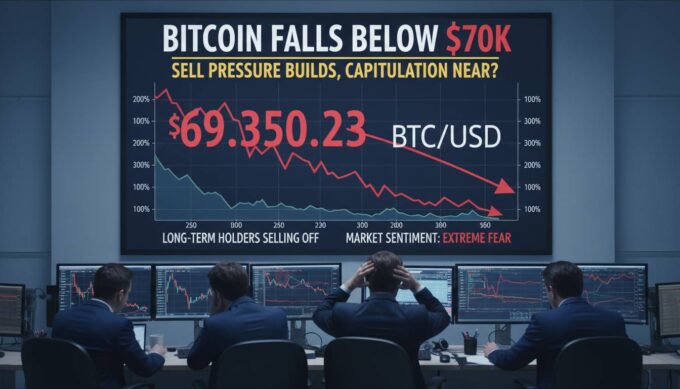
Bitcoin keeps returning to the $70,000 area even after sharp swings, and derivatives traders say that is not an accident. A large concentration of options positioning, combined with the market’s tendency to gravitate toward heavily traded strike prices ahead of expiry, has helped turn $70,000 into a powerful short-term center of gravity. The result is a market that repeatedly snaps back toward the same level, even as macro headlines, ETF flows, and risk sentiment push prices away from it.
Why Bitcoin keeps snapping back to $70k — and the $13B options “magnet” behind it
The basic explanation starts with market structure. Bitcoin options open interest has at times climbed into the low tens of billions of dollars, and one widely cited benchmark put total Bitcoin options open interest at about $13.54 billion during a major expiry period, with the vast majority concentrated on Deribit. In options-heavy markets, large open interest around a specific strike can influence hedging flows, especially as expiry approaches and dealers adjust exposure in response to spot price moves.
That does not mean options traders can simply “pin” Bitcoin wherever they want. But it does mean that when a large amount of contracts sits near a psychologically important level such as $70,000, the market can become sticky around that price. This is particularly true when spot Bitcoin is already trading close to the strike and when gamma-related hedging activity increases into weekly or monthly expirations.
The $70,000 level also matters because it is easy for traders, funds, and retail investors to anchor to it. Round numbers often become self-reinforcing support and resistance zones. When that round number overlaps with concentrated options positioning, the effect can become more visible in day-to-day price action.
How the options “magnet” works
The term “magnet” is market shorthand, not a formal rule. It usually refers to the tendency of price to drift toward a strike with heavy open interest or toward the so-called “max pain” level, where the greatest number of options expire worthless. One Cointelegraph report on a prior expiry noted that Bitcoin’s max pain level sat near the prevailing market price and described how a large expiry could restrain directional moves rather than trigger them.
In practice, the mechanism works through dealer hedging. If market makers have sold options to clients, they often hedge by buying or selling spot or futures as Bitcoin moves. Near a heavily populated strike, those hedging flows can damp volatility and pull price back toward the strike, especially late in the expiry cycle. That is why Bitcoin can rally above $70,000, fade, then rebound again toward the same zone within days. This is an inference based on how options hedging typically affects liquid markets and on reporting around Bitcoin expiry behavior.
A prior The Block report on record March expiry positioning on Deribit showed how large notional open interest clustered around a period when spot Bitcoin traded near $70,000. Deribit data cited in that report indicated that, at the time, billions of dollars’ worth of contracts would expire in the money around that spot range, even though the reported max pain level was lower. That illustrates an important point: a “magnet” does not always mean one exact number. It can also mean a broader zone where positioning is densest and hedging is most active.
Why $70,000 matters beyond derivatives
Options are only part of the story. Bitcoin’s repeated rebounds toward $70,000 also reflect the level’s role as a major technical and psychological threshold. In recent market coverage, analysts pointed to the high-$60,000 to low-$70,000 range as a key battleground for bulls and bears, with $68,700 identified as an important moving-average area and $72,000 as a breakout zone.
Macro conditions have also helped keep Bitcoin tethered to that region. On March 2, 2026, Cointelegraph reported that stronger-than-expected U.S. manufacturing data helped lift Bitcoin back toward $70,000 despite broader geopolitical uncertainty. Two days later, the same outlet reported that Bitcoin had climbed toward $72,000 as traders watched for a possible move toward $80,000. Those reports suggest that macro catalysts can push Bitcoin away from $70,000 temporarily, but the market has repeatedly treated the area as a natural re-entry point.
There is also a liquidity explanation. Large traders often place orders around obvious levels because those levels attract volume. That can make $70,000 a zone where buyers step in, short sellers take profits, and systematic traders rebalance exposure. When those spot and futures flows line up with options-related hedging, the rebound effect can look stronger than any one factor would suggest on its own. This is an inference supported by the overlap between technical reporting and options-expiry analysis.
What traders and investors should watch
For traders, the first variable is the expiry calendar. Large weekly, monthly, and quarterly expirations can change the market’s short-term behavior, especially when open interest is concentrated near current spot levels. The second is whether $70,000 remains a high-open-interest strike or whether positioning shifts higher or lower as sentiment changes.
Key signals to monitor include:
- Options open interest by strike: Heavy concentration near $70,000 can strengthen the “magnet” effect.
- Max pain estimates: These do not predict price perfectly, but they can indicate where expiry-related pressure may build.
- Spot price relative to major technical levels: Recent reporting highlighted roughly $68,700 and $72,000 as important nearby markers.
- Macro catalysts: U.S. economic data, Federal Reserve expectations, and geopolitical developments can overwhelm options effects in the short run.
Investors should also remember that a price “magnet” is usually temporary. Once contracts expire or traders roll positions forward, the center of gravity can move. A market that keeps snapping back to $70,000 one month may start gravitating toward a different strike later if open interest migrates.
The bigger significance for Bitcoin’s market maturity
The repeated focus on options positioning says something larger about Bitcoin’s evolution. The asset is no longer driven only by retail sentiment and spot exchange flows. It is increasingly shaped by institutional-style derivatives activity, where hedging, volatility pricing, and expiry mechanics matter as much as headline momentum. CME has also promoted growing liquidity and open interest in crypto derivatives, underscoring how mainstream these instruments have become.
That shift cuts both ways. On one hand, deeper derivatives markets can improve liquidity and price discovery. On the other, they can create short-term distortions that confuse investors who expect price to respond only to fundamentals. A move back to $70,000 may reflect bullish demand, but it may also reflect mechanical hedging and expiry dynamics rather than a clean directional conviction.
According to market analyses cited in crypto media, large expiries often restrain price swings rather than determine the longer-term trend. That distinction matters. The options “magnet” can explain why Bitcoin keeps revisiting $70,000, but it does not by itself determine whether Bitcoin’s next sustained move is toward $80,000 or back below the high-$60,000 range.
Conclusion
Bitcoin’s repeated rebounds toward $70,000 are best understood as the product of overlapping forces: a psychologically important round number, dense liquidity, technical relevance, and a large options market that can pull spot price toward heavily traded strikes ahead of expiry. The “$13 billion options magnet” is a useful shorthand for that dynamic, even if it oversimplifies the mechanics.
For now, $70,000 remains more than a headline number. It is a zone where derivatives positioning, trader psychology, and macro-sensitive flows meet. As long as open interest stays concentrated nearby, Bitcoin may continue to snap back there. But once positioning shifts, the market’s center of gravity can shift with it.
Frequently Asked Questions
What does the “$13B options magnet” mean for Bitcoin?
It refers to the idea that very large Bitcoin options open interest, especially near a major strike such as $70,000, can influence hedging flows and make price gravitate toward that level ahead of expiry.
Is $70,000 Bitcoin’s max pain level right now?
Not necessarily. Max pain changes by expiry date and positioning. Past reporting has shown that Bitcoin can trade near $70,000 even when the reported max pain level is lower.
Can options alone control Bitcoin’s price?
No. Options can shape short-term behavior, but macro data, ETF and fund flows, technical levels, and broader risk sentiment also matter.
Why do round numbers like $70,000 matter so much?
Round numbers attract attention, orders, and media focus. When they overlap with heavy derivatives positioning, they often become stronger support or resistance zones. This is an inference based on market behavior described in the cited reporting.
Could Bitcoin stop snapping back to $70,000 soon?
Yes. If options open interest shifts to different strikes or a major macro event changes sentiment, the market’s short-term “magnet” can move elsewhere.


















Leave a comment