



An evolving regulatory landscape and growing institutional interest are transforming crypto staking into a mainstream investment strategy. This article explores the latest developments in the U.S., offering data-backed insights, expert perspectives, and practical guidance for investors.
Regulatory Clarity Sparks Institutional Momentum
In May 2025, the U.S. Securities and Exchange Commission (SEC) issued pivotal guidance stating that “protocol staking activities” on proof-of-stake (PoS) networks do not require registration under the Securities Act . This marked a major regulatory breakthrough, easing concerns over whether staking rewards would be treated as securities.
Building on this, the U.S. Department of the Treasury and IRS released Revenue Procedure 2025‑31, effective January 1, 2026. It allows regulated funds—such as ETFs and trusts—to stake PoS assets like Ethereum (ETH), Solana (SOL), Cardano (ADA), and Avalanche (AVAX), and distribute staking rewards directly to investors without being classified as “engaged in business” for tax purposes . Treasury Secretary Scott Bessent hailed the move as a milestone for institutional innovation in digital assets .
These regulatory shifts have paved the way for institutional adoption. Morgan Stanley filed S‑1 registrations for spot ETFs that include staking mechanisms for ETH and SOL, while Grayscale’s Ethereum Staking ETF (ETHE) distributed $9.4 million in staking rewards—its first payout—covering October to December 2025 .
Staking Market Trends and Yields
Ethereum Staking: Scale and Stability
As of early 2026, approximately 35.86 million ETH—nearly 29% of the total supply—is staked across more than 1.1 million active validators . The average annual percentage yield (APY) for Ethereum staking stands at around 3.3%, combining consensus rewards and MEV (miner extractable value) income .
Yield Variations Across Networks
Staking yields vary significantly across networks:
- Ethereum: 2.8%–4.5% APY, with projected stabilization between 3%–4.5% .
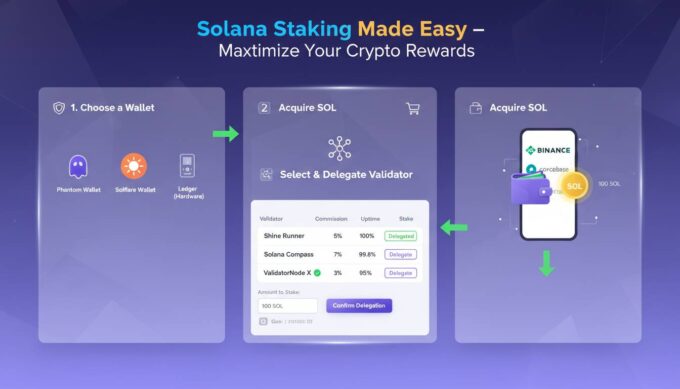
- Solana: 6.0%–7.8% APY, supported by high throughput and DeFi growth .
- Cardano: 3.8%–5.2% APY, with predictable epoch-based rewards .
- Emerging Layer‑1 networks (e.g., Avalanche, Polygon, Cosmos): 7%–13% APY, though with higher volatility and risk .
Platform-specific data from February 2026 shows ETH staking averaging 3.17% APY across eight providers, with Ankr offering the highest rate at 6.19% .
Impact on Stakeholders
Institutional Investors
Regulatory clarity and ETF integration are unlocking new opportunities for institutional investors. The ability to stake within regulated funds and receive direct rewards positions staking as a yield-generating asset class rather than speculative exposure .
Retail Investors
Retail participants benefit from rising yields and platform innovations. Liquid staking providers like Lido dominate the market, offering flexibility and accessibility . However, yield variability across networks and platforms underscores the importance of informed decision-making.
Regulators and Industry
The SEC’s guidance and IRS tax clarity signal a shift from enforcement-heavy approaches toward structured regulation. States like Vermont, South Carolina, Kentucky, and Illinois have dropped lawsuits against Coinbase over staking services, reflecting a broader regulatory easing . Industry groups such as the Crypto Council for Innovation continue advocating for adaptable, principle-based regulation .
Risks and Considerations
While staking offers attractive yields, investors should weigh several factors:
- Regulatory uncertainty: Although guidance has improved, future policy shifts could impact staking models.
- Platform risk: Centralized providers may face operational or compliance challenges.
- Network volatility: Emerging networks offer higher yields but come with greater price and protocol risk.
- Tax treatment: While ETFs benefit from capital gains treatment, individual stakers should consult tax professionals to understand implications.
Future Outlook
The convergence of regulatory clarity, institutional adoption, and technological maturity suggests a promising future for crypto staking in the U.S. Key trends to watch include:
- Expansion of staking-enabled ETFs and investment products.
- Growth in liquid and restaking services offering enhanced flexibility.
- Continued evolution of regulatory frameworks balancing innovation and investor protection.
According to Alison Mangiero, head of staking policy at the Crypto Council for Innovation, the SEC’s guidance represents a “major step forward” for the U.S. crypto industry .
Conclusion
Crypto staking is transitioning from a niche activity to a mainstream investment strategy. Regulatory developments—especially SEC guidance and IRS tax clarity—have unlocked institutional pathways, while yields across networks remain competitive. Investors must navigate platform risks, regulatory shifts, and network volatility, but the outlook for staking in the U.S. is increasingly robust. With staking becoming accessible through ETFs and liquid platforms, both institutional and retail investors can now pursue yield-generating strategies with greater confidence.
Frequently Asked Questions
What is crypto staking?
Crypto staking involves locking up tokens in a proof-of-stake blockchain to help validate transactions and secure the network. In return, stakers earn rewards, typically in the same cryptocurrency.
Are staking rewards taxed?
For individual stakers, rewards are generally treated as income and taxed accordingly. However, staking within regulated ETFs may be treated as capital gains, offering potential tax advantages .
Which networks offer the highest staking yields?
As of 2026, emerging Layer‑1 networks like Avalanche, Polygon, and Cosmos offer the highest yields (7%–13% APY), though with higher risk. Solana offers 6%–7.8%, while Ethereum and Cardano yield 2.8%–5.2% .
Can U.S. investors stake through ETFs?
Yes. New Treasury and IRS guidance allows U.S.-based ETFs to stake PoS assets and distribute rewards directly to investors .
Is staking safe?
Staking is generally secure when using reputable platforms. Risks include regulatory changes, platform failures, and network volatility. Diversification and due diligence are essential.
How much ETH is currently staked?
As of early 2026, approximately 35.86 million ETH—about 28.9% of the total supply—is staked across more than 1.1 million validators .











Leave a comment