


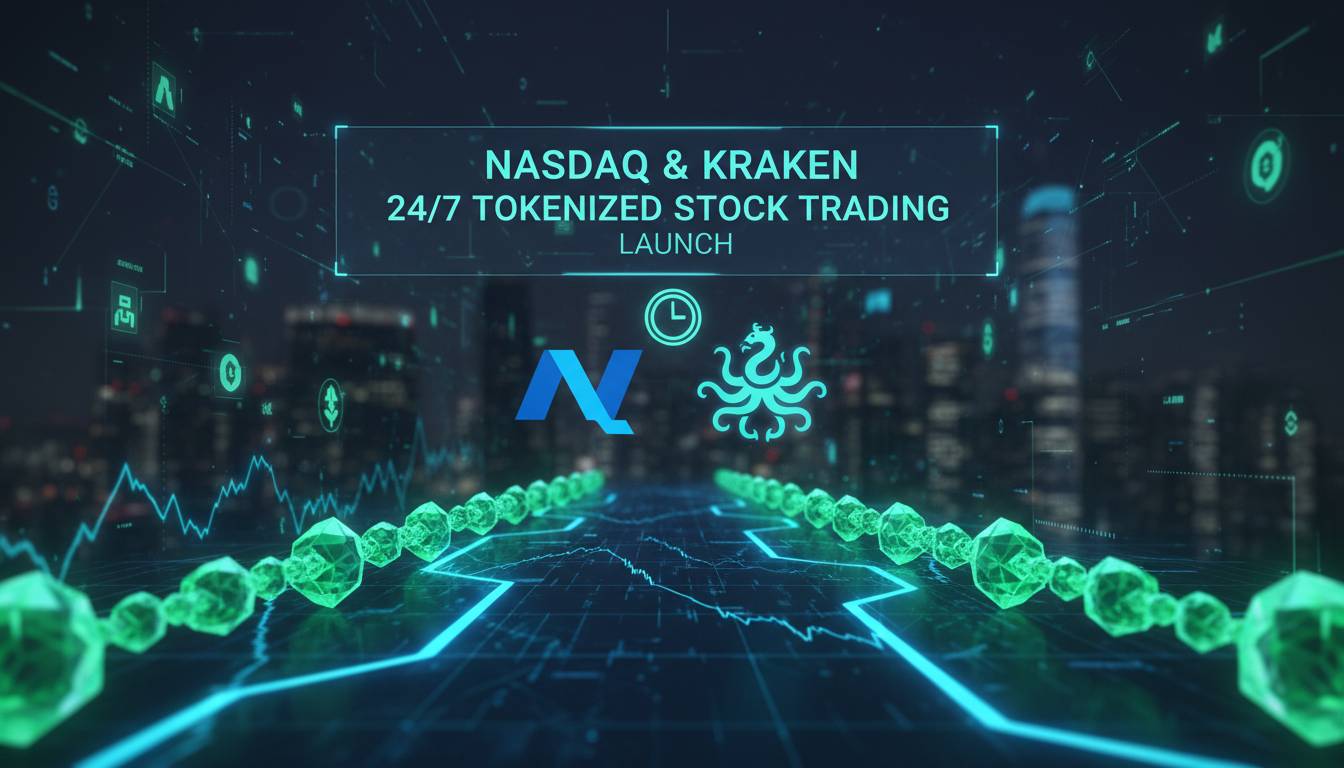
Nasdaq and Kraken are moving deeper into one of finance’s most closely watched experiments: tokenized equities. A new partnership announced on March 9, 2026, links Nasdaq’s market infrastructure with Kraken parent Payward’s blockchain-based settlement rails, with operations expected to begin in the first half of 2027. The development matters because it brings a major U.S. exchange operator into a market that has so far been led mainly by crypto-native firms, and it could reshape how investors access stocks across time zones and trading venues.
What the Nasdaq-Kraken partnership actually means
The core of the announcement is not that Nasdaq is simply listing crypto-style stock tokens tomorrow. Instead, Nasdaq and Payward say they are developing a framework for tokenized equities that is designed to preserve issuer control, fit within existing regulatory structures, and maintain the underlying rights attached to company shares. Nasdaq expects the framework and related distributed ledger services to become operational in the first half of 2027.
That distinction is important. Tokenized stocks have existed in limited forms before, but many earlier efforts struggled with regulatory uncertainty, weak market structure, or limited investor protections. In this case, the companies are presenting the project as institutional-grade infrastructure rather than a loosely structured crypto wrapper around public equities.
Under the plan, Payward will act as the primary settlement layer for Nasdaq’s equity token design in eligible jurisdictions during an initial period. Payward Services will also provide know-your-customer and anti-money-laundering onboarding compliance, according to Kraken’s announcement. That suggests the project is being built around a permissioned access model rather than a fully open, anonymous on-chain market.
For investors and market participants, the headline phrase “Nasdaq and Kraken Are Building 24/7 Tokenized Stock Trading – Launch Set for 2027” points to a broader ambition: combining traditional securities rights with blockchain-based transfer and settlement. If successful, that could allow stock-like instruments to move more efficiently across broker, exchange, and blockchain environments. This is an infrastructure story as much as a trading story.
Nasdaq and Kraken Are Building 24/7 Tokenized Stock Trading – Launch Set for 2027
The partnership builds on Kraken’s existing xStocks business, which already offers tokenized shares of U.S. stocks and ETFs to eligible non-U.S. users. On Kraken’s product page, the company says xStocks allows trading of tokenized shares 24 hours a day every weekday, and that once withdrawn to a self-hosted wallet, those assets can trade 24/7 on-chain.
Kraken and xStocks first unveiled the product in May 2025, describing a lineup of more than 55 tokenized stocks and ETFs. Coverage at the time said the offering included names such as Apple, Tesla, Nvidia, and the SPDR S&P 500 ETF, and that the service was aimed at users outside the United States.
Kraken has since argued that adoption is accelerating. In a blog post published this week, the company said xStocks has surpassed $20 billion in cumulative trading volume since its June 2025 launch, citing third-party data sources including Dune, CoinMarketCap, and RWA.xyz. Because those figures come from Kraken’s own blog, they should be viewed as company-reported performance claims, but they still indicate that tokenized equities are moving beyond proof-of-concept status.
The Nasdaq partnership gives that momentum a different level of legitimacy. Nasdaq is one of the most recognized names in global equity market infrastructure, and its involvement signals that tokenization is no longer confined to crypto startups testing the edges of securities law. It also suggests that established market operators see commercial value in programmable, always-on settlement systems.
Why 24/7 tokenized stock trading matters
Traditional U.S. stock markets still operate within fixed trading windows, even though investor demand is increasingly global and digital asset markets run continuously. Tokenized equities promise a different model by allowing investors to gain exposure to stocks in a format that can move across blockchain networks, settle faster, and potentially trade outside standard exchange hours.
Supporters argue that this could improve market access in several ways:
- Longer trading availability: Investors in Asia, Europe, and Latin America would not need to align with U.S. market hours.
- Fractional access: Tokenized formats can make it easier to buy smaller slices of high-priced shares.
- Programmable settlement: Blockchain rails can automate transfers, collateral movements, and certain compliance functions.
- Interoperability with digital finance: Assets can potentially connect with wallets, decentralized finance applications, and new custody models.
Still, 24/7 access also raises difficult questions. Price discovery in off-hours markets can be thinner, spreads can widen, and investors may face higher volatility when underlying primary exchanges are closed. There is also the issue of corporate actions, voting, dividends, and how those rights are mirrored in tokenized form across jurisdictions and custody structures. Nasdaq’s emphasis on preserving issuer control and shareholder rights appears aimed directly at those concerns.
Another challenge is regulatory alignment. Binance attempted tokenized equities in 2021 but later withdrew the product after regulatory pressure. That history explains why the Nasdaq-Kraken effort is being framed around compliance architecture from the outset.
What this means for exchanges, brokers, and issuers
For crypto exchanges, the partnership is a sign that tokenized equities may become a major competitive category. Kraken has already expanded beyond spot crypto into brokerage-style stock trading for some U.S. customers and into tokenized products abroad. A deeper relationship with Nasdaq could strengthen its position as a bridge between conventional finance and blockchain-based markets.
For traditional exchanges and brokers, the announcement increases pressure to define their own tokenization strategies. If tokenized stocks gain traction, incumbents may need to decide whether to build proprietary rails, partner with crypto infrastructure firms, or focus on regulated custody and compliance services around digital securities. Nasdaq’s move suggests that standing still is becoming less attractive.
Issuers also have a stake in the outcome. Public companies generally want any new trading format to preserve cap-table integrity, voting rights, dividend distribution, and regulatory reporting. Nasdaq says its design is intended to preserve those features, which may make tokenization more acceptable to listed companies than earlier crypto-led models.
For regulators, the project could become a test case. If it works, it may offer a blueprint for how tokenized securities can operate within existing legal frameworks rather than outside them. If it fails, critics will likely argue that the technology adds complexity without solving the core issues of market access and settlement. That debate is likely to intensify as the 2027 launch approaches.
Market context and the road to 2027
The timing of the announcement fits a broader surge in real-world asset tokenization. Over the past year, tokenized Treasury products, private credit instruments, and equity-linked tokens have drawn growing attention from both crypto firms and mainstream financial institutions. Kraken’s xStocks rollout in 2025 was one of the clearest retail-facing pushes into tokenized public equities.
More recently, Kraken introduced 24/7 perpetual futures tied to tokenized U.S. stocks, according to industry coverage published in late February 2026. Those products are different from spot tokenized equities, but they show how quickly the exchange is broadening its equity-linked digital asset offering.
The next major milestone is operational readiness in the first half of 2027. Between now and then, the market will be watching several issues closely:
- Jurisdictional scope: Which countries and investor categories will be eligible first.
- Asset coverage: Whether the system starts with a narrow set of equities or a broad universe.
- Rights management: How dividends, splits, proxy voting, and corporate actions are handled.
- Liquidity design: Whether trading will rely on centralized order books, market makers, or hybrid on-chain models.
- Regulatory treatment: How securities regulators respond in the U.S. and abroad.
According to Kraken’s announcement, the companies believe tokenization can modernize how securities are traded and settled while improving global access and operational efficiency. That is the bullish case. The more cautious view is that tokenized stocks still need to prove they can deliver deep liquidity, reliable investor protections, and clear legal treatment at scale.
Conclusion
Nasdaq and Kraken are not merely testing a crypto side project. They are building a framework that could bring tokenized equities closer to the center of regulated capital markets. With a launch targeted for the first half of 2027, the initiative combines Nasdaq’s market infrastructure with Kraken’s blockchain settlement experience and existing xStocks platform.
Whether the effort becomes a breakthrough or a limited niche product will depend on execution, regulation, and investor adoption. But the direction is clear: always-on, blockchain-enabled versions of public market assets are moving from theory toward institutional deployment. If the project succeeds, the phrase “Nasdaq and Kraken Are Building 24/7 Tokenized Stock Trading – Launch Set for 2027” may mark a turning point in how equities are issued, traded, and settled worldwide.
Frequently Asked Questions
What is the Nasdaq and Kraken tokenized stock project?
It is a partnership between Nasdaq and Kraken parent Payward to develop infrastructure for tokenized equities, with operations expected to begin in the first half of 2027. The design is intended to preserve issuer control, regulatory alignment, and shareholder rights.
Will tokenized stocks trade 24/7?
Kraken’s existing xStocks products already support 24-hour weekday trading on Kraken and 24/7 on-chain trading when held in self-custody wallets. The broader Nasdaq-linked framework is aimed at enabling tokenized equity settlement and expanded market access, though the exact trading model at launch has not yet been fully detailed publicly.
Will U.S. investors be able to use it immediately?
Publicly available details do not say that U.S. investors will have immediate access. The announcements refer to eligible jurisdictions, which suggests availability will depend on regulatory approvals and local compliance requirements.
How are tokenized stocks different from regular stocks?
Tokenized stocks are digital representations of equities or equity-linked rights on blockchain infrastructure. They can offer faster settlement, broader transferability, and extended trading access, but their legal structure, custody model, and rights handling are critical to determining how closely they match traditional shares.
Why is Nasdaq’s involvement important?
Nasdaq is a major global exchange operator and market infrastructure provider. Its participation gives tokenized equities more institutional credibility and suggests that established financial firms see blockchain-based securities infrastructure as commercially relevant.
When is the launch expected?
Nasdaq and Kraken say the framework is expected to become operational in the first half of 2027.














Leave a comment