


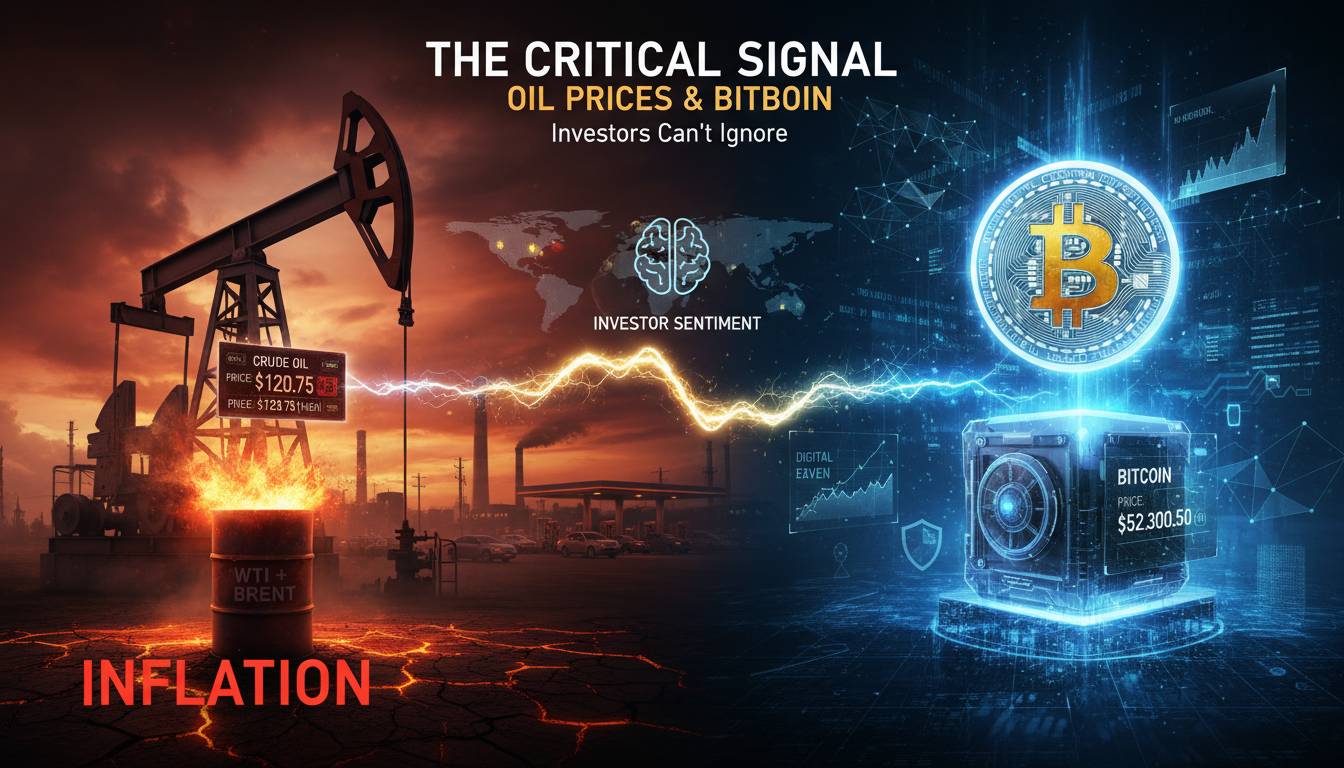
Bitcoin investors have spent the past two years fixated on two macro catalysts: US inflation data and the launch of spot exchange-traded funds. Both still matter. But a growing body of market evidence suggests another variable may now be more important in setting the tone for crypto risk appetite: oil. As Brent crude swings on geopolitics, supply decisions, and growth fears, traders are increasingly treating energy prices as a real-time signal for inflation expectations, central bank policy, and global liquidity conditions that can quickly spill into Bitcoin.
Why oil is moving back to the center of the Bitcoin trade
Oil has always mattered to financial markets, but its role has become more visible as Bitcoin has matured into a macro-sensitive asset. When crude rises sharply, investors often reassess inflation risks, bond yields, and the likelihood of tighter monetary policy. That chain reaction can pressure speculative assets, including cryptocurrencies. When oil falls because growth expectations weaken, Bitcoin can also struggle if traders interpret the move as a sign of softer global demand and reduced risk appetite. In other words, oil now influences both sides of the macro equation.
The International Energy Agency said in its January 2026 Oil Market Report that Brent crude jumped by about $6 a barrel in early January to around $66 before easing to roughly $64 as geopolitical tensions around Iran and Venezuela added uncertainty to exports. The agency also said global oil supplies could rise by another 2.5 million barrels a day in 2026 if major disruptions do not materialize. That combination of geopolitical risk and expected supply growth helps explain why oil has become a fast-moving macro barometer rather than just a commodity story.
The US Energy Information Administration has also pointed to a softer medium-term price path. In a July 8, 2025 release, the EIA said it expected Brent crude to average less than $70 per barrel in 2025 and about $58 per barrel in 2026, citing supply growth outpacing demand. For Bitcoin investors, that matters because lower oil prices can ease headline inflation pressure, potentially improving the backdrop for risk assets if the decline is driven by supply rather than recession fears.
Forget CPI and ETFs — oil prices may now be the biggest signal for Bitcoin
The case for oil as a leading Bitcoin signal rests on timing. CPI is backward-looking by design. It tells investors what inflation did last month. ETF flow data is important, but it often reflects demand that has already formed. Oil, by contrast, trades continuously and reacts immediately to war risk, shipping disruptions, OPEC+ policy, and shifts in expected economic growth. That makes it a more immediate gauge of the macro forces that later show up in inflation prints, rate expectations, and portfolio positioning.
This does not mean CPI and ETFs have become irrelevant. January 2026 CPI data from the Bureau of Labor Statistics still showed energy components moving in ways that can affect the broader inflation narrative. But oil often gives markets an earlier read on whether those pressures are likely to intensify or fade. The same is true for ETFs: spot Bitcoin funds remain a major source of structural demand, yet flows can strengthen or weaken depending on the broader macro backdrop that oil helps shape.
According to the IEA, benchmark crude prices have repeatedly reacted to trade tensions, supply changes, and inventory shifts over the past year. In April 2025, the agency said Brent futures had fallen below $60 a barrel before recovering to around $65 after some tariffs were postponed. In February 2025, it said Brent had rallied above $82 in early January before falling back toward $75 as trade tensions escalated. Those moves illustrate how oil can quickly reprice the market’s view of growth and inflation, often faster than official economic releases.
The ETF era is real, but not always decisive
Spot Bitcoin ETFs transformed market access after the SEC approved the first US spot Bitcoin ETP listings in January 2024. Those products brought in large pools of institutional and retail capital and helped anchor Bitcoin more firmly inside traditional portfolios. SEC filings and fund disclosures show that ETF demand has been a meaningful support for Bitcoin during periods of strong inflows.
Still, ETF demand does not operate in a vacuum. If oil spikes and pushes investors to price in stickier inflation or delayed rate cuts, the same institutions that buy Bitcoin through ETFs may reduce risk elsewhere or rebalance toward cash and short-duration assets. Conversely, if oil declines in an orderly way because supply improves, the macro environment can become more supportive for ETF inflows. That is why some traders now see oil as the upstream variable and ETF flows as the downstream response. This is an inference based on how macro assets interact, rather than a direct statement from any single source.
One reason this matters in 2026 is that the oil market remains unusually sensitive to policy and geopolitics. The IEA has flagged uncertainty tied to sanctioned barrels, OPEC+ quotas, and shipping patterns, while the EIA has emphasized that regional conflict can still alter the near-term price path even when the broader supply-demand balance points lower. For Bitcoin, that means macro volatility can arrive from outside the crypto ecosystem with little warning.
What investors should watch now
For investors trying to interpret the relationship between oil and Bitcoin, several indicators stand out:
- Brent crude direction: Rapid moves higher can revive inflation concerns, while sharp declines can signal either easing supply stress or weaker growth.
- OPEC+ production policy: Changes in quotas or compliance can alter the inflation outlook quickly.
- Geopolitical flashpoints: Tensions involving major producers or shipping routes can move oil before they show up in CPI.
- Rate expectations: Oil-driven inflation fears can affect Treasury yields and the expected path of Federal Reserve policy.
- ETF flow resilience: Strong inflows during oil volatility may signal deeper institutional conviction in Bitcoin.
Investors should also distinguish between “good” and “bad” oil declines. If crude falls because supply is rising faster than demand, as the EIA expects over the medium term, that can reduce inflation pressure without necessarily damaging risk sentiment. If crude falls because the market is pricing in a sharper slowdown, Bitcoin may not benefit even if inflation cools.
What this means for Bitcoin in 2026
The biggest implication is that Bitcoin is increasingly trading like a macro asset with a crypto-specific demand engine layered on top. ETF flows, halving dynamics, and on-chain trends still matter. But oil may now offer the cleaner first signal for how the broader market will interpret inflation, growth, and policy over the coming weeks. That is especially true when CPI data is lagged and ETF flows are reactive.
A balanced view is essential. Oil is not a perfect predictor of Bitcoin, and crypto still responds to regulation, exchange activity, derivatives positioning, and company-specific news. Yet the evidence from the past year suggests that energy prices are once again shaping the macro narrative that surrounds digital assets. For US investors, the practical takeaway is simple: watching Bitcoin alone is no longer enough. Watching oil may offer an earlier clue about where Bitcoin sentiment goes next.
Conclusion
Bitcoin’s market story is no longer driven by a single headline or one policy release. CPI remains important, and spot ETFs remain a structural force. But oil prices now sit closer to the front of the signal chain because they move first, react instantly to geopolitical and supply shocks, and influence the inflation and rate expectations that shape demand for risk assets. If that pattern holds through 2026, crude may become one of the most important charts in every serious Bitcoin investor’s toolkit.
Frequently Asked Questions
Why do oil prices affect Bitcoin?
Oil influences inflation expectations, bond yields, and views on central bank policy. Those factors can change investor appetite for risk assets, including Bitcoin.
Are CPI reports no longer important for Bitcoin?
They are still important, but CPI is backward-looking. Oil often moves earlier and can signal where inflation expectations may head before official data is released.
Do spot Bitcoin ETFs still matter?
Yes. Spot ETFs remain a major channel for institutional and retail demand, but their flows can be influenced by the broader macro environment.
What oil benchmark should Bitcoin investors watch?
Brent crude is widely used as a global benchmark, and it is frequently cited by the IEA and EIA in market analysis and forecasts.
Can falling oil prices be bullish for Bitcoin?
Sometimes. If oil falls because supply improves and inflation pressure eases, that can support risk assets. If it falls because growth fears intensify, Bitcoin may still come under pressure.



















Leave a comment