


Crypto staking is gaining momentum in the United States as a reliable avenue for passive income. With new regulatory clarity and institutional interest, staking is evolving from niche to mainstream. This article explores the latest developments, staking yields, regulatory shifts, and what U.S. investors need to know to participate safely and effectively.
Regulatory Clarity Fuels Growth in Crypto Staking
In May 2025, the U.S. Securities and Exchange Commission (SEC) issued guidance clarifying that certain forms of crypto staking—such as solo staking, delegated staking, and custodial staking tied directly to a network’s consensus process—do not constitute securities offerings under the Howey Test . This marked a pivotal shift, reducing legal uncertainty for validators, node operators, and retail or institutional stakers .
Further reinforcing this progress, the U.S. Department of the Treasury and the Internal Revenue Service (IRS) issued Revenue Procedure 2025‑31, effective January 1, 2026. This allows crypto ETFs and trust funds to stake Proof-of-Stake (PoS) assets like Ethereum, Solana, and Cardano and distribute staking rewards to investors under the Investment Company Act of 1940 . Treasury Secretary Scott Bessent called it a milestone for innovation, positioning staking as a structured yield-generating opportunity within traditional finance .
These regulatory developments are transforming crypto staking from a speculative activity into a credible investment model, opening the door for institutional capital and broader retail participation.
Staking Yields and Market Trends in 2026
Ethereum Staking Landscape
As of early 2026, approximately 35.86 million ETH—about 28.9% of the total supply—is staked across the network, supported by over 1.1 million active validators . Average annual yields for Ethereum staking hover around 3.3% APY, with some providers offering up to 6.19% .
Broader Staking Yields
Staking yields vary across networks:
- Solana (SOL): ~6.8% APY
- Cardano (ADA): 2.4–5% APY
These rates reflect a maturing staking ecosystem where yields are stabilizing post-merge and across major platforms .
Liquid Staking and Restaking Growth
Liquid staking and restaking are gaining traction. In Q2 2025, liquid staking accounted for roughly 27% of total DeFi TVL (~$124 billion), and by Q3, staking plus restaking exceeded 45% of TVL on Ethereum-equivalent networks . Lido leads with a TVL of around $41 billion, followed by Binance Staked ETH (~$14.8 billion) and Rocket Pool (~$3.2 billion) .
Institutional Adoption
Institutional interest is rising. Surveys show that 67% of professional investors plan to increase crypto holdings in 2025 . The regulatory clarity and yield potential are key drivers of this trend.
Impact on Stakeholders
Retail Investors
For U.S. retail investors, staking offers a way to earn passive income without running a node. With yields ranging from 3% to 6%, staking is increasingly competitive with traditional savings products. Liquid staking adds flexibility, allowing users to maintain liquidity while earning rewards .
Institutional Investors
The ability of ETFs and trust funds to stake PoS assets and distribute rewards under clear tax treatment is a game-changer. It enables institutional investors to integrate staking into portfolios, enhancing yield while maintaining regulatory compliance .
Network Security
Higher staking participation strengthens network security. Ethereum’s nearly 29% staked supply and over a million validators contribute to decentralization and resilience . Liquid staking further amplifies this by enabling more capital to be deployed across DeFi applications .
Risks and Considerations
- Slashing and penalties: Validators may lose part or all of their stake for protocol violations .
- Platform risk: High APYs, such as promotional offers (e.g., 55% APY), often come with elevated risk and require careful due diligence .
- Tax implications: Staking rewards are taxable as ordinary income when received .
- Regulatory uncertainty: While current guidance is favorable, future changes could impact staking models.
Future Outlook
- ETF expansion: Expect more staking-enabled ETFs and ETPs to launch in 2026, offering broader access to staking yields.
- Liquid staking innovation: Continued growth in liquid staking and restaking will drive DeFi integration and capital efficiency.
- Regulatory evolution: Ongoing policy developments, including stablecoin regulation under the GENIUS Act, may influence staking indirectly .
- Institutional inflows: As regulatory clarity and infrastructure improve, institutional capital is likely to flow into staking products.
Conclusion
Crypto staking is entering a new era in the U.S., driven by regulatory clarity, institutional adoption, and evolving market infrastructure. With average yields between 3% and 6%, staking offers a compelling passive income opportunity. Liquid staking and ETF integration are enhancing accessibility and liquidity. However, investors must remain vigilant about risks, including slashing, platform reliability, and tax obligations. As staking becomes a mainstream financial tool, it promises to reshape how Americans earn yield in the digital asset economy.
Frequently Asked Questions
What is crypto staking?
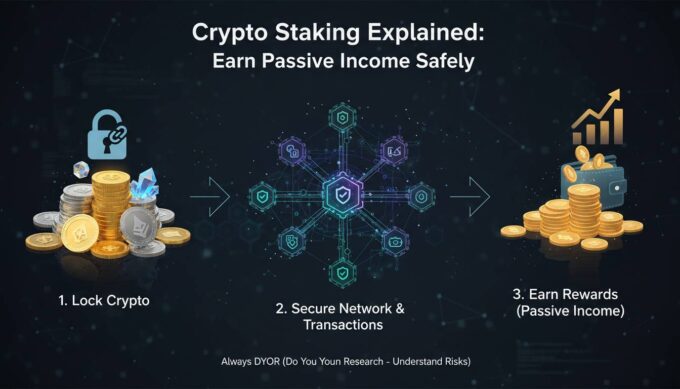
Crypto staking involves locking up PoS tokens to support blockchain operations. In return, participants earn rewards, similar to earning interest on savings.
Are staking rewards taxable?
Yes. In the U.S., staking rewards are considered ordinary income when received and must be reported accordingly .
Can ETFs stake crypto and distribute rewards?
Yes. As of January 1, 2026, U.S. ETFs and trust funds can stake PoS assets like ETH, SOL, and ADA and distribute rewards to investors under Revenue Procedure 2025‑31 .
What are typical staking yields?
Ethereum staking yields average around 3.3% APY, with some providers offering up to 6.19%. Solana yields are around 6.8%, and Cardano ranges from 2.4% to 5% .
What is liquid staking?
Liquid staking allows users to stake assets while retaining liquidity via derivative tokens. It enables participation in DeFi and other yield strategies without losing staking benefits .
What risks should investors consider?
Risks include slashing penalties, platform reliability, tax obligations, and potential regulatory changes. High-yield offers may carry elevated risk and require careful evaluation.

















Leave a comment