


The Bitcoin halving is a pivotal event in the cryptocurrency world, and its latest iteration in April 2024 continues to shape market dynamics and mining economics. This article explores what the halving entails, its significance for stakeholders, and its broader implications for the U.S. market.
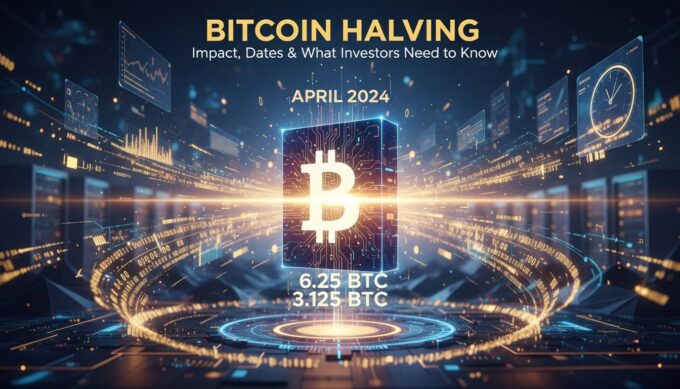
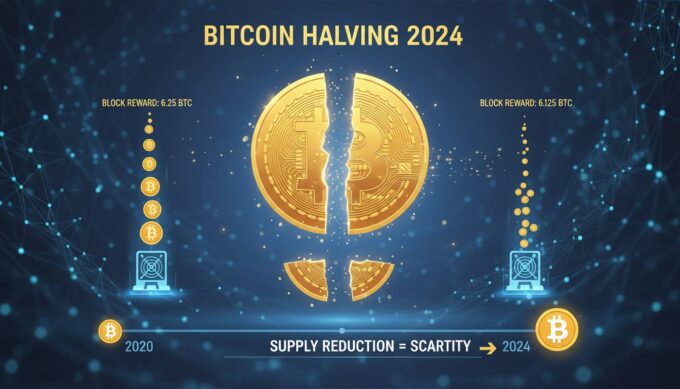
Bitcoin halving is a programmed event that reduces the block reward for miners by 50% approximately every four years, or every 210,000 blocks. The most recent halving occurred on April 20, 2024, cutting the reward from 6.25 BTC to 3.125 BTC per block . This mechanism enforces scarcity, slows the rate of new Bitcoin issuance, and reinforces its deflationary design .
How Bitcoin Halving Works
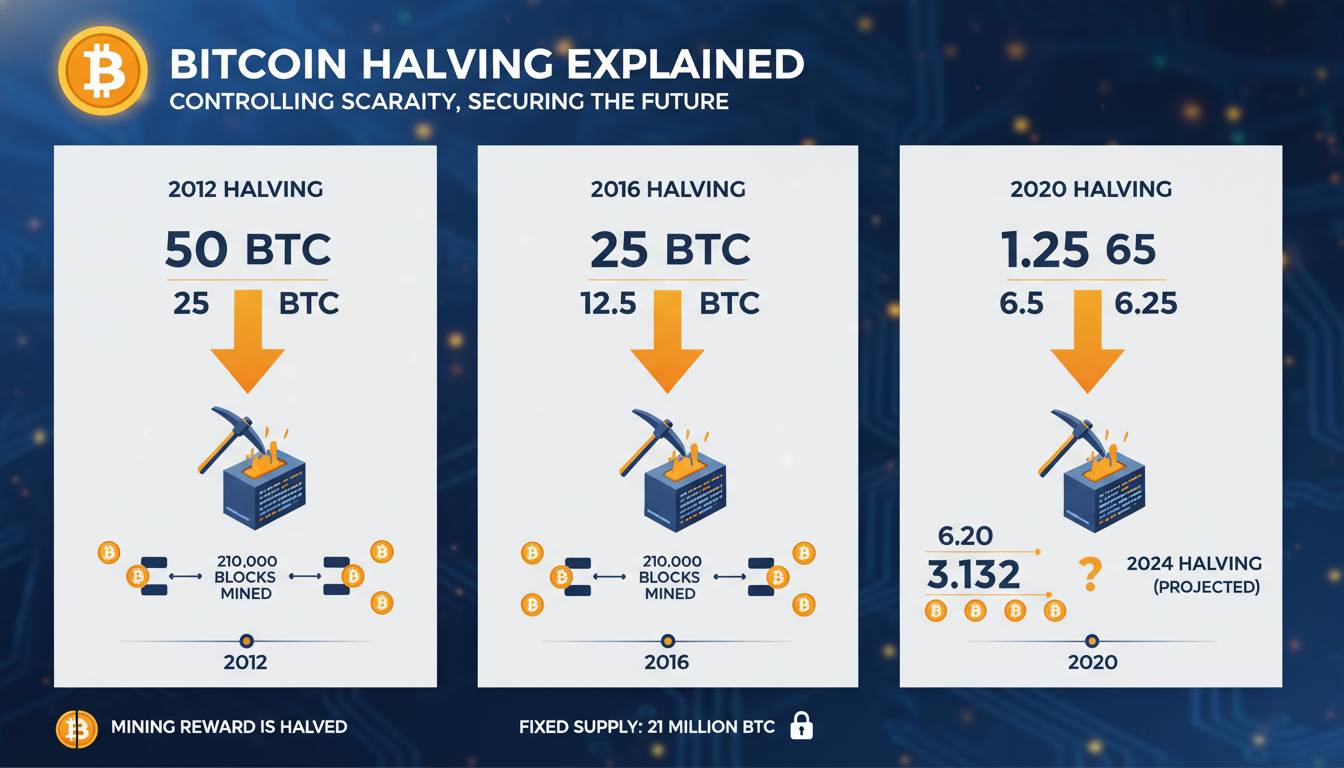
Bitcoin’s protocol is designed to halve the block reward every 210,000 blocks, which equates to roughly four years given the average block time of 10 minutes . The reward began at 50 BTC in 2009 and has since decreased through successive halvings: to 25 BTC in 2012, 12.5 BTC in 2016, 6.25 BTC in 2020, and now 3.125 BTC post-2024 .
This halving mechanism ensures that Bitcoin’s total supply remains capped at 21 million coins. As of 2026, approximately 19.8 million BTC have been mined, leaving just 1.2 million BTC yet to enter circulation .
Significance of the 2024 Halving
Supply and Scarcity
The halving slashes the daily issuance of new Bitcoin from around 900 BTC to 450 BTC . This sharp reduction in supply, if met with steady or growing demand, can exert upward pressure on price. The stock-to-flow ratio—a measure of existing supply relative to annual production—has surged post-2024 halving, surpassing gold’s scarcity level .
Mining Economics
Miners face immediate revenue cuts due to the halved block reward. To remain profitable, they must rely on improved hardware efficiency, lower energy costs, or rising Bitcoin prices . In the U.S., where hosting costs are relatively high (around $0.08/kWh), many miners are upgrading to more efficient models like Bitmain’s S21 series .
Despite initial concerns, the network’s hashrate dipped only briefly after the halving. Difficulty adjustments helped restore profitability, and hashrate resumed its upward trend as miners deployed more efficient hardware .
Market Psychology and Price Dynamics
Historically, halvings have preceded substantial bull runs: Bitcoin gained approximately 9,300% after the 2012 halving, 3,200% after 2016, and 700% after 2020 within 18–24 months . However, the 2024 halving occurred amid a unique backdrop: the rise of spot Bitcoin ETFs and macroeconomic uncertainty.
Some analysts caution that the halving’s impact may already be priced in. JPMorgan and Goldman Sachs have warned of potential post-halving price softness, citing overbought conditions and limited venture capital inflows . Arthur Hayes, co-founder of BitMEX, warned of possible selling pressure around the halving, driven by U.S. tax season liquidity drains and entrenched bullish sentiment .
Broader Implications for the U.S. Market
Institutional Demand and ETFs
The U.S. market has seen significant institutional interest, particularly through spot Bitcoin ETFs launched in early 2024. These funds have attracted substantial inflows, with ETFs reportedly purchasing around 2,500 BTC daily—far exceeding the 900 BTC daily issuance before the halving . This demand-supply imbalance may amplify scarcity effects.
Miner Consolidation and Geographic Shifts
The halving has accelerated consolidation among miners. Less efficient operations are exiting, while larger players with access to cheap energy and capital markets are expanding . Additionally, mining is becoming more geographically diversified, with U.S. miners exploring opportunities in regions like Latin America and Africa to reduce costs .
Network Security and Transaction Fees
As block rewards decline, transaction fees are expected to play a larger role in miner compensation. This shift underscores the importance of network activity and fee markets in sustaining security over time .
Analysis and Outlook
The 2024 halving reinforces Bitcoin’s deflationary design and scarcity narrative. While historical patterns suggest bullish outcomes, the current environment—marked by ETF-driven demand, macroeconomic pressures, and evolving miner economics—introduces uncertainty.
Institutional demand via ETFs may amplify scarcity, but overbought conditions and liquidity constraints could temper immediate gains. Miner consolidation and hardware upgrades are reshaping the industry, while transaction fees are becoming increasingly vital to network sustainability.
Looking ahead, the next halving is projected for 2028, when block rewards will fall to 1.5625 BTC . By then, institutional adoption, regulatory developments, and technological advancements will likely play even greater roles in shaping Bitcoin’s trajectory.
Conclusion
Bitcoin halving remains a cornerstone of its economic model, enforcing scarcity and influencing market cycles. The April 2024 halving has heightened supply constraints, challenged miners, and catalyzed institutional interest in the U.S. While historical trends suggest long-term bullish potential, short-term outcomes depend on broader market dynamics and investor behavior. As the ecosystem evolves, halvings will continue to serve as critical inflection points in Bitcoin’s journey.
Frequently Asked Questions
What is Bitcoin halving?
Bitcoin halving is a pre-programmed event that cuts the block reward for miners by 50% every 210,000 blocks, approximately every four years. The most recent halving occurred on April 20, 2024, reducing the reward from 6.25 BTC to 3.125 BTC .
Why does Bitcoin halving matter?
Halving enforces scarcity by reducing new supply, which can drive price appreciation if demand remains steady. It also pressures miners to improve efficiency and shifts the network toward fee-based incentives .
How does halving affect miners?
Miners face a 50% drop in block rewards, which can squeeze profitability. To adapt, they upgrade to more efficient hardware, seek lower energy costs, or rely on rising Bitcoin prices. Inefficient miners may exit the market .
Has halving historically led to price increases?
Yes. After the 2012, 2016, and 2020 halvings, Bitcoin experienced significant bull runs—gains of 9,300%, 3,200%, and 700%, respectively, over the following 18–24 months .
Could the 2024 halving lead to a price drop?
Some analysts, including JPMorgan and Arthur Hayes, warn that the halving’s effects may already be priced in, and that liquidity constraints or tax season dynamics could trigger short-term selling pressure .
When is the next Bitcoin halving?
The next halving is projected for around April 2028, when block rewards will fall to 1.5625 BTC per block .















Leave a comment