


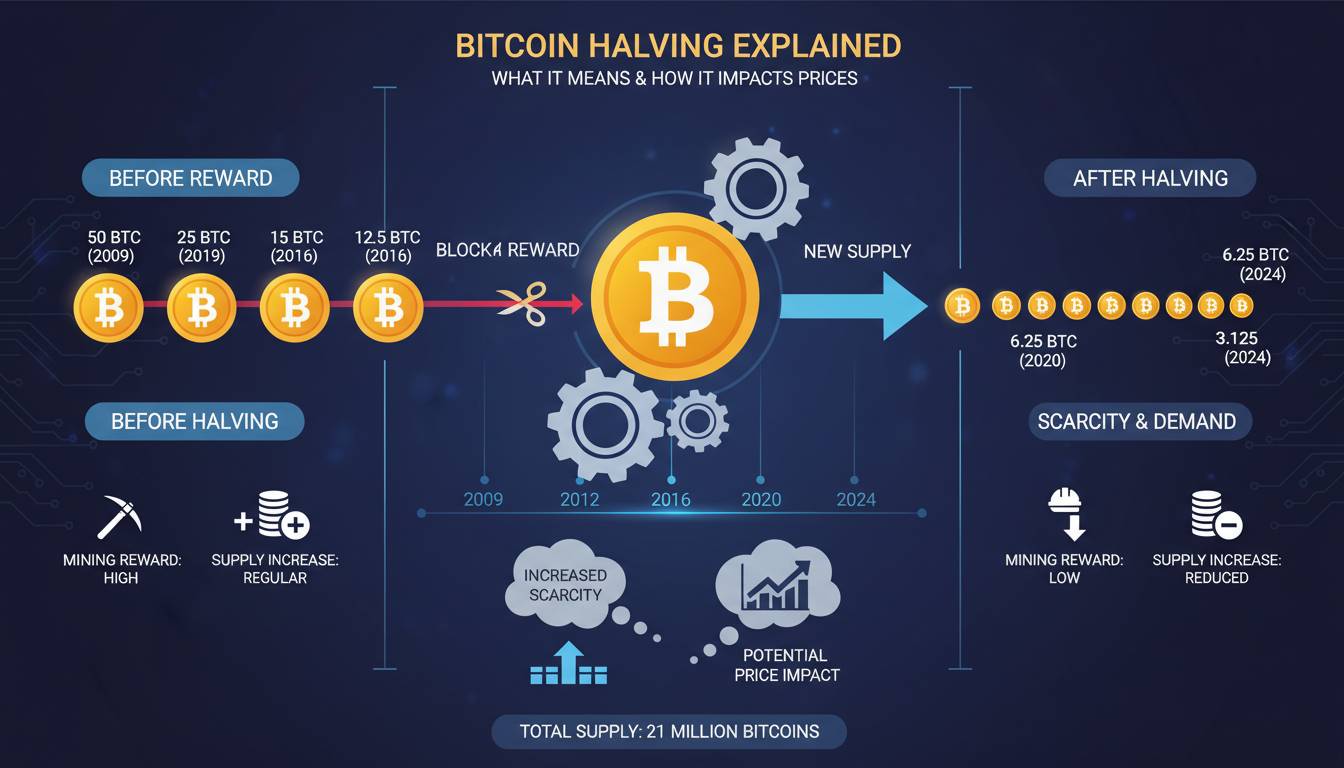
Bitcoin halving is a pivotal event in the cryptocurrency world that reduces the reward miners receive for validating transactions. This article explores the mechanics of halving, its historical and projected impacts on price, mining dynamics, and broader market implications—especially for U.S. investors.
Understanding Bitcoin Halving
Bitcoin halving occurs approximately every 210,000 blocks—roughly every four years—when the reward for mining a new block is cut in half. This mechanism is embedded in Bitcoin’s protocol to control inflation and cap the total supply at 21 million coins .
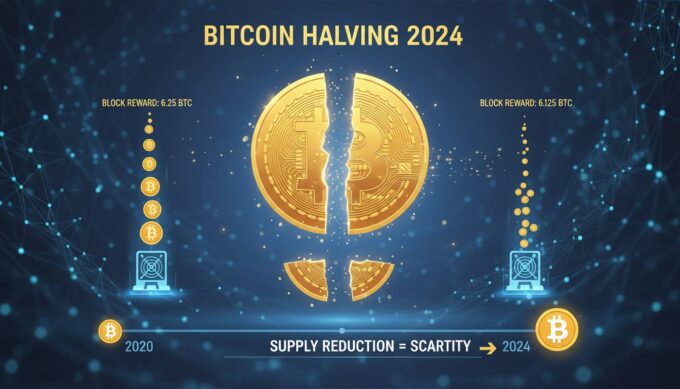
The most recent halving took place in April 2024, reducing the block reward from 6.25 BTC to 3.125 BTC . The next halving is projected for mid‑April 2028, when the reward will drop further to 1.5625 BTC per block .
Historical Price Trends After Halvings
Bitcoin halvings have historically preceded significant price rallies, though the magnitude has varied across cycles:
- 2012 Halving: Price surged from around $12 to over $1,000 within a year—an increase of approximately 8,200% .
- 2016 Halving: Price rose from about $650 to $19,000 by late 2017—roughly 285% growth .
- 2020 Halving: Price climbed from around $8,600 to over $60,000 in 2021—about a 600% increase .
- 2024 Halving: As of mid‑2025, Bitcoin’s price increased from ~$60,000 to ~$109,800—an 83% gain .
A broader analysis shows diminishing returns over time: 8,858% gain after the first halving, 294% after the second, 540% after the third, and a more modest 31% gain following the fourth halving (ongoing as of mid‑2025) .
Why Halving Matters: Supply Shock and Market Psychology
Halving events create a sudden reduction in new Bitcoin supply, reinforcing scarcity. If demand remains steady or increases, economic theory suggests upward price pressure .
Moreover, halving events often generate heightened market sentiment and media attention, fueling speculative interest. Institutional adoption—such as the launch of Bitcoin ETFs—can amplify these effects. For instance, ETFs managed by BlackRock and Fidelity have attracted over $12 billion in inflows, purchasing around 2,500 BTC daily—far exceeding the ~900 BTC newly mined per day before the 2024 halving .
Mining Economics and Network Effects
Halving directly impacts miners by cutting their block rewards in half. This can render operations unprofitable for those with high energy costs, potentially leading to shutdowns and reduced network hash rate .
However, technological improvements and rising transaction fees can help offset these losses. As miners adapt, the network remains secure, though the shift underscores the importance of efficiency and fee-based revenue .
Evolving Market Dynamics: Demand vs. Supply
Recent research suggests that the halving’s impact on price may be diminishing. CryptoQuant reports that long-term holders are accumulating Bitcoin at rates far exceeding new issuance—holding about 200,000 BTC per month versus ~28,000 BTC issued pre-halving, and ~14,000 BTC post-halving .
A causal study using synthetic control methods found that the 2024 halving contributed positively to price three months later—but accounted for only one-fifth of the total price change between April 2023 and July 2024 . This suggests that while halving remains a factor, demand-side forces are increasingly dominant.
Looking Ahead: The 2028 Halving and Beyond
The next halving, expected in April 2028, will reduce the block reward to 1.5625 BTC . As Bitcoin’s circulating supply grows, the relative impact of halving may diminish. Yet, scarcity remains a core narrative.
Institutional adoption, regulatory clarity, and macroeconomic conditions will likely shape future price dynamics more than halving alone . Some analysts caution that while halving events historically align with bull markets, they also bring volatility and risk .
Conclusion
Bitcoin halving is a foundational mechanism that enforces scarcity by reducing miner rewards every four years. Historically, halvings have preceded substantial price rallies, though gains have diminished over time. The 2024 halving saw an 83% price increase within a year, while institutional demand and ETF inflows played a significant role.
Mining economics shift post-halving, favoring efficient operations and fee revenue. Meanwhile, demand—especially from long-term holders—has become a stronger price driver than supply constraints alone.
Looking ahead to 2028, halving will remain a key event, but its impact will be shaped by broader market maturity, regulatory developments, and macroeconomic trends. For U.S. investors, understanding these dynamics is essential for navigating Bitcoin’s evolving landscape.
Frequently Asked Questions
What is Bitcoin halving?
Bitcoin halving is a protocol event that cuts the block reward for miners in half every 210,000 blocks—approximately every four years—to control inflation and cap total supply at 21 million BTC.
When did the last halving occur, and when is the next one?
The most recent halving occurred in April 2024, reducing the reward to 3.125 BTC. The next halving is projected for mid‑April 2028, when the reward will drop to 1.5625 BTC .
How does halving affect Bitcoin’s price?
Halving reduces new supply, creating scarcity. Historically, this has led to significant price increases—ranging from hundreds to thousands of percent—but gains have diminished with each cycle .
Do halvings guarantee price increases?
No. While halvings often precede rallies, they also bring volatility. Recent research shows demand-side factors—like long-term holder accumulation and institutional inflows—play a larger role in price movements .
How do halvings impact miners?
Halvings reduce miner rewards, which can hurt profitability for less efficient operations. Some miners may shut down, reducing network hash rate. However, improvements in technology and transaction fees can help offset losses .
Why is the 2028 halving significant?
As Bitcoin matures, the relative impact of halving may lessen. The 2028 event will occur in a more developed market with greater institutional participation and regulatory clarity—factors likely to shape its effects more than supply shock alone .
This article provides a comprehensive, up-to-date overview of Bitcoin halving—its mechanics, historical impact, and future implications—tailored for U.S. readers seeking clarity on this critical crypto event.
















Leave a comment