


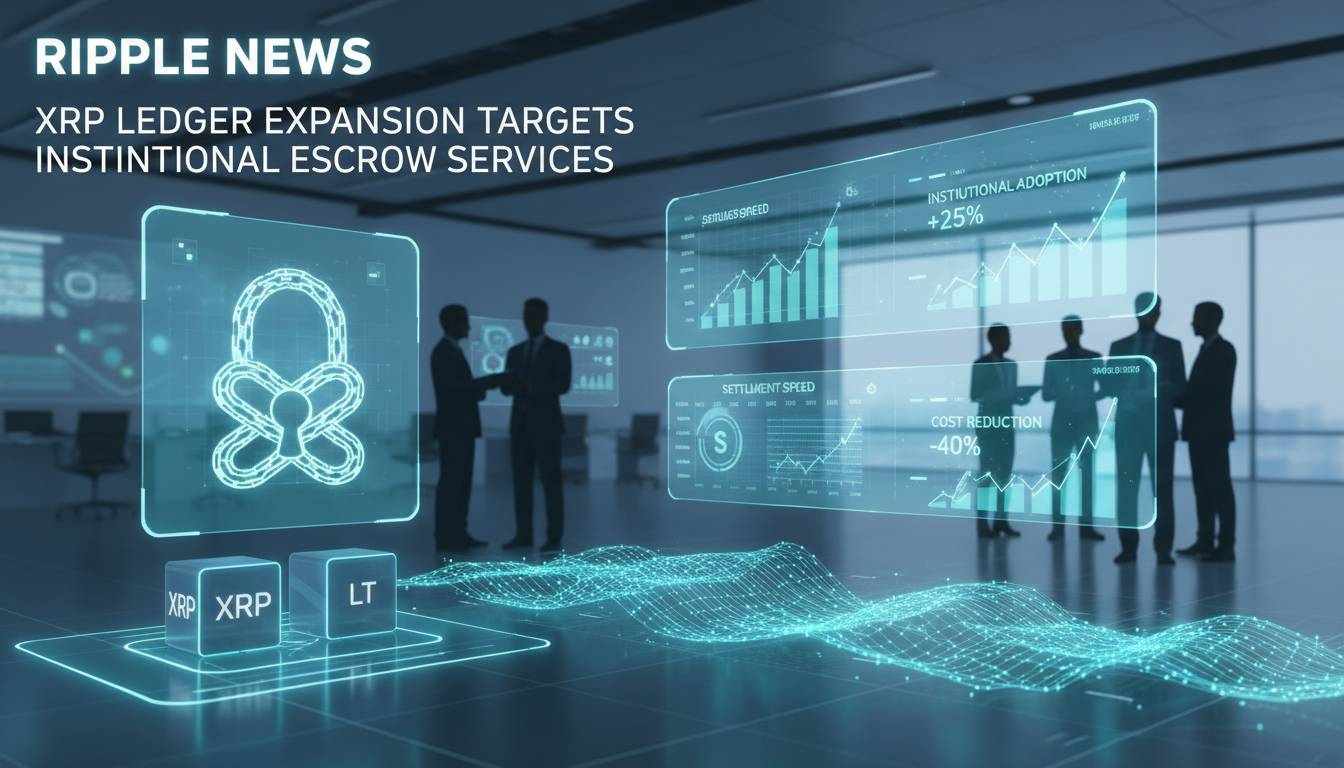
This article explains how the XRP Ledger (XRPL) has expanded its escrow capabilities to support institutional finance through native, conditional token escrows. It focuses on how these developments empower regulated settlements, stablecoin workflows, and real-world asset (RWA) tokenization.
Introduction: A Clear Answer, Fast
The XRP Ledger has expanded its escrow service beyond XRP to include issued tokens like stablecoins and real‑world assets. This upgrade—known as the XLS-85 amendment—enables native, programmable, on‑chain escrow for trustline tokens and Multi‑Purpose Tokens (MPTs). It paves the way for institutional, compliant settlement without relying on clunky third-party tools.
Why Institutions Care: Escrow for Everything
Escrow Beyond XRP Unlocks New Use Cases
With XLS‑85, issuers can lock token assets time‑based or condition‑based. This includes stablecoins, tokenized treasuries, and other RWAs, bringing trust-minimized, secure settlement on-chain. Institutions can design vesting schedules, structured payouts, or compliance-driven flows natively.
Conditional Logic but Lightweight
Upgrades like “smart escrows” amplify this further. They imbue escrow entries with light on-chain logic, like price or oracle-based triggers—no heavy smart contracts needed. This maintains XRPL’s speed while allowing for automated vendor payments and collateral flow automation.
Complementary Enhancements: Building the Institutional Toolkit
Permissioned DEXs and Governance
Permissioned DEXs now allow issuers and participants to enforce access controls—crucial for meeting compliance standards. This complements escrow by keeping transaction environments regulated and transparent.
Credentials, Deep Freeze, and Privacy
Complementary tools like Credentials (DID-linked identity attestations) and Deep Freeze (locking suspicious accounts) enable compliance-aware participation. Privacy enhancements such as zero-knowledge proofs are in testing, aiming to balance auditability with confidentiality.
Real-World Momentum: Adoption in Action
-
Institutional Escrow in Motion
The new escrow features support sophisticated workflows—issuers can hold, conditionally release, or claw back assets as needed. This is a game-changer for regulated token use. -
Stablecoins and Tokenized Assets on XRPL
Major launches, including USDC, RLUSD, and tokenized treasuries (e.g., Ondo Finance’s OUSG), are already live, proving XRPL is more than talk—it’s infrastructure. -
Smart Escrow Use-Cases Brewing
The community is testing uses like price‑based payments, collateralized lending, and automated settlements—an entirely new tier of institutional workflows enabled natively.
What This Means for XRP and Token Economics
XRP Demand Could Rise
Every escrow on XRPL requires a native reserve (e.g., 0.2 XRP per escrow). As the number of token escrows multiplies across stablecoins and RWAs, demand for XRP may grow to support network activity.
Supply Discipline Reinforces Institutional Trust
Ripple’s escrow mechanisms—even beyond this upgrade—are mature. Time‑locked releases, re-escrows, and monthly predictable schedules make supply transparent. Institutions value that.
Expert Insight
“From stablecoins like RLUSD to Real World Assets, the XRPL now supports secure, conditional, on‑chain settlement for all assets.”
— RippleX official statement
This underscores Ripple’s push: not just technical updates, but institutional-grade building blocks.
Summary: XRPL Is Becoming Institutional-Ready
The XLS‑85 escrow upgrade is not just code—it’s foundation-level infrastructure for institutional token finance. With programmable escrows for issued tokens, permissioned exchanges, identity tools, privacy features, and predictable token economics, XRPL is positioning itself as a top-tier chain for regulated, real-world asset finance.
Native escrow—paired with these governance and compliance features—means institutions can settle, tokenize, lend, and trade in a trusted environment. The path is clear: XRPL is building toward a future where regulated on‑chain finance is seamless and native.
FAQs
What does the XLS‑85 upgrade do?
It expands native escrow to include trustline tokens and Multi-Purpose Tokens, enabling time-based and conditional on-chain settlement for issued assets.
Why is escrow important for institutions?
Escrow ensures funds are released only under predetermined conditions, improving trust and control. It matters for settlement, vesting, compliance, and tokenized assets.
Do token escrows require XRP?
Yes—issuers must set aside a small XRP reserve for each escrow, which may drive native token demand.
How does this differ from smart contracts?
Smart escrows embed lightweight logic (like price triggers) directly into blockchain-native escrow objects—simpler, faster, and more efficient than heavyweight smart contracts.
What else supports institutional use on XRPL?
Features like permissioned DEXs, identity-based Credentials, Deep Freeze mechanisms, privacy via ZK proofs, and lending/vault systems all converge to create a comprehensive institutional infrastructure.






















Leave a comment