


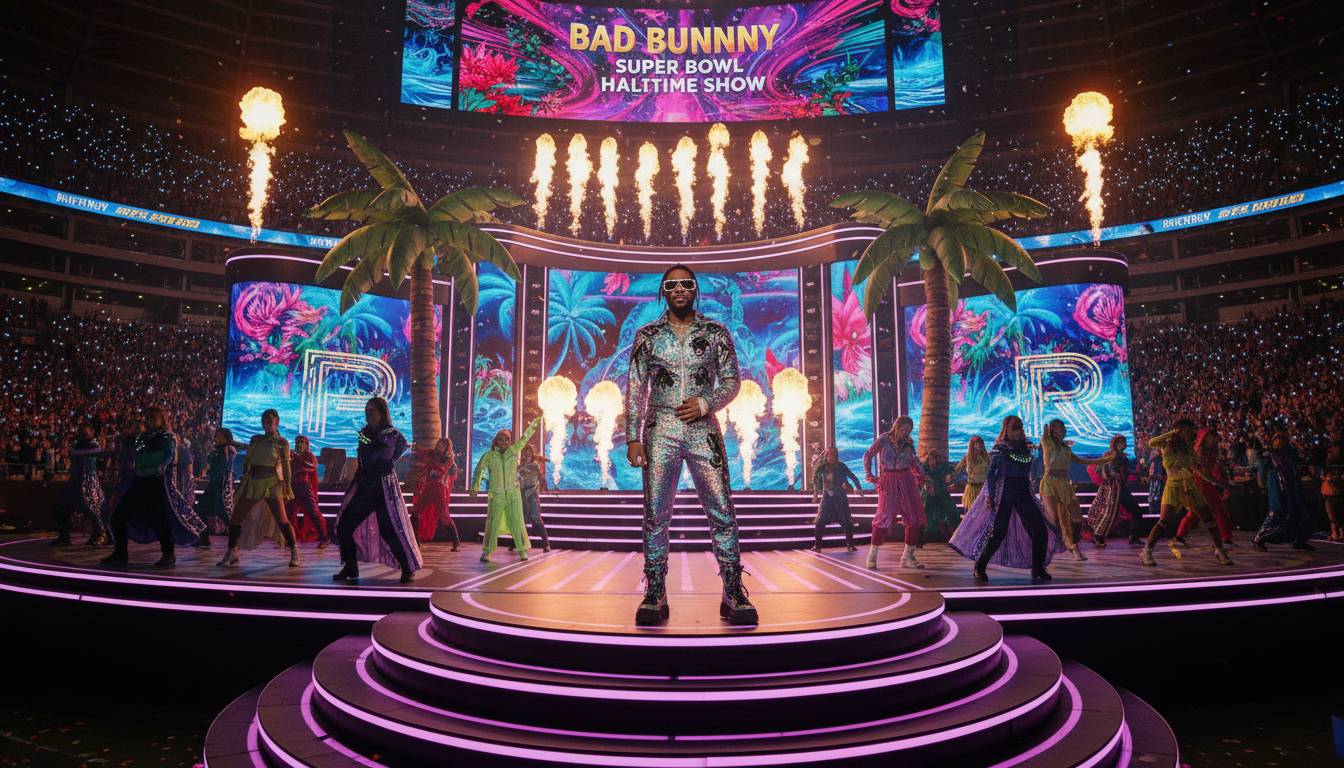
Bad Bunny’s Super Bowl LX halftime show was a vibrant, culturally rich spectacle that made history as the first time the Super Bowl featured a mostly Spanish-language performance by a solo Latino artist. It drew massive viewership, sparked spirited reactions across the political and cultural spectrum, and left a lasting impact cross‑platform. Here’s a breakdown of what happened, what it meant, and how fans responded.
Historic Firsts and Standout Moments
Milestone Performances in Spanish
Bad Bunny made Super Bowl history by performing almost entirely in Spanish, the first solo Latino artist to do so as a halftime headliner . Clad in a cream-colored jersey labeled “OCASIO” with the number 64, he paid tribute to his late uncle, his early NFL inspiration . The creative staging—even a sugar cane field, street vendors, domino players, and a real wedding—immersed viewers in Puerto Rican life at Levi’s Stadium .
Guest Stars and Cultural Homages
Surprise appearances from Lady Gaga and Ricky Martin elevated the performance. Gaga offered a salsa twist on “Die With a Smile,” while Martin joined for “Lo Que Le Pasó a Hawaii.” Other celebrities—Karol G, Cardi B, Pedro Pascal, and Jessica Alba—dropped in during a lively “casita” scene . These moments reinforced the show’s festive, community spirit.
A Creative, Symbolic Production
The show featured a mix of narrative vignettes showcasing Puerto Rican culture. From coconut vendors to jewelers and boxers, dancers in pajá hats, and a staged wedding, the performance unfolded like a mini-documentary of everyday life. It ended on a powerful note: Bad Bunny raised an inscribed football reading “Together We Are America,” surrounded by flags of Latin American nations .
Metrics, Reach, and Streaming Surge
Massive Viewership Across Platforms
The halftime show attracted 128.2 million viewers, marking the fourth-largest halftime audience in Super Bowl history . It became a record draw not just on NBC, but also on Telemundo, reaching 4.8 million Spanish-language viewers—both milestone figures .
Social Media and Streaming Explosion
Total social consumption of the show soared to 4 billion views within 24 hours—a staggering year-over-year increase of 137% . Streaming numbers followed suit: in the U.S., Spotify streams spiked around 470%, and globally about 210%. “Yo Perreo Sola” surged more than 2,100%, while “El Apagón” rose over 1,300% . Apple Music charts were also flooded: 23 songs made the Top 100, nine landed in the Top 25, and five cracked the Top 10 with “DTMF” hitting number one .
Political Themes and Cultural Significance
A Statement on Identity
The performance embraced Puerto Rican culture—not just as an artistic expression, but as a political one. Bad Bunny’s set redefined “America” as a continental identity, not just U.S.-centric. His gestures, from lighting utility poles during “El Apagón” to holding a light‑blue Puerto Rican flag, referenced the island’s colonial past, struggles with privatized power, and independence movement .
Defying Division, Embracing Love
The show’s closing message—“The only thing more powerful than hate is love”—became the emotional core. It countered divisive rhetoric with inclusive imagery: love, unity, shared culture .
Divided Reactions in the Spotlight
Praise From Fans and Celebrities
Many viewers and public figures celebrated the performance as boldly affirming. Marc Anthony lauded it as “a proud and meaningful moment for Puerto Rican and Latino culture” . TIME called it “an act of resistance,” and The Guardian awarded it five stars for its joyous, community-rooted storytelling .
Backlash and Political Fire
Not everyone embraced the all-Spanish, culturally explicit show. Former President Donald Trump slammed it as “disgusting” and “an affront to the Greatness of America,” particularly criticizing its language and themes . Other conservative commentators echoed the sentiment, prompting Bad Bunny to wipe his Instagram shortly after .
Late-night hosts pushed back hard. Jon Stewart labeled the backlash “actually pathetic,” mocking critics for expecting “unity” via English-only performances. Jimmy Kimmel echoed the sentiment and suggested the outrage was performative .
Conclusion
Bad Bunny’s Super Bowl LX halftime show was more than a performance—it was a cultural milestone. In just 13 minutes, he brought Puerto Rico to the biggest stage, broke viewer and streaming records, and sparked widespread conversation about identity, unity, and representation. His celebration of heritage resonated—and divided opinions—marking this as a moment that will ripple far beyond music.
FAQs
What made Bad Bunny’s Super Bowl performance unique?
He was the first solo Latino artist to headline the halftime show and performed nearly entirely in Spanish—bringing Puerto Rican culture front and center in a historic first.
How many people watched the halftime show?
It drew 128.2 million viewers in the U.S. and set Telemundo records with 4.8 million Spanish-language viewers—making it one of the most-watched halftime performances ever.
How did streaming and social media respond?
Bad Bunny’s streaming spiked dramatically—up about 470% in the U.S., 210% globally. Songs from the show flooded the charts, and social consumption hit 4 billion views in 24 hours.
Were there political messages in the performance?
Yes. Imagery like utility poles, a light‑blue Puerto Rican flag, and the closing theme “Together We Are America” conveyed themes of colonial resistance, identity, love, and unity.
How did fans and celebrities react?
Many praised it—including Marc Anthony, TIME, and The Guardian—as a powerful, prideful showcase of Latino culture.
What was the backlash?
Conservative critics—including Donald Trump—attacked the show for being Spanish-language and politically charged. In contrast, late-night hosts defended it and critiqued the backlash.
















Leave a comment