


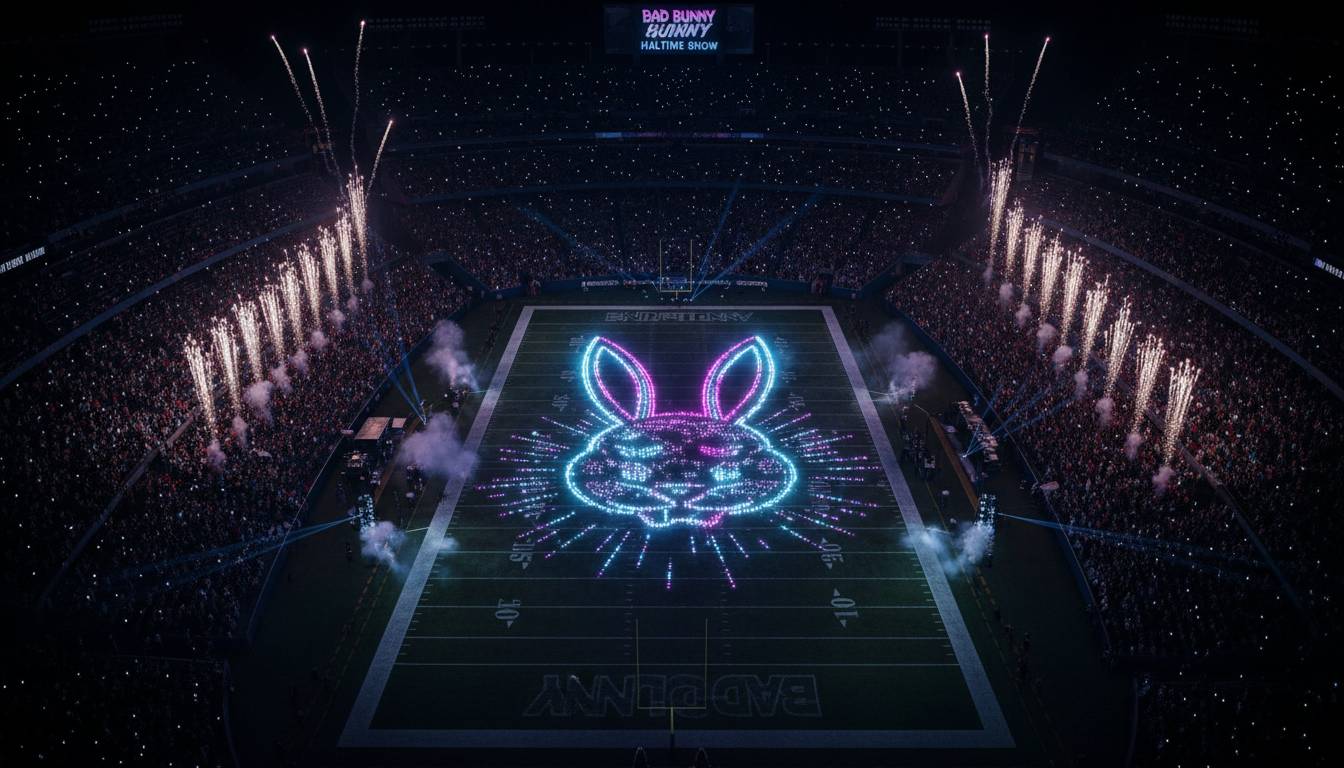
The Bad Bunny Super Bowl LX halftime show on February 8, 2026, was a high‑energy, culturally charged event where Bad Bunny made history as the first solo Latino artist to headline the Super Bowl, performing almost entirely in Spanish and drawing a record‑breaking 128.2 million viewers . It was a bold live set full of surprises, cultural nods, and emotional resonance.
A Historic Milestone: Spanish‑Language Power
The show was a cultural landmark, with Bad Bunny delivering his set almost entirely in Spanish—a groundbreaking moment in Super Bowl history . From the opening notes of “Tití Me Preguntó” to his closing anthem, he brought Latin music—and pride—to America’s most-watched sporting event .
Beyond language, the themes were deeply symbolic. Bad Bunny leaned into his Puerto Rican roots, weaving political and cultural statements into choreography, set design, and lyrics. It wasn’t just a performance—it was storytelling (and political art) .
Standout Moments That Stole the Show
Vibrant Visuals and Meaningful Symbolism
The stage transformed into a vivid sugarcane field, setting the tone for a journey through Puerto Rican life. Dancers played dominoes, food stands offered piraguas and tacos, and everyday scenes came alive with warmth and authenticity .
Guest Stars and Cameos
Celebrities flooded the stage in a joyful parade: Lady Gaga surprised with a salsa rendition of “Die with a Smile,” while Ricky Martin brought nostalgia with “Lo Que Le Pasó a Hawaii.” Other cameos included Cardi B, Karol G, Pedro Pascal, Jessica Alba, and Young Miko—turning the halftime show into a star-studded fiesta .
A Wedding, Live on the Field
In one of the most unforgettable highlights, Bad Bunny officiated the wedding of Eleisa Aparicio and Thomas Wolter live onstage. The couple, who had been dating since 2023, got married in front of 128 million viewers, danced to “Baile Inolvidable,” and even had Bad Bunny serve as a legal witness on their certificate .
Emotional Pass of a Grammy
Midway through “Me Porto Bonito,” Bad Bunny invited 12-year-old Mateo Rivera—a rising reggaeton artist from Puerto Rico—to the stage and gave him one of his actual Grammy Awards. A touching moment of mentorship and legacy rather than showmanship .
Powerful Finale
The show ended with Bad Bunny holding a football inscribed with “Together, We Are America,” then spiking it in front of a massive slogan: “The only thing more powerful than hate is love.” It felt equal parts protest, poetry, and performance art .
Audience, Reach & Cultural Impact
This wasn’t just a Super Bowl halftime—it was a global media moment. It drew 128.2 million viewers, outpacing the game’s own 124.9 million average . Socially, it shattered norms: four billion views in the first 24 hours, the highest social media traction for any NFL halftime show .
Telemundo’s Spanish-language broadcast hit new highs—3.3 million average viewers, peaking at 4.8 million during the show .
Following the event, Bad Bunny’s streaming exploded: U.S. listens soared around 470%, global streams climbed 210%, and his tracks dominated Spotify and Apple Music charts. Shazam named him the Most Recognized Latin Artist in a single day .
The Messages Behind the Music
Beyond spectacle, Bad Bunny made explicit statements about identity, unity, and resistance:
- He redefined “America” as a continental concept, not just U.S.-centric, as he carried multiple Latin American flags across the stage .
- The imagery of power lines and sugarcane evoked Puerto Rico’s colonial history and ongoing infrastructure struggles—especially post-Hurricane María—and hinted at calls for independence .
- Marc Anthony celebrated it as a proud moment for Latino culture and praised Bad Bunny’s uplift for the community .
Of course, not all reactions were glowing. Some conservative figures, including Donald Trump, slammed the performance for being “too Spanish” and not reflective of American values. The backlash prompted Bad Bunny to clear his Instagram afterwards—a reaction that was widely noted .
Quotes That Captured the Mood
“Our culture was always worthy of celebration,” said Marc Anthony, calling the performance a proud and meaningful tribute to Puerto Rican and Latino identity .
In his announcement, Bad Bunny said, “This is for my people, my culture, and our history,” framing his Super Bowl platform as a cultural touchdown, not just musical glory .
Summary Takeaways
Bad Bunny’s Super Bowl LX halftime show was more than an electrifying performance—it was a cultural reckoning. From historical firsts to emotional surprises (like a real wedding and passing a Grammy to a young fan), from Latino pride to thoughtful protest, it captured both hearts and headlines. The result? A seismic moment for representation, for unity, and for the future of pop performance.
FAQs
Q: What made Bad Bunny’s halftime show unique?
A: He was the first solo Latino artist to headline and the first to perform almost entirely in Spanish, blending music with cultural storytelling in a way that felt deeply personal and bold.
Q: How many people watched the performance?
A: Around 128.2 million viewers in the U.S. tuned in—higher than the Super Bowl game itself—while it earned record-breaking social media engagement, with four billion views in 24 hours.
Q: Were there any surprise moments?
A: Yes—Lady Gaga and Ricky Martin joined for special duets, and Bad Bunny officiated a live wedding and passed a Grammy award to a Young artist on stage.
Q: What themes did the show explore?
A: It highlighted Latino and Puerto Rican identity, unity across the Americas, resistance, and love. Visual metaphors such as sugarcane fields and electrical poles echoed Puerto Rico’s colonial past and resilience.
Q: Did the show face any backlash?
A: Some conservative figures criticized the Spanish-language focus and cultural framing. In response, Bad Bunny wiped his Instagram afterward. Others, like Marc Anthony, praised the show for its cultural significance.
Q: What impact followed the show?
A: Streams and chart positions skyrocketed for Bad Bunny, with multi-hundred‑percent increases on platforms like Spotify and Apple Music. Telemundo’s viewership hit new highs, and Shazam reported him as the most recognized Latin artist in a single day.
Bad Bunny didn’t just perform at the Super Bowl—he transformed halftime into a cultural movement.














Leave a comment