


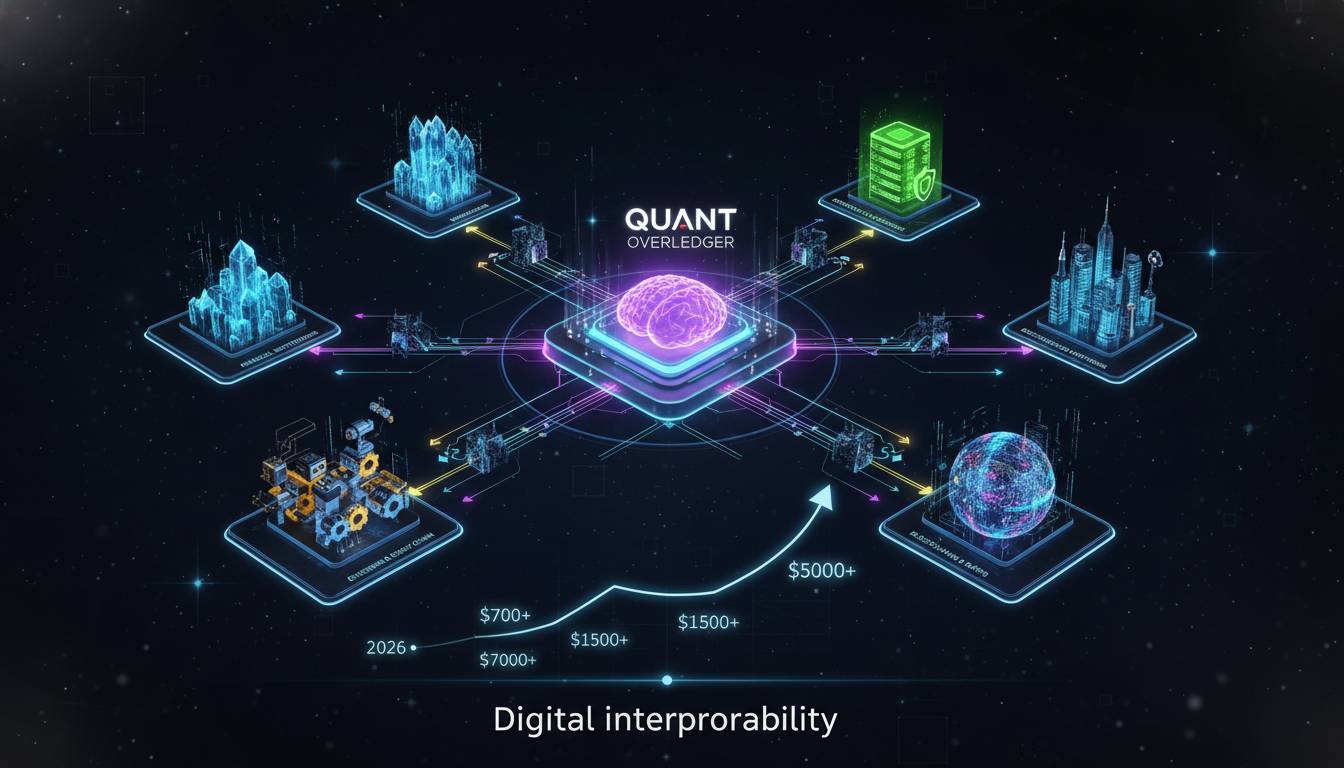
Quant has remained one of the more closely watched interoperability-focused crypto projects, even as digital asset markets have shifted from retail speculation toward institutional infrastructure. For investors searching for a realistic Quant Price Prediction 2026, 2027 – 2030: How High Can QNT Go in the Next Decade?, the key question is not only where QNT trades next, but whether Quant’s enterprise strategy can translate into sustained token demand. Current market data, supply constraints, and recent infrastructure developments all shape that outlook.
What Quant Does and Why QNT Matters
Quant is best known for Overledger, a platform designed to connect different distributed ledger and blockchain systems. The project has long positioned itself around interoperability, a theme that has gained relevance as banks, central banks, and financial institutions test tokenized deposits, digital assets, and blockchain-based settlement systems. Quant founder and CEO Gilbert Verdian has repeatedly argued that interoperability is essential for mainstream adoption of digital finance.
That positioning matters because QNT is not simply another payment token competing on transaction speed. Its investment case is more closely tied to enterprise usage, licensing, ecosystem growth, and the broader adoption of interoperable digital money infrastructure. Quant has highlighted its role in projects involving programmable money and tokenized deposits, including work connected to the UK’s regulated liability network initiative.
From a supply perspective, QNT also stands out. CoinMarketCap data shows a maximum supply of 14.88 million QNT, with about 12.07 million already in circulation as of mid-March 2026. That relatively tight supply is one reason bullish investors continue to see upside if adoption accelerates.
Quant Price Snapshot in 2026
Any serious Quant Price Prediction 2026, 2027 – 2030: How High Can QNT Go in the Next Decade? starts with the current market base. As of the latest available CoinMarketCap data, QNT trades near $62.88, with a market capitalization of roughly $759 million. The token remains far below its all-time high of $428.38, reached on September 11, 2021.
Those numbers tell two stories at once:
- QNT has already shown it can attract strong market interest in a bullish cycle.
- It is still trading at a steep discount to its prior peak.
- The gap between current price and all-time high leaves room for recovery if fundamentals improve.
- It also shows that the market has not yet fully priced in Quant’s long-term enterprise narrative.
For 2026, price direction is likely to depend on three variables: broader crypto market sentiment, measurable adoption of Quant’s technology, and whether institutional blockchain infrastructure moves from pilot programs to production-scale deployment. The last point is especially important because Quant’s value proposition is more closely linked to real-world financial integration than to meme-driven momentum.
Quant Price Prediction 2026
A balanced 2026 outlook for QNT requires separating optimistic scenarios from base-case expectations. If crypto markets remain constructive and enterprise blockchain adoption continues to mature, QNT could revisit higher resistance zones. Still, price forecasts should be treated as scenarios, not certainties.
Base-case outlook for 2026
In a moderate-growth scenario, QNT could trade in a broad range of $75 to $140 during 2026. That would imply recovery from current levels, but still keep the token well below its 2021 peak. This scenario assumes continued interest in interoperability infrastructure, but no major speculative mania. The case is supported by Quant’s ongoing visibility in institutional digital money discussions and by the limited token supply.
Bullish outlook for 2026
A stronger bullish case could place QNT in the $150 to $220 range if several catalysts align:
- Broader crypto market strength.
- New enterprise or public-sector partnerships.
- Clear evidence that Quant-powered infrastructure is being used in live financial workflows.
- Renewed investor appetite for utility-focused altcoins.
Bearish outlook for 2026
A weaker market backdrop could keep QNT between $45 and $75. That outcome would likely reflect delayed institutional adoption, lower crypto liquidity, or a market preference for larger-cap assets such as Bitcoin and Ethereum. Since Quant’s thesis depends heavily on execution rather than hype, slower commercial traction could weigh on sentiment.
Quant Price Prediction 2027–2030
Longer-term forecasting is inherently more uncertain, but the framework becomes clearer when tied to adoption milestones. The central issue in any Quant Price Prediction 2026, 2027 – 2030: How High Can QNT Go in the Next Decade? is whether Quant becomes a meaningful layer in the emerging digital asset infrastructure stack.
2027 outlook
By 2027, QNT could benefit if tokenized deposits, central bank settlement experiments, and cross-chain enterprise applications move further into production. A reasonable scenario range is $110 to $260, with upside depending on whether Quant can convert its enterprise narrative into recurring ecosystem demand. The European Central Bank’s expanding work on settling DLT-based transactions in central bank money shows that the broader market for interoperable infrastructure is still developing.
2028 outlook
For 2028, a plausible range is $140 to $320 under a constructive market environment. By then, investors would likely focus less on concept validation and more on actual usage, revenue visibility, and network effects. If Quant’s technology is embedded in more institutional workflows, scarcity could become a stronger pricing factor because of the token’s capped supply.
2029 outlook
A 2029 range of $180 to $380 is possible in a mature bullish cycle. This would still require sustained execution and a favorable macro backdrop for digital assets. It would also likely depend on whether interoperability remains a premium sector within crypto rather than becoming commoditized.
2030 outlook
By 2030, the range of outcomes widens significantly. A conservative scenario might place QNT around $120 to $220 if adoption remains niche. A stronger scenario could see $300 to $500 if Quant becomes a recognized infrastructure provider in tokenized finance and cross-network settlement. Reclaiming and surpassing the 2021 all-time high of $428.38 would require both company execution and a supportive digital asset cycle.
Key Catalysts That Could Drive QNT Higher
Several factors could influence whether QNT reaches the upper end of these forecasts.
1. Institutional adoption
Quant’s strongest differentiator is its focus on banks, enterprises, and regulated financial infrastructure. Its recent selection to provide infrastructure for live transactions of tokenized sterling deposits is one of the clearest examples of that strategy in action. If more projects move from pilot to production, investor confidence could improve materially.
2. Growth in tokenized assets
The market for tokenized deposits, securities, and digital cash is expanding. The ECB has said its initiative on settling DLT-based transactions in central bank money is intended to support an integrated European market for digital assets. That broader trend supports the case for interoperability providers.
3. Limited supply
With a max supply of 14.88 million and roughly 12.07 million already circulating, QNT has a scarcity profile that can amplify price moves if demand rises. In crypto markets, low supply alone is not enough, but it can become a powerful tailwind when paired with stronger utility or investor conviction.
4. Sector rotation within crypto
If market participants rotate back into infrastructure and utility tokens, QNT could benefit. That is especially true if investors begin favoring projects tied to real-world financial use cases over purely speculative narratives. This remains a market inference based on Quant’s positioning and current industry direction.
Risks That Could Limit Quant’s Upside
No Quant Price Prediction 2026, 2027 – 2030: How High Can QNT Go in the Next Decade? is complete without a clear view of the downside.
The first risk is execution. Quant’s long-term thesis depends on enterprise adoption, and enterprise sales cycles are often slow. A strong technology narrative does not automatically translate into token appreciation.
The second risk is competition. Interoperability is a crowded theme in blockchain, and investors have many alternatives. If competing protocols or traditional financial infrastructure providers solve similar problems more effectively, Quant’s market position could weaken.
The third risk is market structure. Even fundamentally strong crypto assets can underperform for long periods when liquidity tightens or macro conditions deteriorate. QNT’s history shows that sharp drawdowns are possible, given its decline from the 2021 peak to current levels.
What Analysts and Investors Should Watch Next
For readers evaluating QNT over the next several years, the most important indicators are not daily price swings. The more meaningful signals include:
- New enterprise deployments
- Evidence of production-scale usage
- Growth in tokenized money and asset markets
- Regulatory clarity for digital finance
- Whether Quant continues to appear in major institutional interoperability initiatives
According to Gilbert Verdian, interoperability is central to the future of global payments and digital finance. That view aligns with the broader institutional push toward programmable and interoperable money, but investors still need proof that this thesis will create durable value for QNT holders.
Conclusion
Quant remains one of the more distinctive infrastructure plays in crypto because its thesis is tied to interoperability, enterprise adoption, and the digitization of financial markets. Based on current data, QNT starts 2026 near $62.88, with a capped supply of 14.88 million tokens and a previous all-time high of $428.38. Those figures leave room for both recovery and volatility.
A realistic Quant Price Prediction 2026, 2027 – 2030: How High Can QNT Go in the Next Decade? points to a wide range of outcomes. In a moderate scenario, QNT could gradually recover into triple digits over the next several years. In a stronger institutional adoption case, it could challenge or exceed prior highs by 2030. But that upside depends less on hype than on whether Quant can turn interoperability demand into measurable, scalable usage.
Frequently Asked Questions
Is Quant a good long-term investment?
Quant’s long-term appeal depends on whether interoperability becomes a core layer of digital finance and whether Quant captures meaningful adoption in that market. Its enterprise focus and limited supply are positives, but execution and competition remain important risks.
What is QNT’s current supply?
CoinMarketCap lists QNT with a maximum supply of 14.88 million and a circulating supply of about 12.07 million as of March 2026.
Can QNT reach its old all-time high again?
It is possible, but not guaranteed. QNT’s all-time high was $428.38 on September 11, 2021, and reclaiming that level would likely require stronger institutional adoption, favorable market conditions, and broader investor interest in utility-focused crypto assets.
What could drive Quant’s price higher by 2030?
The main catalysts include enterprise adoption of Overledger, growth in tokenized deposits and digital asset settlement, broader demand for interoperability, and a supportive crypto market cycle.
What is the biggest risk for QNT?
The biggest risk is that enterprise adoption takes longer than expected or fails to translate into sustained token demand. Competition and broader crypto market weakness are also major factors.



















Leave a comment