


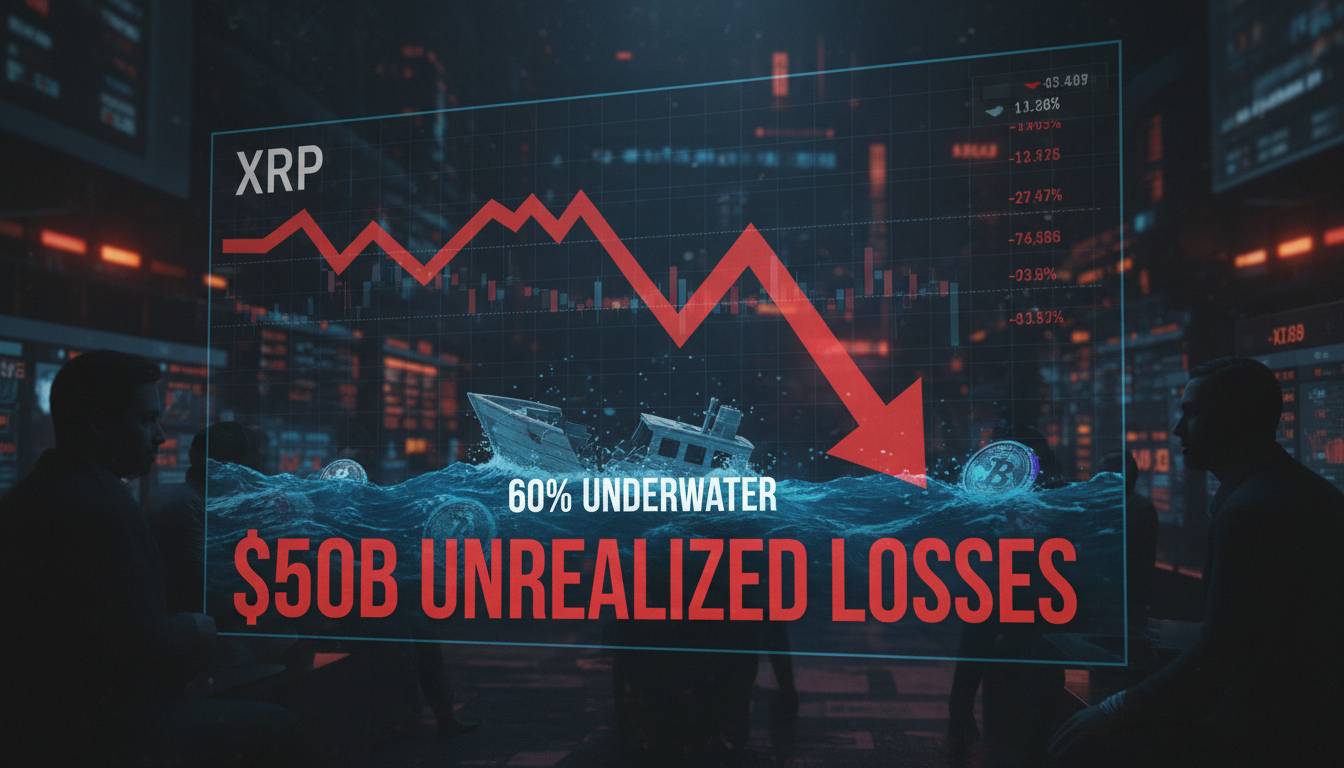
XRP is facing a sharp deterioration in holder profitability, with on-chain data indicating that a large share of the token’s circulating supply has slipped underwater after the market’s latest pullback. The shift is notable because XRP had been one of the stronger-performing large-cap digital assets during parts of 2025, helped by optimism around Ripple’s legal position and broader crypto market momentum. Now, the picture looks materially weaker: recent market data suggests that a majority of supply is no longer sitting on paper gains, raising fresh questions about sentiment, support levels, and the durability of the asset’s rally.
XRP Is Bleeding With Over $50 Billion in Unrealized Losses as 60% of Supply Goes Underwater
The core claim behind the current market narrative is that XRP is bleeding with over $50 billion in unrealized losses as 60% of supply goes underwater. Publicly surfaced reporting tied to Glassnode data shows XRP’s share of supply in profit had fallen to 58.5% in late 2025, implying that 41.5% of circulating supply was already at a loss at that point. That reading was described as the lowest since November 2024, even though XRP was still trading far above its earlier lows.
To understand the scale, it helps to separate market capitalization from realized value. Market capitalization measures the current value of all circulating XRP at the latest price, while realized capitalization estimates the value of coins based on the price when they last moved on-chain. When market cap falls below realized cap, unrealized losses expand across the network. A March 2025 market report referencing XRP’s “USD value for all native units based on the USD closing price on the day that a unit last moved” points to the same framework used to assess network-wide paper gains and losses.
If roughly 60% of supply is underwater, the implied paper loss can move into the tens of billions of dollars depending on circulating supply and spot price. Coinbase’s XRP market page recently listed circulating supply at about 60.9 billion XRP, while historical CoinMarketCap data showed 58.2 billion XRP in circulation in late March 2025. Those supply figures mean even modest average losses per token can aggregate into very large unrealized losses across the network.
What the Latest Data Shows
The most concrete public data point available from recent reporting is the 58.5% supply-in-profit figure, which implies 41.5% of XRP supply was underwater at that time. That alone does not confirm the exact “60% underwater” threshold, but it does establish a clear weakening trend in XRP holder profitability. It also shows how quickly sentiment can reverse after a strong rally draws in late buyers at elevated prices.
Earlier in 2025, the picture was dramatically different. Market coverage citing Glassnode said XRP’s percent supply in profit had climbed above 93% when the token traded above $3 during a powerful rally. That meant only a small minority of holders were underwater at the time. The reversal from more than 90% of supply in profit to a much lower level later in the year underscores how concentrated the pain can become when momentum fades.
Recent price references also show why the market has become more fragile. Coinbase data cited XRP around $1.43 with a market cap near $87.6 billion and circulating supply above 60.9 billion XRP. By comparison, CoinMarketCap’s March 26, 2025 historical snapshot showed XRP at $2.3491 and a market cap of about $136.7 billion. That decline in price and market value helps explain why a larger share of holders who bought during the rally may now be sitting on losses.
Why XRP’s Profitability Has Deteriorated
One reason is the classic late-cycle entry problem. When an asset rallies sharply, new buyers often enter after the strongest gains have already occurred. If the price then retraces, those newer holders become underwater quickly, even if long-term holders remain in profit. The TradingView report summarizing Glassnode data explicitly described XRP’s structure as “top-heavy” and “dominated by late buyers,” a pattern that tends to amplify downside pressure during corrections.
Another factor is that legal and regulatory optimism may have been priced in aggressively. In March 2025, Ripple CEO Brad Garlinghouse said the SEC had ended or was withdrawing from its long-running case against the company, a development that helped lift XRP sharply at the time. Associated Press and Axios both reported that the SEC’s retreat marked a major shift in the regulatory backdrop for Ripple and the broader crypto sector. But once that catalyst was absorbed, XRP still had to contend with broader market conditions and valuation expectations.
According to Brad Garlinghouse, the end of the SEC case represented a major turning point for Ripple. Even so, legal clarity does not guarantee sustained price appreciation. Crypto assets remain highly sensitive to liquidity conditions, risk appetite, and momentum-driven trading, all of which can reverse quickly.
Impact on Investors and the Broader Market
When a large share of supply goes underwater, market behavior often changes in several ways:
- Selling pressure can increase as holders exit on rebounds to reduce losses.
- Volatility can rise because confidence weakens and short-term traders dominate flows.
- Support levels become more important as investors watch for signs of capitulation or stabilization.
- Narratives shift from growth and adoption to balance-sheet stress and holder pain.
For retail investors, unrealized losses are not the same as realized losses. A paper loss becomes permanent only when an investor sells below cost basis. Still, widespread unrealized losses can weigh heavily on sentiment and reduce willingness to deploy fresh capital. That dynamic matters for XRP because network-wide profitability often influences whether rallies attract follow-through buying or fade into resistance.
For institutional and professional traders, underwater supply can be interpreted in two different ways. One view is bearish: a large overhang of trapped holders can cap upside as investors sell into strength. The other view is contrarian: if capitulation becomes extreme, the market may be closer to a bottom than a top. The data alone does not settle that debate, but it does show XRP has moved from a position of broad holder profitability to one of much greater stress.
Can XRP Recover From Here?
A recovery is possible, but it likely depends on a combination of price stabilization, renewed demand, and a broader improvement in crypto market conditions. XRP has previously shown the ability to recover sharply when legal or macro catalysts improve. The March 2025 jump following Ripple’s announcement on the SEC case is a recent example of how quickly sentiment can turn.
At the same time, the current setup suggests that any rebound may face overhead resistance from holders seeking to break even. If 60% of supply is underwater, or even if the true figure is somewhat lower but rising, many wallets may be waiting for a bounce to reduce exposure. That can slow the pace of recovery compared with earlier phases of the rally, when most holders were already in profit. This is an inference based on how underwater supply typically affects market structure.
The most important variables to watch next are:
- Percent supply in profit/loss from on-chain analytics providers.
- Spot price relative to recent highs near the levels seen in early 2025.
- Circulating supply growth, which can affect market cap and valuation metrics.
- Broader crypto market direction, especially risk appetite across large-cap tokens.
Conclusion
XRP’s latest on-chain and market signals point to a meaningful deterioration in holder profitability. Publicly available reporting confirms that XRP’s share of supply in profit fell to 58.5% in late 2025, a sharp drop from levels above 90% seen during the token’s rally earlier that year. Combined with circulating supply above 58 billion to 60 billion XRP and a much lower spot price than its 2025 highs, that shift helps explain why the market is increasingly framed around deep unrealized losses and a growing share of underwater supply.
Whether the headline figure of more than $50 billion in unrealized losses and 60% of supply underwater is reached exactly depends on the latest proprietary on-chain calculations and the price point used. What is clear is that XRP has moved into a much more fragile phase, where sentiment, positioning, and support levels matter more than legal headlines alone. For investors, the next chapter will likely depend on whether XRP can rebuild profitability across the network or whether trapped supply continues to weigh on every rebound.
Frequently Asked Questions
What does it mean when XRP supply is underwater?
It means coins are worth less at the current market price than the price at which they last moved or were acquired, leaving holders with unrealized losses.
Are unrealized losses the same as actual losses?
No. Unrealized losses are paper losses. They become realized only if an investor sells at a lower price than their cost basis.
Is the claim that 60% of XRP supply is underwater fully confirmed?
Recent public reporting clearly confirmed a drop to 58.5% of supply in profit, meaning 41.5% was underwater at that point. The exact 60% underwater figure would require the latest direct on-chain reading from analytics providers.
Why did XRP weaken after positive SEC news?
Legal relief can improve sentiment, but prices also depend on valuation, liquidity, and broader market conditions. Once positive legal developments were priced in, XRP still faced normal market pressures.
Can underwater supply be bullish?
Sometimes. Extreme unrealized losses can signal capitulation, which some traders view as a potential bottoming condition. But it can also create selling pressure from holders trying to exit at break-even.
What should investors watch next?
Key indicators include XRP’s percent supply in profit, price relative to prior highs, circulating supply changes, and the broader direction of the crypto market.

















Leave a comment