


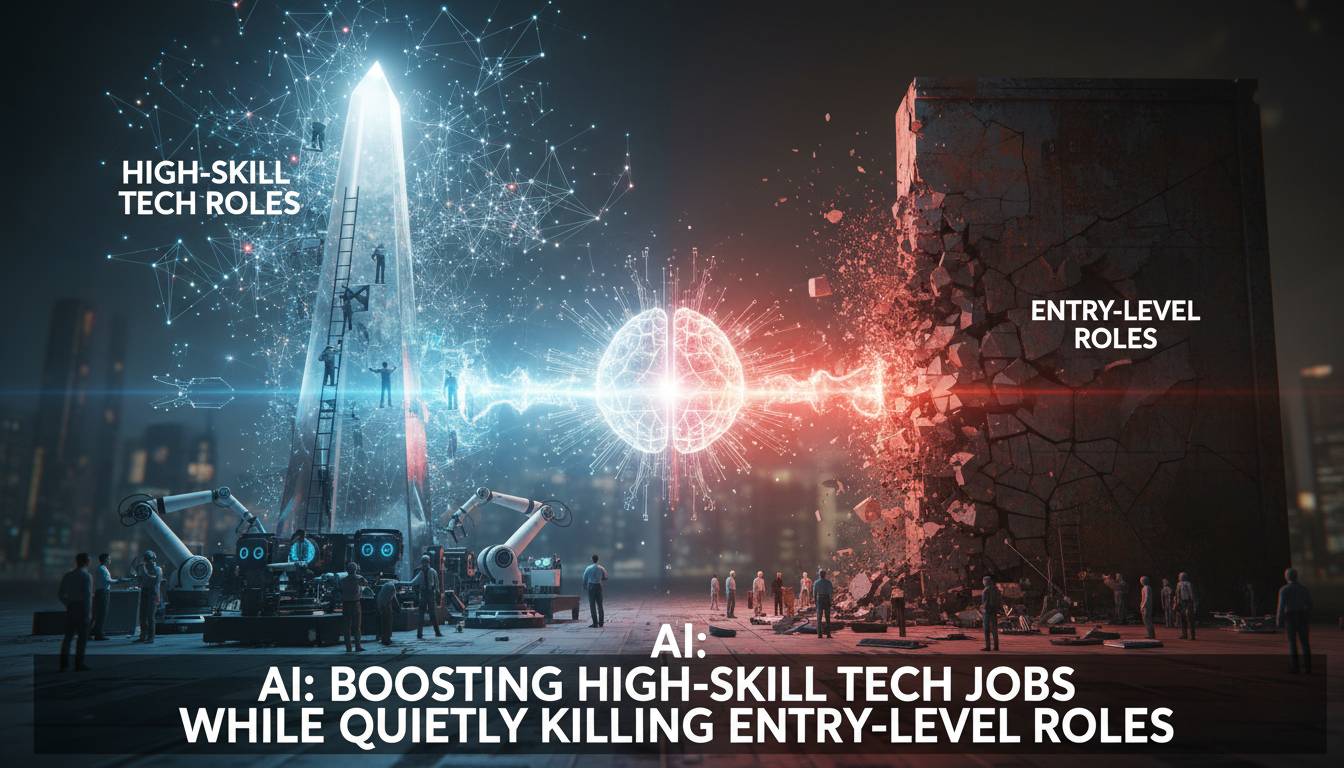
Artificial intelligence is reshaping the U.S. tech labor market in two directions at once. Companies are paying more for workers with advanced AI, data, cloud, and cybersecurity skills, while many routine junior roles are becoming harder to find. The result is a widening gap between the top and the bottom of the hiring ladder: experienced specialists are in demand, but new graduates and early-career workers face a quieter squeeze as employers automate basic tasks and expect smaller teams to do more.
A Two-Speed Tech Job Market Is Taking Shape
The clearest signal comes from hiring and wage data tied to AI skills. PwC’s 2025 Global AI Jobs Barometer, based on nearly a billion job ads, found that jobs requiring AI skills are growing faster than overall postings and carry a large wage premium. In the U.S., workers with advanced AI skills earned a 56% wage premium, more than double the prior year’s level, according to PwC’s U.S. summary.
At the same time, employers are changing what they want from tech teams. The World Economic Forum’s Future of Jobs Report 2025 says AI, information processing, and automation are among the biggest forces transforming work through 2030. The report identifies AI and big data, networks and cybersecurity, and technological literacy among the fastest-growing skill areas, while clerical and routine roles remain among the most exposed to decline.
That divergence is especially visible in tech. SignalFire’s 2025 State of Tech Talent Report says tighter budgets and stronger AI capabilities are pushing companies to reduce investment in new-graduate opportunities. In a separate SignalFire analysis, the firm said new-grad hiring has dropped 50% compared with pre-pandemic levels.
According to PwC, the broader picture is not one of simple job destruction. The firm says AI-exposed industries are seeing faster productivity growth and continued job creation, even in some roles considered highly automatable. But that growth is unevenly distributed, favoring workers who can build, manage, or strategically apply AI systems rather than those entering the market through routine support work.
Why AI Is Boosting Demand for High Skill Tech Jobs While Quietly Killing Entry-Level Roles
The reason is not hard to see. Generative AI tools can now handle parts of the work that once trained junior employees: drafting code, summarizing documents, writing first-pass marketing copy, producing support responses, and assisting with research. That allows companies to ask senior engineers, analysts, and product teams to move faster without adding as many entry-level staff. The Federal Reserve has noted rapid growth in workplace AI adoption, reinforcing the view that firms are integrating these tools into everyday operations.
For employers, this creates a strong incentive to hire fewer but more capable people. A lean team with experienced engineers and domain experts can use AI tools to absorb tasks that previously justified junior headcount. SignalFire said Series A SaaS startups are now 20% smaller than in 2020, while engineering accounts for a larger share of startup hiring.
This does not mean entry-level workers are no longer needed. It means the definition of “entry level” is changing. Employers increasingly want junior candidates who already bring practical skills in AI-assisted coding, data analysis, prompt design, cloud platforms, or security operations. In other words, the first rung of the ladder is moving upward.
According to the World Economic Forum, 40% of employers expect to reduce their workforce where AI can automate tasks. The same body also says technology is projected to create 11 million jobs and displace 9 million globally, showing why the debate is more about transition than collapse.
The Roles Winning in the AI Era
The strongest demand is clustering around specialized and infrastructure-heavy jobs. These include:
- AI and machine learning engineers
- Data engineers and data scientists
- Cloud architects and DevOps specialists
- Cybersecurity analysts and engineers
- Product managers who can deploy AI into business workflows
- Software engineers with strong systems, platform, or MLOps experience
These roles benefit from two trends. First, companies need people who can build and govern AI systems. Second, they need workers who can connect AI tools to real business processes, compliance requirements, and customer products. That combination raises the value of technical depth plus judgment.
PwC says skills demanded by employers are changing 66% faster in occupations most exposed to AI than they were a year earlier. That suggests companies are not just adding AI as a bonus skill; they are rewriting job expectations at speed.
The World Economic Forum reaches a similar conclusion. Its 2025 report says employers expect technology-related skills to rise fastest through 2030, especially AI and big data, cybersecurity, and broader technological literacy.
The Entry-Level Squeeze Is Real but Often Hard to See
The decline in junior hiring is often less visible than layoffs because it happens through slower backfilling, fewer campus recruiting programs, and smaller internship classes. Companies may not announce that they are cutting entry-level openings; they simply stop posting them or raise the bar for who qualifies.
That matters because entry-level roles have long served as training grounds. Junior developers learned by fixing bugs, writing internal tools, and handling lower-risk tickets. Junior analysts learned by cleaning data and preparing reports. Help desk staff built the operational knowledge that later fed into systems administration and security careers. If AI absorbs more of that foundational work, the pipeline into senior roles can weaken over time. This concern has also been raised by the World Economic Forum, which argues companies should use AI to train the next generation rather than simply eliminate stepping-stone jobs.
There is also a social dimension. Early-career workers, recent graduates, and career changers are less likely to have the experience employers now demand. That can deepen inequality between workers who already have access to elite training, strong networks, or prior industry experience and those trying to break in for the first time. The World Economic Forum warns that without the right incentives and workforce strategies, AI-driven substitution could increase inequality and unemployment.
What It Means for Employers, Workers, and Schools
For employers, the short-term gains are clear: higher productivity, leaner teams, and faster output. PwC says productivity growth in AI-exposed industries has accelerated sharply since generative AI spread in 2022.
For workers, the message is more mixed. Experienced professionals who can work with AI are gaining leverage, while those in routine or transitional roles face more pressure. According to the Federal Reserve, AI uptake in the workplace has grown rapidly, which means this shift is no longer theoretical.
For colleges, boot camps, and training providers, the challenge is urgent. Programs that still prepare students for yesterday’s junior roles may leave graduates exposed. Curricula increasingly need to include AI literacy, data skills, cloud tools, security basics, and real-world workflow automation.
A practical response is emerging across the market:
- teach AI-assisted work, not just traditional software workflows
- build stronger apprenticeship and internship pipelines
- measure candidates by skills and portfolios, not only credentials
- create junior roles focused on AI supervision, testing, governance, and implementation
What Comes Next
The most likely outcome is not a tech job collapse but a reordering of the ladder. High-skill roles should continue to expand as AI investment spreads beyond the largest tech firms. LinkedIn’s labor market updates show AI hiring broadening beyond the tech sector, while demand for AI literacy is rising quickly.
The bigger question is whether companies will rebuild enough early-career pathways to sustain the talent pipeline. If they do not, the industry may solve a short-term efficiency problem only to create a long-term skills shortage. Businesses still need future senior engineers, security leaders, and data architects. Those workers do not appear fully formed; they usually begin in junior roles that teach context, judgment, and execution.
For now, the evidence points to a labor market where AI is boosting demand for high skill tech jobs while quietly killing entry-level roles. That shift is increasing pay and opportunity for workers with advanced capabilities, but it is also making the first step into tech more difficult. The next phase of the AI economy may depend on whether employers treat that as an acceptable side effect or as a problem worth fixing.
Frequently Asked Questions
Is AI reducing tech jobs overall?
Not necessarily. Current research suggests AI is changing the mix of jobs more than eliminating tech work outright. Demand is rising for AI-related, data, cloud, and cybersecurity roles, even as some routine and junior tasks are automated.
Why are entry-level tech roles under pressure?
Many tasks once assigned to junior workers can now be completed faster with generative AI tools. Employers are also running leaner teams and asking experienced staff to use AI to cover more ground.
Which tech skills are gaining the most value?
AI and machine learning, data engineering, cybersecurity, cloud infrastructure, DevOps, and broader AI literacy are among the fastest-rising skill areas in current reports.
Are wages really rising for AI-skilled workers?
Yes. PwC says U.S. workers with advanced AI skills earned a 56% wage premium in its 2025 analysis, showing how strongly employers value those capabilities.
Can new graduates still break into tech?
Yes, but the path is harder. Candidates increasingly need portfolios, internships, and practical experience with AI-assisted workflows, cloud tools, data, or security rather than relying on a degree alone.
What should companies do to avoid a long-term talent gap?
They can preserve internships, apprenticeships, and junior roles that focus on AI supervision, implementation, and governance. That helps maintain the pipeline of future senior talent while still capturing AI productivity gains.



















Leave a comment