


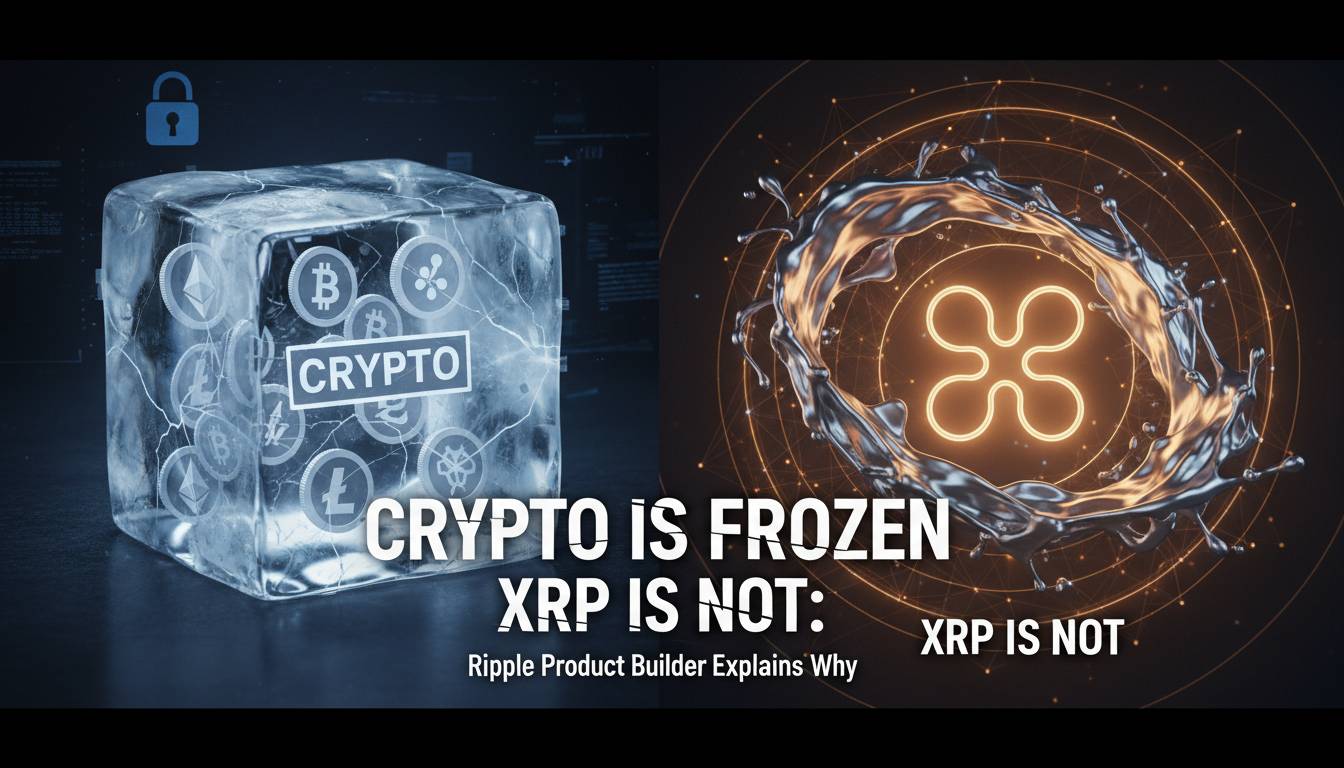
At a time when much of the digital-asset market is struggling to regain momentum, XRP is once again separating itself from the broader crypto narrative. The latest debate has been sharpened by a widely shared claim — “crypto is frozen. xrp is not. the man who built ripple’s products explains why” — which centers on how XRP works, how Ripple’s products evolved, and why the token continues to attract attention even during periods of market hesitation. The issue is not only price action. It is also about utility, legal clarity, and a persistent misunderstanding over whether XRP can be frozen at all.
Why the “crypto is frozen. xrp is not. the man who built ripple’s products explains why” narrative is gaining traction
The phrase has gained visibility because it combines two themes that matter deeply to U.S. crypto investors in 2026: market stagnation and structural differentiation. In recent coverage, former Ripple executive Asheesh Birla, who helped build Ripple’s early product strategy, argued that XRP continues to draw interest because it is tied to a payments-focused ecosystem rather than a purely speculative story. According to Birla, the current environment has pushed investors and institutions to look more closely at assets with clearer use cases and stronger policy tailwinds.
That message lands at a moment when XRP has already benefited from a major legal and regulatory shift. On March 19, 2025, Ripple CEO Brad Garlinghouse said the U.S. Securities and Exchange Commission would withdraw its appeal in the long-running case against Ripple, a development that triggered an immediate jump in XRP’s price. Coverage from AP and Axios described the move as a major turning point for Ripple and the token’s market standing.
The broader significance is that XRP is increasingly being discussed not just as a cryptocurrency, but as a digital asset with a distinct market identity. That identity rests on three pillars:
- its role in the XRP Ledger ecosystem,
- its association with cross-border payments,
- and its improving regulatory position in the United States.
XRP cannot be frozen on the ledger
One of the most important factual points in this discussion is also one of the most misunderstood. XRP itself cannot be frozen on the XRP Ledger. The XRP Ledger documentation explicitly states that XRP exists in accounts that cannot be frozen, and that no single party — not Ripple, not the XRP Ledger Foundation, and not any other actor — controls the decentralized ledger in a way that would allow a freeze of native XRP balances.
This distinction matters because many market participants confuse XRP with issued tokens or with custodial balances held on exchanges. The XRP Ledger does support freeze functions for certain issued assets, sometimes called IOUs or fungible tokens created by issuers on the network. But that functionality does not apply to native XRP itself. In practice, if an exchange freezes a user account, that is a custodial action by the exchange, not a protocol-level freeze of XRP on the ledger.
That difference has become central to the “crypto is frozen. xrp is not. the man who built ripple’s products explains why” discussion. The argument is not that XRP is immune from market volatility or legal scrutiny. It is that the asset’s core ledger mechanics are often misunderstood, and those mechanics are materially different from the controls seen in some other digital-asset systems or centralized platforms.
Ripple and XRP are related, but not identical
Another reason the topic resonates is the long-running confusion between Ripple the company and XRP the digital asset. Ripple has built enterprise products around payments and liquidity, while the XRP Ledger is an open-source blockchain network. The two are connected historically and economically, but they are not the same thing. That distinction has been emphasized for years by Ripple executives and by XRP Ledger documentation.
For U.S. readers, this matters because debates over Ripple’s business model often spill over into assumptions about XRP’s technical design. Birla’s comments, as summarized in recent reporting, appear aimed at separating those issues: Ripple’s products may evolve, but XRP’s core value proposition still depends on liquidity, transfer speed, and the structure of the ledger itself.
Legal clarity has changed the conversation
No analysis of XRP’s resilience is complete without the SEC case. The lawsuit, filed in late 2020, cast a long shadow over Ripple and over XRP trading in the United States. It affected exchange listings, investor sentiment, and the token’s ability to compete on equal footing with other large-cap crypto assets. AP reported that the SEC had accused Ripple and two executives of raising $1.4 billion through XRP sales.
By 2025, however, the legal picture had shifted sharply. Ripple’s leadership said the SEC would withdraw its appeal, and major news outlets described the move as a substantial win for the company and for XRP holders. XRP rose more than 8% to 10% immediately after the announcement, according to AP and Axios.
According to Brad Garlinghouse, the end of the appeal represented a broader victory for the crypto sector, not just for Ripple. While critics may argue that regulatory risk has not disappeared entirely, the practical effect is clear: XRP now operates in a more favorable U.S. environment than it did during the height of the litigation.
That legal shift helps explain why the “crypto is frozen. xrp is not. the man who built ripple’s products explains why” framing has found an audience. In a market where uncertainty often suppresses capital flows, legal clarity can act as a catalyst.
Market data shows XRP remains a major asset
Ripple’s Q1 2025 XRP Markets Report shows the company continues to publish updates on XRP-related developments and its own holdings, while citing market data from public sources including CoinDesk Data, Bloomberg, and Refinitiv Eikon. The report also states that Ripple maintains public access to information about its XRP holdings.
At the time of the March 19, 2025 legal update, Axios described XRP as a roughly $150 billion crypto asset, while AP reported a sharp one-day gain following the SEC news. That scale is important. Even after years of controversy, XRP remains one of the largest digital assets by market capitalization, which gives it a level of liquidity and visibility that many competing tokens do not have.
For stakeholders, the implications differ:
- Investors watch XRP as a large-cap asset with renewed regulatory momentum.
- Institutions view it through the lens of payments, liquidity, and settlement efficiency.
- Developers focus on the XRP Ledger’s open-source structure and transaction design.
- Regulators continue to treat it as a high-profile test case for crypto policy in the U.S.
Why supporters say XRP stands apart in a frozen market
Supporters of XRP generally make a straightforward case. First, they argue that XRP has a clearer utility narrative than many tokens built mainly around community momentum. Second, they point to the XRP Ledger’s technical characteristics and the fact that native XRP cannot be frozen at the protocol level. Third, they cite the easing of legal pressure in the United States as a reason institutional interest may continue to build.
There is also a political and policy dimension. Recent reporting noted that XRP was mentioned in discussions around a proposed U.S. cryptocurrency reserve framework in 2025, though such proposals remain politically and operationally uncertain. Even so, the fact that XRP is part of those conversations shows how far it has moved from the defensive posture of the SEC lawsuit years.
Still, skepticism remains warranted. XRP’s long-term performance will depend on adoption, liquidity demand, competition from stablecoins and other payment rails, and the extent to which Ripple’s business strategy continues to reinforce the token’s relevance. A favorable legal backdrop does not guarantee sustained growth. It only removes one major obstacle.
Conclusion
The phrase “crypto is frozen. xrp is not. the man who built ripple’s products explains why” captures a real shift in market perception, but the strongest part of the argument is factual rather than promotional. Native XRP cannot be frozen on the XRP Ledger, and that technical reality is often confused with exchange-level account restrictions or issuer controls on other assets. At the same time, XRP has benefited from a major improvement in its U.S. legal position and remains one of the largest digital assets in the market.
For U.S. investors and industry observers, the key takeaway is not that XRP is immune to risk. It is that XRP occupies a distinct place in crypto: technically different from many token models, commercially tied to a long-running payments thesis, and newly strengthened by regulatory developments that have changed the tone of the conversation.
Frequently Asked Questions
Can XRP be frozen by Ripple?
No. Native XRP cannot be frozen on the XRP Ledger, and Ripple does not control the ledger in a way that would allow it to freeze XRP balances.
Why do some people think XRP can be frozen?
The confusion usually comes from exchange account freezes or from freeze functions that apply to certain issued assets on the XRP Ledger, not to native XRP itself.
What changed for XRP in 2025?
Ripple said on March 19, 2025 that the SEC would withdraw its appeal in the long-running case, and XRP rose sharply after the announcement.
Is Ripple the same as XRP?
No. Ripple is a company that builds financial products and services, while XRP is the native digital asset of the XRP Ledger, an open-source blockchain network.
Why is XRP still attracting attention when crypto markets slow down?
Supporters point to its payments use case, large market capitalization, technical design, and improved regulatory clarity in the U.S. as reasons it continues to stand out.

















Leave a comment