


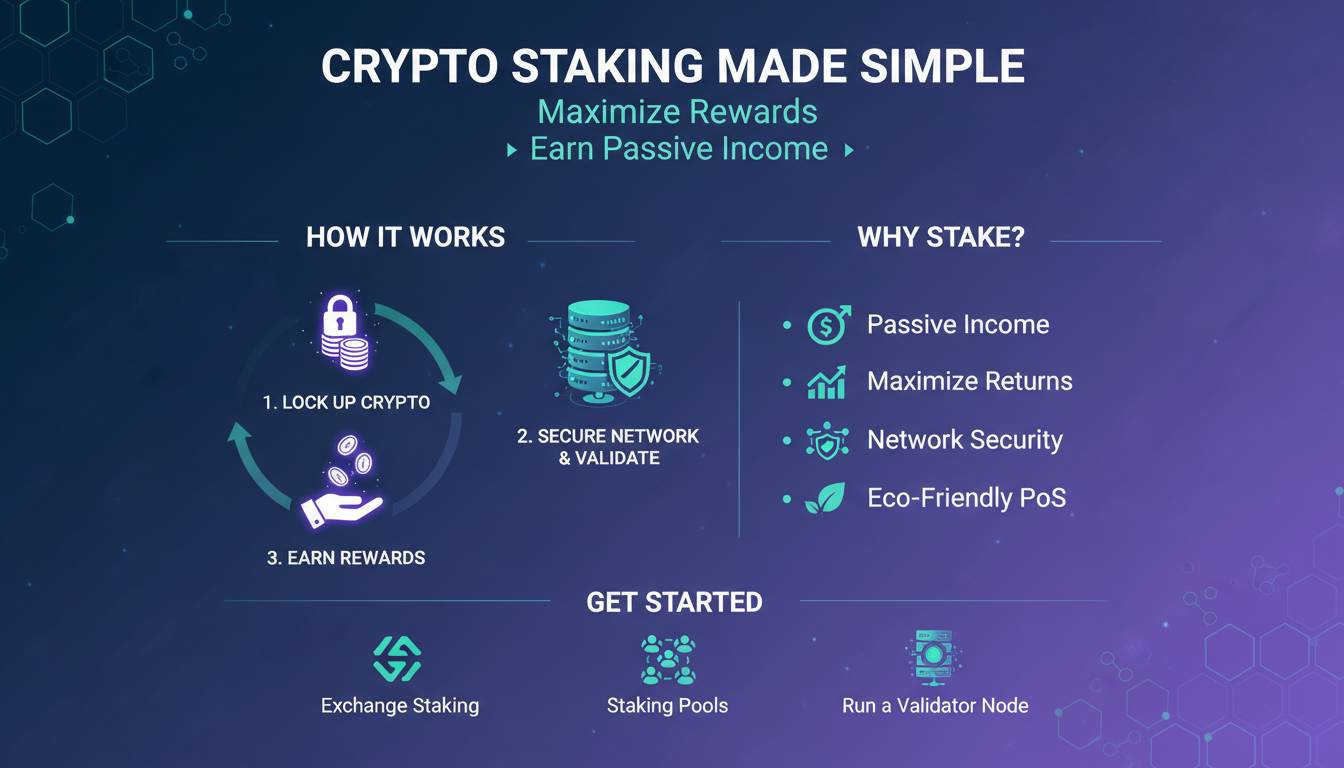
Crypto staking is gaining traction across the U.S., offering investors a streamlined path to passive income. This article explores the latest developments, regulatory clarity, staking yields, and institutional momentum shaping the landscape in 2026.
An increasing number of Americans are turning to crypto staking as a reliable income source. With over 58 million active crypto users in the U.S. as of 2025, the potential audience for staking services continues to expand . Regulatory clarity from the SEC and CFTC, along with the emergence of staking-enabled ETFs, is fueling both retail and institutional participation.
Regulatory Clarity Fuels Growth in Crypto Staking
In May 2025, the SEC’s Division of Corporation Finance issued guidance clarifying that protocol staking—such as solo, delegated, or custodial staking tied directly to a network’s consensus process—does not constitute a securities offering under U.S. law . This marked a pivotal moment, removing legal ambiguity for validators, node operators, and retail stakers.
Further regulatory alignment emerged in January 2026 when the CFTC announced a coordinated initiative with the SEC—Project Crypto—to modernize oversight of crypto markets, including staking products . This unified approach signals growing institutional confidence in staking as a mainstream financial activity.
Staking Yields and Market Trends in 2026
Staking yields vary significantly across networks. Ethereum staking currently offers an average annual percentage yield (APY) of around 3.3%, with approximately 35.86 million ETH staked—nearly 29% of its total supply . Solana delivers higher returns, with APYs ranging from 6.0% to 7.8% .
According to Bitcompare’s February 2026 report, ETH staking averages 3.17% APY across eight platforms, with Ankr offering the highest rate at 6.19% . Solana staking averages 5.21% APY, with a floor of 4.29% .
Emerging Layer‑1 networks like Avalanche, Polygon, and Cosmos offer even higher yields—between 7% and 13%—though they come with elevated risk due to token volatility and evolving validator ecosystems .
Institutional Momentum: ETFs and Large-Scale Staking
Institutional interest in staking is surging. In early 2026, Morgan Stanley filed S‑1 registrations for spot Bitcoin, Ethereum, and Solana ETFs that include staking mechanisms . Grayscale also made headlines by distributing $9.4 million in staking rewards—$0.083 per share—to investors in its Ethereum Staking ETF, marking the first U.S. spot crypto ETF to pass through staking income .
Bitmine, a major institutional player, now stakes over 908,000 ETH—worth approximately $2.95 billion—representing 3.43% of the total ETH supply . This underscores the growing role of large-scale staking in crypto treasuries.
Security and Smart Contract Integrity in DeFi Staking
As staking grows, so do concerns about smart contract vulnerabilities. A recent academic study analyzed nearly 16,000 DeFi staking contracts and found that 22.24% contained at least one logical defect . The researchers developed SSR (Safeguarding Staking Reward), a static analysis tool that detects such flaws with 92.31% precision and 87.92% recall . This highlights the importance of rigorous auditing and security measures for staking platforms.
Impact on Stakeholders
- Retail investors benefit from clearer regulations, accessible staking platforms, and diversified yield options.
- Institutions gain new avenues for passive income through staking-enabled ETFs and treasury strategies.
- Networks strengthen security and decentralization as staking participation grows.
- Developers and auditors face increasing pressure to ensure smart contract integrity and protect user funds.
Future Outlook for Crypto Staking
Looking ahead, staking yields are expected to stabilize as networks mature and validator participation increases . Regulatory frameworks are likely to evolve further, particularly with Project Crypto’s unified approach to oversight .
The rise of staking ETFs may attract more institutional capital, potentially boosting network security and liquidity. However, smart contract risks remain a concern, emphasizing the need for robust security practices.
Conclusion
Crypto staking in the U.S. is entering a new era of legitimacy and growth. Regulatory clarity, competitive yields, and institutional participation are converging to make staking a viable passive income strategy. As staking becomes more accessible and secure, it promises to reshape how investors engage with proof‑of‑stake networks.
Frequently Asked Questions
What is crypto staking?
Crypto staking involves locking tokens in a proof‑of‑stake blockchain to help validate transactions and secure the network. In return, stakers earn rewards, typically in the form of additional tokens.
Is staking legal in the U.S.?
Yes. In May 2025, the SEC clarified that protocol staking—solo, delegated, or custodial—is not considered a securities offering, providing legal clarity for U.S. participants .
What kind of yields can I expect from staking?
Yields vary by network. Ethereum staking averages around 3.3% APY, Solana offers between 6% and 7.8%, and emerging Layer‑1 networks may offer 7% to 13% APY .
Are staking ETFs available?
Yes. Grayscale has distributed staking rewards via its Ethereum Staking ETF, and Morgan Stanley has filed for staking-enabled ETFs for ETH and SOL .
What are the risks of staking?
Risks include smart contract vulnerabilities—studies show over 22% of DeFi staking contracts contain logical defects . Platform reliability and regulatory changes also pose potential risks.
How can I choose a staking provider?
Consider factors such as APY, platform reputation, security audits, lock‑up terms, and decentralization. Comparing providers like Ankr, Lido, and others can help optimize yield and risk balance.
This article provides a comprehensive, up‑to‑date overview of crypto staking in the U.S., offering clarity and actionable insights for both retail and institutional audiences.




















Leave a comment