


The Bitcoin halving is a pivotal event in the cryptocurrency world, marking a programmed reduction in mining rewards that occurs roughly every four years. This article explores the mechanics of the halving, its historical effects, and what it means for miners, investors, and the broader U.S. market.
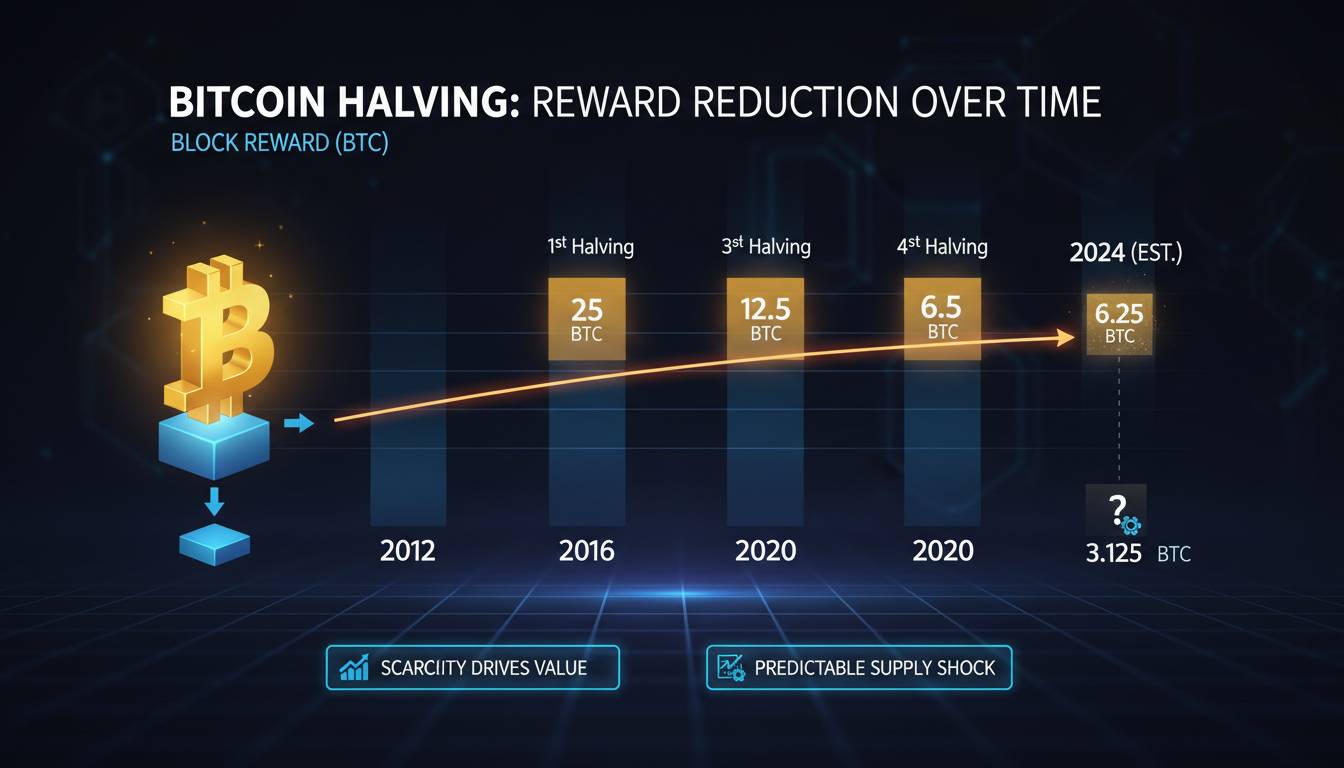
Bitcoin halving is a pre-programmed event that cuts the reward miners receive for validating new blocks by 50% every 210,000 blocks—approximately every four years. Since its inception in 2009, Bitcoin has undergone four halvings: in 2012, 2016, 2020, and most recently in April 2024, when the block reward dropped from 6.25 BTC to 3.125 BTC . This mechanism ensures Bitcoin’s total supply remains capped at 21 million, reinforcing its deflationary nature .
What Is the Bitcoin Halving?
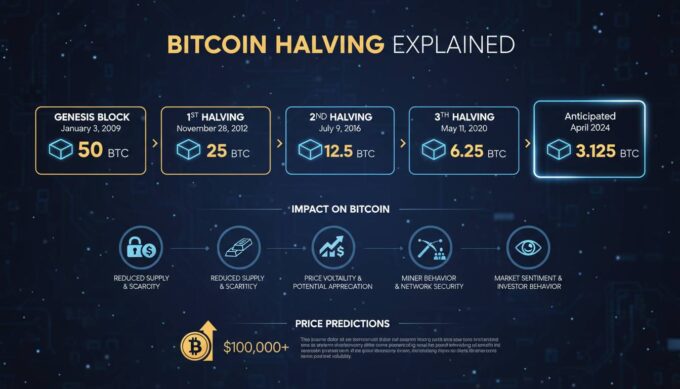
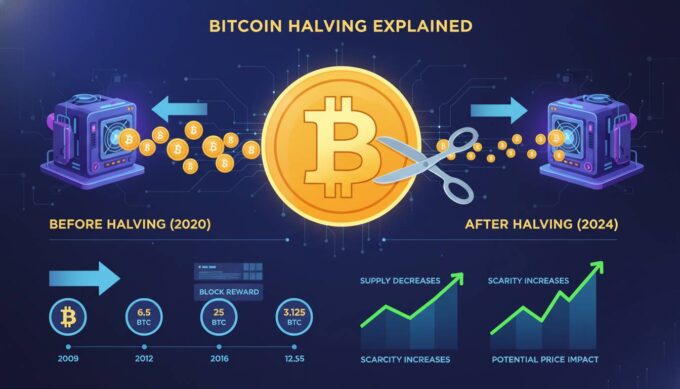
Bitcoin halving is embedded in the protocol to control inflation and introduce scarcity. Miners are rewarded with newly minted BTC for securing the network, but this reward halves every 210,000 blocks, roughly every four years . The schedule has unfolded as follows:
- 2009 (Genesis): 50 BTC per block
- 2012 (1st): 25 BTC
- 2016 (2nd): 12.5 BTC
- 2020 (3rd): 6.25 BTC
- 2024 (4th): 3.125 BTC
The next halving is projected for 2028, reducing the reward to approximately 1.5625 BTC per block .
Historical Impact and Market Dynamics
Price Trends and Market Cycles
Historically, Bitcoin halvings have preceded significant bull markets, with price surges occurring 12 to 18 months after the event. For instance:
- After the 2012 halving, Bitcoin gained over 8,800% within a year .
- The 2016 halving saw a 294% gain in 12 months .
- The 2020 halving produced a 540% gain within a year .
- The 2024 halving has shown a more modest 31% gain as of mid‑2025 .
This pattern of diminishing returns reflects Bitcoin’s maturation and growing market capitalization .
Recent Cycle: 2024 Halving
The April 19, 2024 halving occurred amid strong pre-halving momentum, driven by U.S. spot Bitcoin ETF approvals and institutional inflows. Bitcoin reached $70,000 in early 2024, and by April 2025, it stabilized around $83,000, with peaks near $109,000 . A recent academic study using synthetic control methods found that the 2024 halving had a positive effect on Bitcoin’s price three months later, accounting for about one-fifth of the total price change from April 2023 to July 2024 .
Market Patterns and Liquidity Considerations
Analysts have noted that Bitcoin’s price often follows a steady pattern post-halving, with all-time highs occurring around 1,065 days after the previous two halvings . However, macroeconomic factors such as U.S. dollar liquidity and tax season can influence short-term price behavior. For example, Arthur Hayes warned of potential selling pressure around the 2024 halving due to U.S. tax payments and tighter dollar liquidity .
Impact on Miners and Network Security
Miner Profitability and Industry Consolidation
Halvings immediately cut miner revenue in half, challenging those with inefficient hardware or high energy costs. After the 2024 halving, some miners struggled to remain profitable, leading to consolidation within the industry . Charles Edwards, founder of Capriole Investments, noted that older mining equipment could become unprofitable unless Bitcoin prices remain high .
Technological Adaptation and Efficiency
To survive, miners are investing in more efficient ASIC hardware and seeking cheaper energy sources. This trend is accelerating the shift toward renewable energy regions and driving innovation in mining operations . Despite reduced rewards, the network’s hash rate has remained resilient, underscoring the robustness of Bitcoin’s security model .
Broader Implications for U.S. Investors and Markets
Institutional Adoption and Regulatory Clarity
The 2024 halving coincided with growing institutional interest, particularly following U.S. spot Bitcoin ETF approvals. Regulatory clarity has encouraged investment and may amplify halving effects in future cycles .
Supply Scarcity and Inflation Dynamics
Bitcoin’s halving mechanism enforces scarcity, reducing new issuance and lowering inflation. The annual inflation rate is projected to fall to around 0.42% by 2028 . This makes Bitcoin increasingly attractive as a store of value, especially amid concerns over fiat currency inflation.
Macro and Market Risks
Despite the halving’s supply-side impact, macroeconomic conditions, regulatory developments, and market sentiment remain critical. Tim Draper has suggested that broader macro trends, such as U.S. dollar depreciation, may weaken the halving’s influence over time .
What to Expect Next
- The next halving is expected in early to mid‑2028, reducing the block reward to approximately 1.5625 BTC .
- Price appreciation may follow, but gains could be more modest as the market matures.
- Miners will continue optimizing operations, and the industry may further consolidate.
- Regulatory clarity and institutional adoption will play key roles in shaping market dynamics.
Conclusion
Bitcoin halving remains a defining feature of its economic design, reinforcing scarcity and influencing market cycles. While historical patterns suggest post-halving price rallies, each cycle shows diminishing returns as the market matures. The 2024 halving demonstrated resilience, with strong institutional support and technological adaptation among miners. Looking ahead to 2028, the halving will continue to shape Bitcoin’s trajectory, but its impact will increasingly depend on broader economic, regulatory, and adoption trends.
Frequently Asked Questions
What is a Bitcoin halving?
A Bitcoin halving is a programmed event that cuts the mining reward by 50% every 210,000 blocks, roughly every four years. It controls supply and enforces scarcity.
When was the most recent halving, and what was the reward change?
The most recent halving occurred on April 19, 2024, reducing the block reward from 6.25 BTC to 3.125 BTC.
When is the next halving expected?
The next halving is projected for early to mid‑2028, when the reward will drop to approximately 1.5625 BTC per block.
How have past halvings affected Bitcoin’s price?
Historically, halvings have preceded significant price rallies: over 8,800% after 2012, 294% after 2016, and 540% after 2020. The 2024 halving saw more modest gains, reflecting market maturity.
How do halvings impact Bitcoin miners?
Halvings halve miner revenue, challenging less efficient operations. This drives consolidation, technological upgrades, and a focus on energy efficiency.
Are halvings still relevant in a mature market?
Yes. Halvings continue to enforce scarcity and influence long-term value. However, their impact is now intertwined with institutional adoption, regulatory clarity, and macroeconomic conditions.
















Leave a comment