


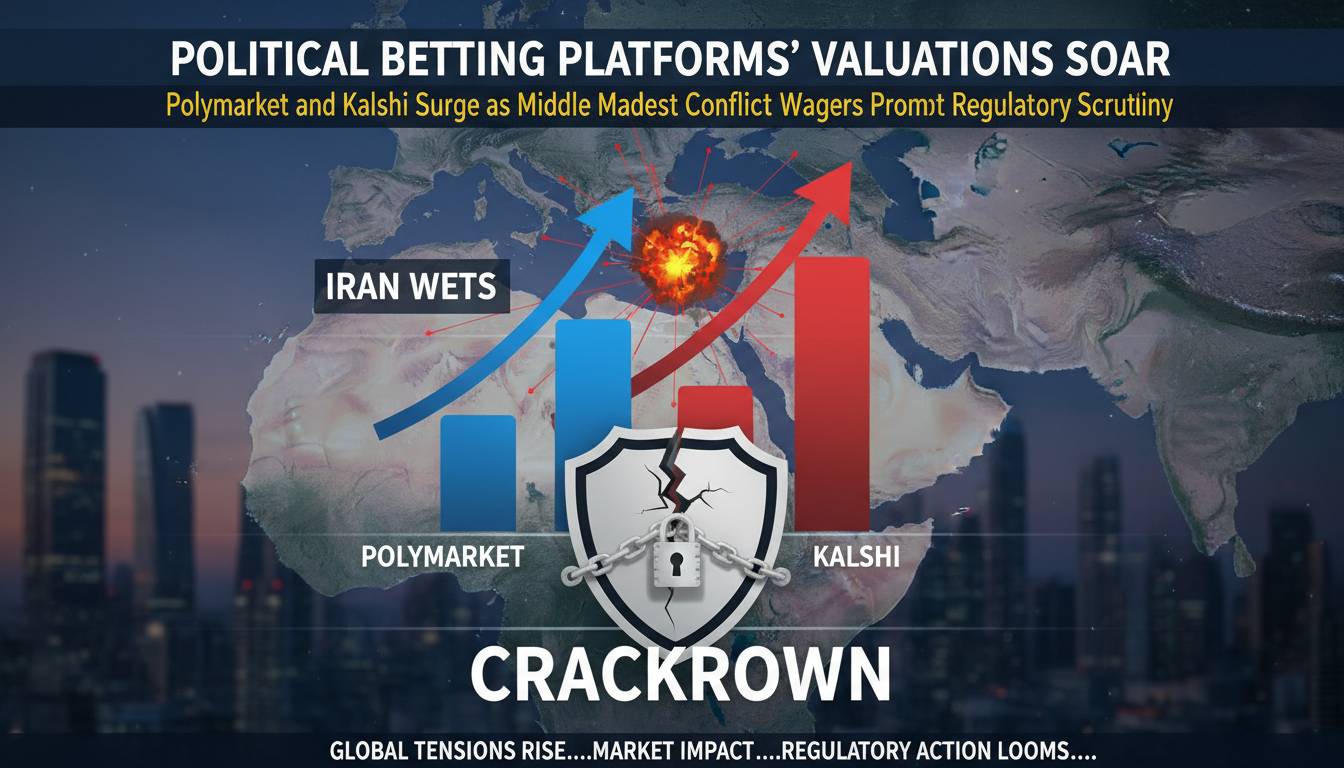
Wall Street’s interest in prediction markets is rising fast, but so is political scrutiny. Polymarket and Kalshi have moved from niche trading venues to major financial and policy flashpoints, with investors and lawmakers now debating whether these platforms are the next big market infrastructure story or a new regulatory risk. The debate intensified after heavy trading tied to Iran-related military events in early 2026, which triggered insider-trading concerns, national security questions, and a fresh push in Washington to tighten oversight.
Why Wall Street is watching prediction markets
The core investment case is simple: prediction markets turn uncertainty into tradable prices. Supporters argue that this creates a new category of financial data, one that can be sold to traders, institutions, media companies, and corporate clients. That logic has helped drive sharp valuation gains for both companies over the past year. Kalshi announced in June 2025 that it raised $185 million in a Series C round at a $2 billion valuation.
Polymarket’s trajectory has been even steeper. In October 2025, Intercontinental Exchange, the parent of the New York Stock Exchange, agreed to invest up to $2 billion in Polymarket, valuing the company at about $9 billion, according to Fortune, Yahoo Finance, and Axios reporting on the deal. Bloomberg-reported fundraising discussions later indicated Polymarket was seeking a valuation in the $12 billion to $15 billion range, while Kalshi was also said to be exploring financing at valuations above earlier levels.
That is why talk of eventual $20 billion valuations for Polymarket and Kalshi has gained traction on Wall Street. At this stage, however, a $20 billion figure appears to be market speculation rather than a completed financing benchmark for either company. Publicly reported completed valuations remain far below that level: about $9 billion for Polymarket after the ICE deal and $2 billion for Kalshi after its June 2025 round.
Wall Street eyes $20 billion valuations for Polymarket and Kalshi: How Iran war bets triggered Washington’s 2026 crackdown
The turning point came with a wave of Iran-related contracts that drew extraordinary trading activity and public attention. In late February and early March 2026, prediction markets tied to possible U.S. and Israeli military action against Iran surged in volume. Axios reported that Kalshi saw about $36 million in volume around an Iran regime-shift question, while Polymarket markets tied to Iran and the status of Supreme Leader Ali Khamenei also jumped sharply.
At the same time, media reports and outside analysts flagged suspiciously timed trades. The Washington Post reported that analytics firm Bubblemaps identified six suspected insiders on Polymarket who allegedly made about $1.2 million betting that the U.S. would strike Iran by February 28, 2026. The Associated Press separately reported in February 2026 that two Israelis were charged with using classified military information to place bets on Polymarket tied to future military operations.
Those developments transformed a fast-growing fintech story into a Washington policy issue. Critics argued that markets tied to war, assassinations, regime change, and military action create incentives that go beyond ordinary speculation. Supporters countered that prediction markets aggregate information and can provide useful signals during crises. That split now defines the industry’s next phase.
The regulatory backdrop around Kalshi and Polymarket
Kalshi and Polymarket operate under very different structures, and that distinction matters. Kalshi is a federally regulated exchange overseen by the Commodity Futures Trading Commission. Its legal position strengthened after court rulings in 2024 and the CFTC’s decision in May 2025 to drop its appeal in the election-contract case, clearing a major obstacle to political event trading.
Polymarket, by contrast, has built its business around crypto-based event contracts and has faced a more complicated U.S. regulatory path. Even as it expanded commercially and attracted major investors, reporting has noted continuing legal and compliance questions around access for U.S. users and the treatment of its contracts.
The result is a fragmented market:
- Kalshi has the advantage of federal regulation and a clearer legal framework.
- Polymarket has stronger crypto-native scale, brand recognition, and investor momentum.
- Both platforms now face rising pressure over contracts linked to war, politics, and sensitive government actions.
What Washington is doing in 2026
Washington’s response in 2026 has been swift but not uniform. AP reported in February 2026 that the Trump administration’s CFTC leadership signaled support for a federal framework that could help Kalshi and Polymarket operate across all 50 states. At the same time, lawmakers from both parties and several states have moved in the opposite direction, arguing that prediction markets are encroaching on gambling law and creating new corruption risks.
The most immediate pressure has centered on insider trading and misuse of nonpublic information. According to Washington Post reporting, Senator Chris Murphy said he is drafting legislation to broadly ban prediction-market trades related to government actions, arguing that such contracts could distort public decision-making by allowing officials or connected actors to profit from secret information. The Guardian also reported that Representative Ritchie Torres introduced the Public Integrity in Financial Prediction Markets Act after earlier concerns about politically sensitive trading.
This means the 2026 crackdown is not a single ban. It is better understood as a three-part response:
- Enforcement pressure over suspicious trading and market manipulation.
- Legislative proposals aimed at restricting contracts tied to war or government action.
- State-level legal fights over whether prediction markets are finance, gambling, or both.
Why the valuation story still matters
Even with the crackdown, investors continue to see a large addressable market. Prediction platforms generate revenue from trading activity, data licensing, and potentially enterprise analytics. If they become embedded in brokerage systems, media terminals, and institutional workflows, their economics could begin to resemble exchange operators or market-data businesses rather than simple betting apps. That is the thesis behind the aggressive valuation talk.
Still, the gap between current valuations and a hypothetical $20 billion benchmark remains large. For Polymarket, moving from about $9 billion to $20 billion would require sustained growth, regulatory durability, and broader institutional adoption. For Kalshi, the leap from $2 billion would be even more dramatic, though supporters argue its regulated status could justify a premium if Washington ultimately favors licensed exchanges over offshore or crypto-native rivals.
According to Judge Jia Cobb’s 2024 ruling in Kalshi’s favor, the CFTC does not have unlimited authority to reject election contracts on broad public-interest grounds, a legal point that strengthened the company’s market position. But that court victory does not settle the broader political question of whether Congress will now rewrite the rules.
Risks for investors, users, and policymakers
The current clash exposes several risks that go beyond headline valuations.
For investors
A platform can grow quickly and still face a sharp repricing if lawmakers restrict its most active contract categories. War, elections, and political outcomes often drive the highest engagement, but they are also the most controversial.
For users
Traders face uncertainty over contract design, settlement rules, and possible enforcement actions. The Washington Post highlighted controversy around Kalshi’s handling of bets tied to Khamenei’s death, showing how sensitive geopolitical contracts can create disputes even after an event occurs.
For policymakers
Officials must decide whether prediction markets improve price discovery or create perverse incentives. Academic and policy critics argue that these markets can project an illusion of neutral truth while being vulnerable to manipulation, capital asymmetry, and strategic trading.
Conclusion
Polymarket and Kalshi are now at the center of one of the most important regulatory debates in modern finance. Wall Street sees the outline of a new asset class and, potentially, companies that could one day command $20 billion valuations. Washington sees a fast-growing market where war, politics, and privileged information can collide in dangerous ways. As Iran-related bets pushed prediction markets into the national spotlight in early 2026, the industry’s future became less about novelty and more about whether regulators can draw a durable line between financial forecasting and unacceptable speculation.
Frequently Asked Questions
What are Polymarket and Kalshi?
Polymarket and Kalshi are prediction-market platforms where users trade contracts tied to future events. Kalshi operates as a CFTC-regulated exchange in the U.S., while Polymarket is a crypto-based platform with a more complex U.S. regulatory history.
Have Polymarket or Kalshi actually reached $20 billion valuations?
No completed public financing cited here shows either company at $20 billion. Publicly reported figures place Polymarket at about $9 billion after the October 2025 ICE deal and Kalshi at $2 billion after its June 2025 funding round.
Why did Iran war bets trigger a crackdown?
Iran-related contracts drew huge trading volumes and raised concerns about insider trading, misuse of classified information, and the ethics of profiting from military action. Those concerns prompted fresh scrutiny from lawmakers, regulators, and state officials.
Is Kalshi legal in the United States?
Kalshi has a stronger legal footing than many rivals because it is federally regulated by the CFTC, and court rulings in 2024 and 2025 strengthened its position on event contracts. That said, it still faces political and state-level challenges.
What is Washington likely to do next?
The most likely next steps are targeted enforcement, new disclosure and integrity rules, and possible legislation limiting contracts tied to war or sensitive government actions. A full nationwide ban is not established, but the policy direction is clearly toward tighter oversight.















Leave a comment