


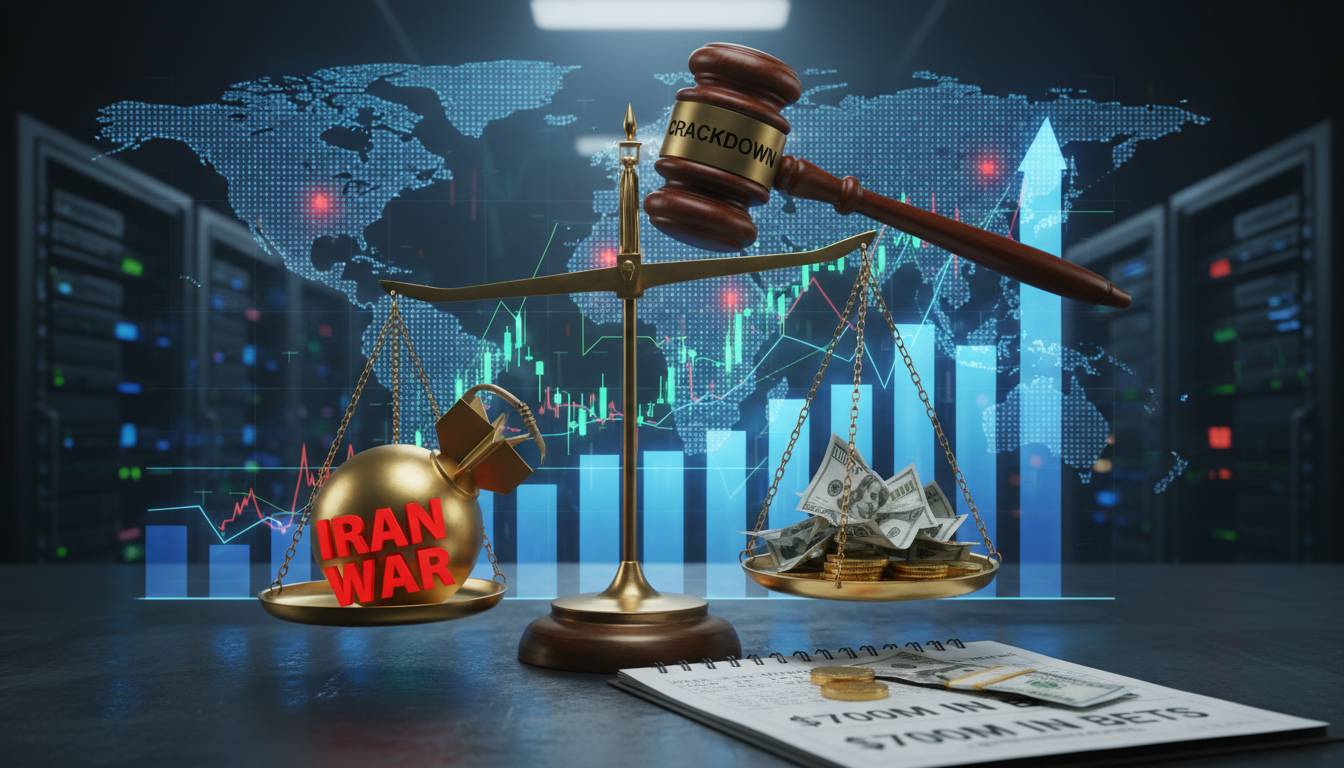
A surge of betting tied to a potential war with Iran is intensifying pressure in Washington to tighten oversight of prediction markets. Lawmakers, regulators and market critics are now focusing on two figures that have become central to the debate: roughly $529 million in Polymarket wagers tied to the timing of U.S. strikes on Iran, plus tens of millions more on related leadership and conflict contracts, and about $1.2 million in profits flagged by analysts as potentially suspicious. Together, those numbers have pushed the issue from a niche financial-regulation fight into a broader debate over national security, insider trading and the limits of event-based speculation.
A betting frenzy around war
The immediate trigger for the latest backlash was a wave of contracts linked to whether the United States would strike Iran by specific dates and whether Iran’s Supreme Leader would remain in power. Bloomberg Law reported that conflict-related betting on prediction markets hit a record in the week ending March 1, 2026, with Polymarket users placing $425.4 million on geopolitics questions during that week alone, up sharply from $163.9 million the week before. Separate reporting tied total Polymarket volume on Iran strike-timing contracts to about $529 million.
That figure does not capture the full universe of Iran-related wagers. The Washington Post reported that Polymarket users also placed more than $500 million on trades related to the timing of American strikes against Iran, while Kalshi froze $54 million in bets tied to Ayatollah Ali Khamenei’s status after controversy over contracts linked to violent outcomes.
Taken together, the combined volume across strike-timing, regime-change and leadership markets has fueled the shorthand now circulating in Washington: roughly $700 million in Iran war bets. That total is best understood as an aggregation from multiple related contracts and platforms, rather than a single official tally.
Suspicious profits sharpen scrutiny
The political reaction intensified after blockchain analysts and media reports highlighted unusual trading patterns shortly before the February 28, 2026 strikes. Forbes reported that six newly funded wallets collectively made about $1.2 million by betting “yes” on a contract asking whether the U.S. would strike Iran by February 28. The report said the wallets were funded within 24 hours of the strikes and followed a similar pattern: large bets on one date, smaller “decoy” bets on nearby dates, and limited prior trading history.
TechCrunch, citing analytics firm Bubblemaps SA, similarly reported that six newly created accounts made about $1 million in profit by correctly betting on the exact date of the attack. Fox Business also cited Reuters and other reporting describing a surge of “suspiciously timed bets” before the strikes.
No public evidence has yet shown that the wallets belonged to U.S. officials or that a crime occurred in this specific case. Forbes noted that no evidence had emerged publicly linking the suspicious wallets to any government official or political figure. Still, the pattern has become a rallying point for lawmakers who argue that markets tied to military action create obvious opportunities for misuse of nonpublic information.
Washington moves toward a crackdown
The response in Washington is no longer limited to criticism on social media. On March 10, 2026, Sen. Adam Schiff announced legislation to explicitly ban death and war prediction contracts, arguing that existing gaps still allow traders to profit from violent outcomes. In a Senate press release, Schiff said regulators had allowed prediction markets to become “the Wild West,” even though federal law already restricts certain contracts tied to terrorism, war and assassination.
Other Democrats have also escalated pressure. A February 13, 2026 letter led by Schiff and Sen. Catherine Cortez Masto urged CFTC Chair Michael Selig not to weaken the commission’s stance on contracts involving gaming, sports, terrorism and assassination. The letter came as the agency was already facing legal and political battles over the scope of its authority.
Rep. Ritchie Torres has also been linked to proposed legislation called the Public Integrity in Financial Prediction Markets Act, which would make trading on classified government information in prediction markets a federal crime, according to Forbes and other reports.
The CFTC’s role and the legal fight
The Commodity Futures Trading Commission sits at the center of the dispute. In a February 17, 2026 filing, the agency said it has exclusive jurisdiction over U.S. commodity derivatives markets, including event contract markets commonly called prediction markets. That position is significant because states, advocacy groups and some lawmakers have argued that many of these products function more like gambling than hedging or price discovery.
The CFTC had already announced a roundtable on prediction markets in 2025, citing unresolved questions involving event contracts, gaming restrictions, enforcement, federalism and ongoing litigation. Those issues have become more urgent as platforms expand from elections and sports into geopolitics and military conflict.
According to the CFTC, the agency has authority to police fraud, manipulation and misuse of confidential information in these markets. But critics argue that enforcement after the fact may not be enough when contracts involve war, assassination or state action.
Platforms defend their model
Prediction-market operators and supporters say the products can provide useful forecasting signals. Polymarket has argued that markets on world affairs can help users understand fast-moving events, especially during periods of geopolitical stress. The company has defended the informational value of such contracts even as criticism has mounted.
Kalshi, which is regulated in the United States, has taken a somewhat different approach. The company said it has a “death carveout” policy and reimbursed net losses for users in violent-event markets after concerns over Iran-related contracts. CEO Tarek Mansour said the company does not want to enable direct profiting from war, assassination, terrorism or similar outcomes.
That distinction matters politically. Kalshi operates under U.S. regulatory oversight, while Polymarket is structured differently and does not technically allow U.S. users to trade on its platform, though its markets still influence the broader debate in Washington.
Why the issue now looks bigger than gambling
The controversy is no longer just about whether prediction markets resemble sports betting. It now touches three separate policy concerns:
- National security: Contracts tied to military action may create incentives to exploit or seek nonpublic information.
- Market integrity: Suspiciously timed trades raise manipulation and insider-trading concerns.
- Regulatory boundaries: Federal and state authorities remain divided over whether these products are lawful derivatives, prohibited gaming, or something in between.
The concern is not theoretical. In February 2026, the Associated Press reported that two Israelis were charged with using classified military information to place bets on future military operations on Polymarket, in a separate case tied to earlier events. That case has added weight to arguments that prediction markets can become vehicles for trading on sensitive state information.
What comes next
Washington’s next steps could include new legislation, tighter CFTC enforcement, or both. Schiff’s bill targets war and death contracts directly, while broader proposals would criminalize trading on classified or nonpublic government information in prediction markets. At the same time, the CFTC is defending its authority over event contracts in court, suggesting the legal framework for the industry remains unsettled.
For investors, platforms and policymakers, the Iran betting episode may become a defining test case. If regulators conclude that these markets can be manipulated by insiders or can distort incentives around military action, the current light-touch approach is unlikely to survive. If, however, platforms can show robust surveillance, clear exclusions and effective compliance, they may preserve a narrower path for regulated event contracts in the United States. That balance will shape the next phase of the prediction-market industry.
Conclusion
The clash over $700 million in Iran war bets and $1.2 million in suspicious profits has transformed prediction markets from a fast-growing financial niche into a Washington flashpoint. The core question is no longer whether people will speculate on world events. It is whether markets tied to war, death and state action can exist without creating unacceptable risks for public integrity, national security and market fairness. With lawmakers drafting new restrictions and regulators under pressure to act, a crackdown now looks less like a possibility and more like the next chapter in the industry’s evolution.
Frequently Asked Questions
What are prediction markets?
Prediction markets are platforms where users trade contracts tied to the outcome of future events, such as elections, economic data releases or geopolitical developments. In the U.S., some event contracts fall under CFTC oversight.
Why are Iran-related bets causing controversy?
The controversy stems from the scale of the wagers, the violent nature of the underlying events, and reports that a small group of wallets made unusually well-timed profits shortly before the February 28, 2026 strikes on Iran.
Was there really $700 million bet on war with Iran?
The most widely cited confirmed figure is about $529 million in Polymarket strike-related contracts, plus tens of millions more in related leadership and conflict markets on Polymarket and Kalshi. The $700 million figure is a broader estimate across related Iran war contracts, not a single official total.
What is the $1.2 million suspicious profit figure?
That figure refers to profits attributed by analysts and media reports to a cluster of newly funded wallets that correctly bet on the timing of U.S. strikes on Iran shortly before they occurred. Public reporting has not established who controlled those wallets.
What is Washington likely to do next?
Lawmakers are pursuing bills that would ban war and death contracts or criminalize trading on classified government information. The CFTC is also under pressure to strengthen enforcement and clarify what kinds of event contracts are allowed.
Are prediction markets legal in the United States?
Some are, but the legal landscape is unsettled. The CFTC says it has exclusive jurisdiction over U.S. event contract markets, while courts, states and lawmakers continue to debate where lawful financial contracts end and prohibited gaming begins.

















Leave a comment