


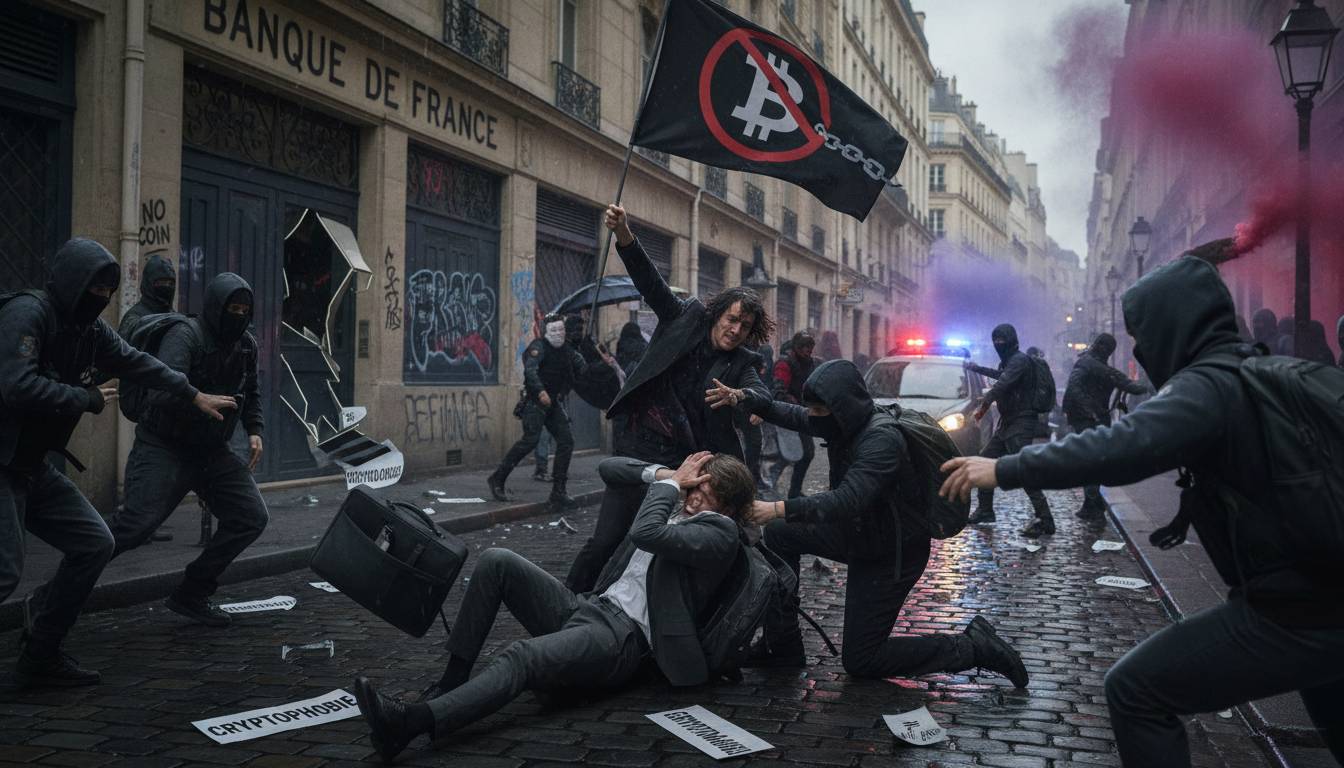
A wave of violent attacks linked to cryptocurrency wealth in France is drawing renewed attention from police, policymakers, and the digital-asset industry. What once appeared to be a threat concentrated around founders, executives, and high-profile insiders is now being discussed more broadly as criminals target people perceived to control or hold significant crypto assets. French authorities have publicly acknowledged the severity of the threat, while recent cases suggest the risk is no longer confined to company leadership alone.
A New Phase in France’s Crypto Crime Problem
The phrase “Crypto holders in France are being violently targeted again — and it’s no longer just insiders” captures a shift that has become harder to ignore in 2025 and early 2026. France has seen a series of kidnappings, attempted extortions, and violent abductions tied to digital-asset wealth, with some cases involving well-known figures in the sector and others extending to relatives or people adjacent to crypto fortunes. French officials have described these acts as “enlèvements et tentatives d’extorsion d’une grande violence,” or kidnappings and attempted extortions of great violence.
One of the most prominent cases involved David Balland, co-founder of French crypto wallet company Ledger, who was kidnapped with his wife in January 2025 from their home in central France before being rescued. The case became a national flashpoint because it showed how criminals were willing to move from online theft to physical coercion in pursuit of crypto-related ransom. Later reporting in France connected that case to a broader pattern of organized kidnappings targeting people associated with digital assets.
Another major case, reported by the Associated Press in May 2025, involved the father of a wealthy cryptocurrency entrepreneur. French police rescued him in a nighttime raid after he had been held for ransom. Authorities said the investigation included possible charges related to kidnapping involving torture or a barbaric act, underscoring the brutality of the methods being used.
These incidents matter because they show a widening target set. In earlier years, the greatest concern often centered on founders, exchange operators, or wallet executives. Now, relatives and other people believed to have access to crypto wealth are also at risk, suggesting criminals are relying on social mapping, public visibility, and perceived vulnerability rather than only direct insider status. That is an inference based on the pattern of reported cases and official concern about the broader “sector” rather than just named executives.
Why Crypto Holders in France Are Being Violently Targeted Again — and It’s No Longer Just Insiders
Several factors help explain why France has become a focal point for this type of crime. First, cryptocurrency can be transferred quickly, across borders, and in some cases under duress, making it attractive to organized criminal groups seeking ransom. Second, public visibility around crypto success — through media coverage, social media, startup profiles, and investment communities — can make targets easier to identify. Third, criminals appear to believe that some victims may prefer discretion, which can reduce immediate reporting and complicate prevention.
Chainalysis, in its 2025 crypto crime reporting, highlighted the escalation from cyber-enabled theft to physical attacks, describing violent crypto-related incidents as a notable development in the broader crime landscape. The firm’s analysis places France’s cases within an international pattern in which digital-asset crime is no longer limited to hacks, scams, and laundering networks.
French authorities have responded by treating the issue as a sector-wide security problem. On May 16, 2025, the French Interior Ministry convened crypto industry participants alongside senior police and gendarmerie officials and the Association for the Development of Digital Assets, or ADAN. The ministry said the goal was to “prevent, deter and protect the sector,” and it announced work on identifying specific vulnerabilities and strengthening protective measures.
That official framing is important. It suggests the state no longer sees these attacks as isolated incidents involving a few prominent entrepreneurs. Instead, the threat is being addressed as a structural risk affecting a wider ecosystem that includes founders, investors, employees, and potentially family members.
How the target profile appears to be expanding
Recent reporting points to at least three categories of victims:
- Company insiders, such as founders and executives in the crypto sector.
- Relatives of crypto entrepreneurs or investors, who may be seen as leverage points for ransom.
- People publicly associated with crypto wealth, even if they are not operational insiders. This is an inference drawn from the broader pattern of attacks and official warnings to the sector.
Organized Crime, Cross-Border Links, and Law Enforcement Response
French and international reporting indicates that some of these attacks are not opportunistic street crimes but organized operations. Le Monde reported in June 2025 that Moroccan authorities arrested a Franco-Moroccan man suspected of orchestrating crypto-related kidnappings in France, including the January 2025 abduction of David Balland. The report described a structured organization using local intermediaries, vehicle theft and disguise teams, detention logistics, and supply support.
If that reporting reflects the broader pattern, it means the threat has evolved into a form of specialized ransom crime with planning, compartmentalized roles, and cross-border dimensions. That raises the stakes for law enforcement because these networks may combine digital intelligence gathering with conventional kidnapping tactics.
French authorities have signaled a more coordinated response. The Interior Ministry said in May 2025 that police and gendarmerie were mobilized in support of crypto professionals and that perpetrators would be brought to justice. The ministry also referenced training on anti-money-laundering issues related to cryptoassets for police and gendarmerie through its cyber training center and police academy.
That response reflects a broader reality: crypto crime now sits at the intersection of cybercrime, financial crime, and violent organized crime. Traditional digital security measures such as hardware wallets, multi-signature controls, and phishing awareness remain important, but they do not fully address coercion in the physical world. Once criminals believe a victim can be forced to unlock devices, reveal seed phrases, or authorize transfers, the threat model changes dramatically. This is one reason the French cases are being watched closely outside the country as well.
Impact on the Crypto Industry and Investors
For France’s crypto sector, the attacks create both a security challenge and a reputational challenge. France has positioned itself as an important European market for digital assets, with homegrown firms such as Ledger helping define the region’s crypto infrastructure. Violent targeting of people linked to that ecosystem risks chilling entrepreneurship, increasing private security costs, and pushing some investors or executives to reduce their public profile.
The impact extends beyond founders. Venture investors, early employees, family offices, and high-net-worth individuals with visible crypto exposure may now reassess how much personal information they share publicly. In practical terms, that can mean tighter operational security, reduced social media visibility, more careful event attendance, and stronger coordination with law enforcement. Those are reasonable implications drawn from the nature of the attacks and the official response, though individual security decisions vary.
There is also a broader policy implication. As “Crypto holders in France are being violently targeted again — and it’s no longer just insiders” becomes a recognized public-safety issue, regulators and industry groups may face pressure to develop guidance that goes beyond compliance and cybersecurity. That could include best practices for executive protection, family risk management, incident reporting, and coordination between exchanges, wallet providers, and police. France’s May 2025 Interior Ministry meeting suggests that process is already beginning.
What stakeholders are watching now
Key questions for the market include:
- Whether attacks continue to spread beyond founders and executives.
- Whether law enforcement can dismantle the organized networks behind the crimes.
- Whether crypto firms adopt more formal physical-security protocols. This is an inference based on the ministry’s sector meeting and the nature of the threat.
- Whether other European countries see similar copycat patterns. Chainalysis indicates the issue is part of a wider international trend in violent crypto crime.
Conclusion
The recent pattern of kidnappings and extortion attempts in France marks a troubling evolution in crypto-related crime. High-profile cases involving Ledger co-founder David Balland and the father of a wealthy crypto entrepreneur show that criminals are willing to use extreme violence to pursue digital-asset ransom. French authorities have responded by elevating the issue to a national security concern for the crypto sector, and reporting suggests some of the networks involved are organized and transnational.
The central takeaway is clear: Crypto holders in France are being violently targeted again — and it’s no longer just insiders. The threat now appears broader, more organized, and more personal than many in the industry once assumed. For investors, companies, and policymakers, that means the next phase of crypto security will have to address not only wallets and blockchains, but also the physical safety of the people behind them.
Frequently Asked Questions
Why are crypto holders in France being targeted physically?
Because criminals may view crypto assets as fast-moving, high-value, and potentially accessible under coercion. Recent French cases show kidnappings and ransom attempts tied to people associated with digital-asset wealth.
Are only crypto executives being attacked?
No. Recent cases indicate that relatives of crypto entrepreneurs have also been targeted, suggesting the threat extends beyond direct company insiders.
What did French authorities do in response?
On May 16, 2025, the French Interior Ministry held a meeting with crypto-sector participants, police, gendarmerie, and ADAN to improve prevention, deterrence, and protection for the sector.
Was Ledger connected to one of the attacks?
Yes. David Balland, co-founder of Ledger, was kidnapped with his wife in January 2025 and later rescued by French authorities.
Is this only a France problem?
No. France is one of the most visible recent examples, but Chainalysis has described violent crypto-related crime as part of a broader international trend.
What is the biggest implication for the crypto industry?
The biggest implication is that security planning must now include physical protection, family risk, and crisis response, not only cybersecurity and compliance. This is an inference based on the pattern of attacks and the official French response.



















Leave a comment