


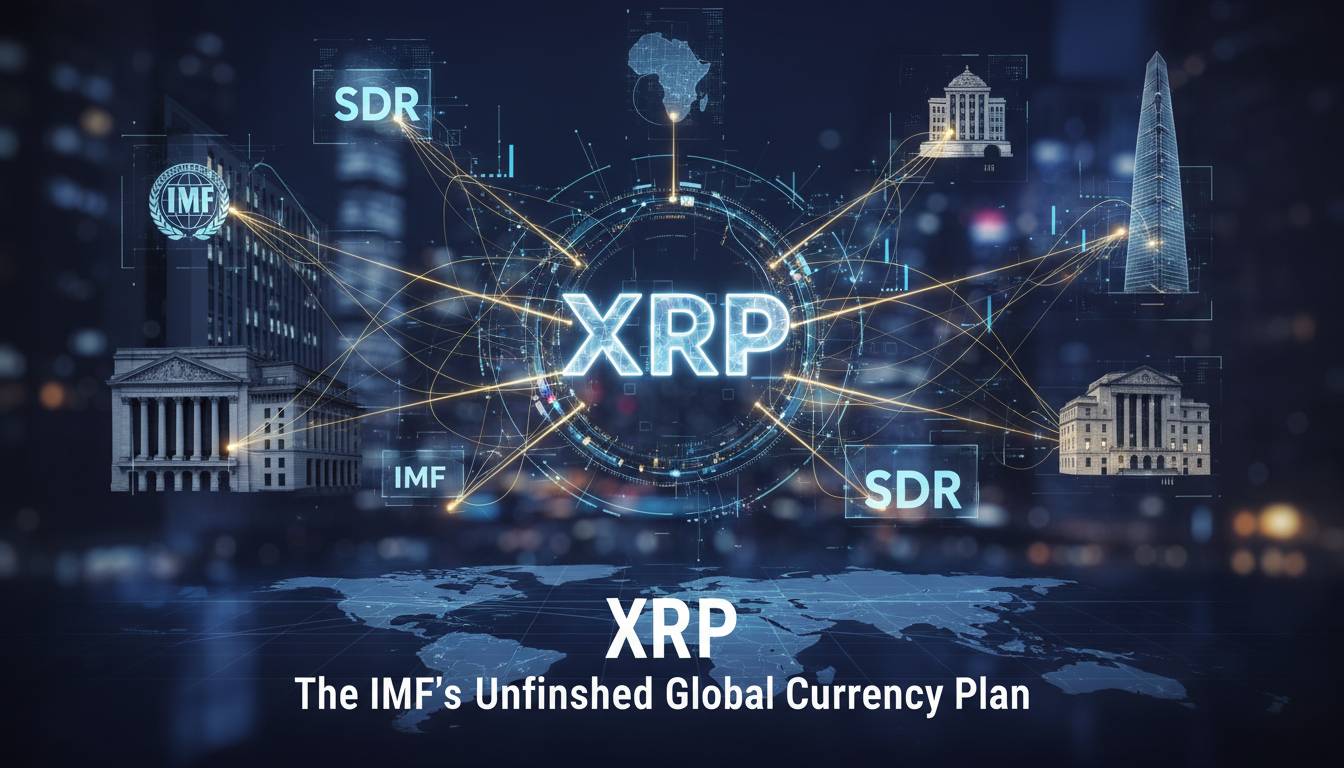
The idea behind “The 37-Year Plan: Is XRP the Global Currency the IMF Never Finished Building?” has gained traction in crypto circles because it connects two very different stories: the International Monetary Fund’s long-running effort to strengthen the global reserve system, and Ripple’s push to position XRP as a bridge asset for cross-border payments. The comparison is provocative, but the facts show a more nuanced picture. The IMF did create a reserve asset designed to support international liquidity, yet XRP remains a privately linked digital asset used in a commercial payments ecosystem rather than an IMF-backed monetary instrument.
Why the IMF Created the SDR
To understand the claim, it is necessary to start with the IMF’s Special Drawing Rights, or SDRs. The IMF created the SDR in 1969 as a supplementary international reserve asset during the Bretton Woods era, when the global monetary system depended heavily on gold and the U.S. dollar. Today, the SDR is valued against a basket of five currencies: the U.S. dollar, euro, Chinese renminbi, Japanese yen, and British pound. The IMF is explicit on one key point: the SDR is not a currency.
The historical record also explains why some commentators describe the SDR project as “unfinished.” In its institutional history, the IMF notes that the Second Amendment of its Articles stated that the SDR was intended to become “the principal reserve asset in the international monetary system.” In practice, however, that ambition was never fully realized. Political disagreements, the collapse of fixed exchange rates, and the continued dominance of major national currencies limited the SDR’s role.
That gap between ambition and reality is the foundation of the “unfinished plan” narrative. But the IMF’s own materials show that the SDR was designed as an official reserve asset for member states and prescribed holders, not as a retail or market-traded global currency. That distinction matters when comparing it with XRP.
The 37-Year Plan: Is XRP the Global Currency the IMF Never Finished Building?
The phrase “The 37-Year Plan: Is XRP the Global Currency the IMF Never Finished Building?” suggests that XRP may be the market-based successor to the IMF’s unrealized reserve-asset vision. There is no public evidence from the IMF stating that XRP is part of such a plan, or that the Fund has endorsed XRP as a future global currency. A factual reading of the record shows that this is an interpretation advanced by some market participants, not an official policy position.
What gives the theory staying power is XRP’s stated use case. Ripple says its payments products use XRP as a bridge asset that can help financial institutions move value across borders quickly, with settlement in about three seconds in some workflows. Ripple also markets infrastructure for cross-border payments, stablecoins, and central bank digital currency projects. Those features naturally invite comparisons with older efforts to modernize international settlement.
Still, the comparison has limits. The IMF’s SDR is a reserve asset allocated to member countries in proportion to IMF quotas. XRP, by contrast, is a digital asset operating on the XRP Ledger and used in private-sector and market-based contexts. One is an intergovernmental instrument embedded in treaty-based monetary governance; the other is a crypto asset associated with a technology company’s payments strategy.
What Ripple Is Actually Building
Ripple’s public materials focus on payments infrastructure rather than replacing sovereign currencies. The company says its cross-border products are designed to make transfers faster, more reliable, and less expensive for payment providers and institutions. XRP’s role in that model is to bridge between currencies, reducing the need for pre-funded accounts in destination markets.
Ripple has also expanded its messaging around tokenized finance and public-sector digital money. In 2023, the company launched a CBDC platform aimed at central banks and governments, noting that more than 90% of countries were exploring, developing, or implementing central bank digital currencies. More recently, Ripple highlighted ecosystem growth such as the launch of regulated stablecoin activity on the XRP Ledger, including Singapore dollar-denominated XSGD.
These developments are significant because they place XRP and XRPL within a broader debate about the future of cross-border settlement. Yet they do not amount to proof that XRP is becoming a global reserve currency. According to Ripple’s own descriptions, the company is building transaction rails and liquidity tools, not an IMF-style reserve architecture.
Regulation Remains a Central Risk
Any serious assessment of XRP’s global role must include regulation. In the United States, the SEC’s case against Ripple has shaped how institutions view XRP. The SEC stated in 2025 that the court found Ripple’s institutional sales of XRP violated Section 5 of the Securities Act, while certain secondary market sales did not receive the same treatment in the summary judgment ruling. The court also imposed a civil penalty of more than $125 million, according to the SEC statement.
That legal history matters because reserve assets and settlement infrastructure depend on trust, legal clarity, and broad institutional acceptance. Even if XRP has technical advantages in speed or cost, its path to becoming a universally accepted bridge asset is shaped by court rulings, regulatory policy, and market confidence. Those are not minor obstacles; they are central to whether any digital asset can scale into core financial plumbing.
At the same time, the regulatory environment is evolving. Public submissions and market filings in 2025 show that XRP continues to be discussed in policy and investment contexts, but those documents also underline the uncertainty around classification and enforcement. That uncertainty weakens the claim that XRP is already on a clear path to becoming a de facto global currency.
Why the Theory Persists
There are several reasons the theory behind “The 37-Year Plan: Is XRP the Global Currency the IMF Never Finished Building?” continues to resonate:
- The IMF did pursue a long-term reserve-asset project through the SDR.
- The SDR never became the dominant reserve instrument many reformers once imagined.
- Ripple promotes XRP as a tool for cross-border liquidity and settlement.
- Governments and financial institutions are actively exploring digital money infrastructure, including CBDCs and tokenized payments.
Those facts create a compelling narrative. But a compelling narrative is not the same as evidence of institutional continuity between the IMF’s SDR agenda and XRP’s market role. No official IMF source says XRP is the completion of the SDR project, and no public IMF framework identifies XRP as a designated reserve asset.
What This Means for Markets and Policymakers
For investors, the main takeaway is that XRP’s long-term value proposition depends less on grand historical theories and more on measurable adoption, legal clarity, and utility in payments. For policymakers, the debate highlights a broader issue: the global financial system still lacks a universally efficient, politically neutral, and widely accepted mechanism for cross-border settlement. The IMF’s SDR addressed that problem at the official reserve level, while crypto networks attempt to address it through technology and market incentives.
According to the IMF, the SDR remains an international reserve asset rather than a currency. According to Ripple, XRP is a digital asset that can bridge currencies in cross-border transactions. Those are related ideas, but they are not interchangeable.
The most balanced conclusion is that XRP is not the global currency the IMF “never finished building,” at least not on the basis of publicly available evidence. What XRP does represent is a private-sector attempt to solve some of the same frictions that motivated international monetary reform decades ago. That makes the comparison interesting, but not conclusive.
Conclusion
The story behind “The 37-Year Plan: Is XRP the Global Currency the IMF Never Finished Building?” is powerful because it blends monetary history with digital-asset ambition. The IMF’s SDR was created in 1969 to supplement global reserves, and for a time it was meant to play a larger systemic role. XRP, meanwhile, is being developed and marketed as a fast bridge asset for cross-border payments.
But the evidence does not support the stronger claim that XRP is the IMF’s unfinished project brought to life. The SDR is an official reserve asset governed by the IMF; XRP is a market-traded digital asset used in a private payments ecosystem. The overlap lies in the problem both seek to address, not in a shared institutional blueprint.
Frequently Asked Questions
Is XRP backed by the IMF?
No. There is no public IMF source showing that XRP is backed, issued, or endorsed by the IMF as a reserve asset.
What did the IMF actually create in 1969?
The IMF created the Special Drawing Right, or SDR, as a supplementary international reserve asset. The IMF states that the SDR is not a currency.
Why do people compare XRP with the SDR?
The comparison comes from their shared connection to cross-border liquidity and international settlement. XRP is promoted as a bridge asset, while the SDR was designed to support the global reserve system.
Can XRP become a global currency?
It could expand as a payment or liquidity asset if adoption and regulation move in its favor, but there is no factual basis today to describe it as a global currency on the level of an IMF reserve instrument.
What is the biggest obstacle to XRP’s broader adoption?
Regulatory clarity remains one of the biggest challenges, especially in the United States, where the SEC litigation has shaped institutional perceptions of XRP.
















Leave a comment