


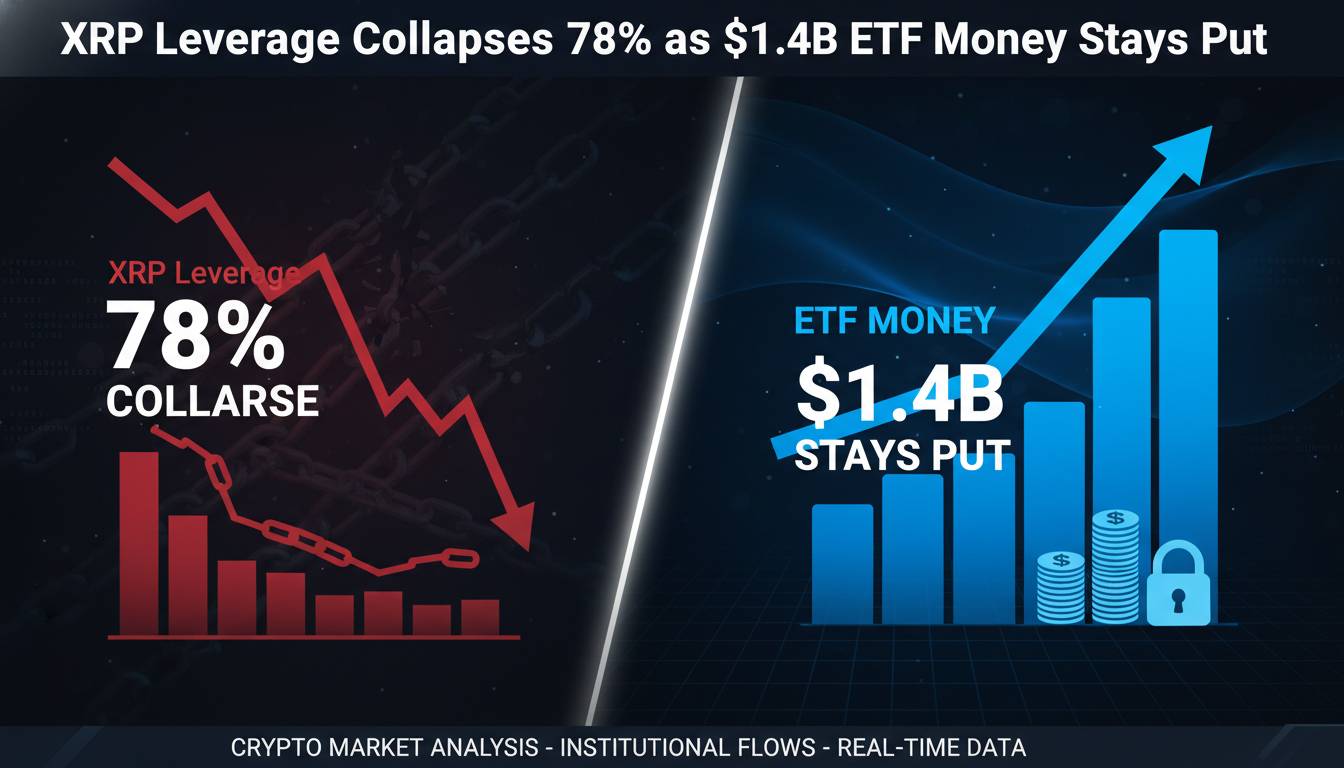
A sharp unwind in XRP derivatives has collided with a very different story in institutional positioning. While leveraged activity tied to XRP has fallen steeply, interest in exchange-traded products and broader Ripple-linked infrastructure has remained resilient. That divergence matters for U.S. investors because it suggests speculative heat is cooling faster than longer-duration capital is leaving the market. The result is a more nuanced picture: weaker short-term conviction in futures, but continued confidence in Ripple’s expanding global footprint and the investment products built around XRP.
A sharp reset in XRP leverage
The phrase “XRP leverage collapses 78%, but $1.4B in ETF money still won’t leave because of Ripple’s expanding footprint” captures a split market. On one side, XRP futures traders have been reducing risk. CoinGlass has highlighted periods in which XRP open interest dropped to the lowest levels of 2025, a sign that leveraged traders were unwinding positions rather than adding fresh exposure. That kind of move typically points to lower speculative appetite, tighter risk management, or both.
In crypto markets, leverage often amplifies price swings. When open interest and derivatives activity contract sharply, it usually means traders are stepping back after volatility, liquidations, or a failed breakout. For XRP, that matters because the token has often traded as both a legal-regulatory proxy for Ripple and a momentum asset for retail and derivatives desks. A 78% collapse in leverage, if measured from a prior peak in speculative positioning, would indicate a dramatic cooling in short-term risk-taking rather than a simple pause.
That does not automatically translate into broad capitulation. Futures traders and ETF-style investors often behave differently. Leveraged participants can exit quickly when volatility rises or momentum fades. Longer-horizon holders, by contrast, may focus more on custody, regulation, product access, and the issuer ecosystem around the asset. That distinction helps explain why a derivatives washout does not necessarily force money out of XRP-linked funds.
Why ETF-linked capital appears stickier
The second half of the story is the persistence of roughly $1.4 billion in ETF-related money tied to XRP exposure. In practice, that figure is best understood as capital committed to XRP-focused exchange-traded or trust-style products rather than a signal that U.S. spot XRP ETFs are fully established and trading at scale. Public SEC filings show active work around XRP investment vehicles, including filings connected to Grayscale and exchange proposals involving XRP-based products.
That distinction is important for U.S. readers. As of March 11, 2026, the regulatory pathway for XRP exchange-traded products has involved filings, amendments, and exchange-rule proposals, but the market structure remains more complex than for spot Bitcoin ETFs. Investors looking at the $1.4 billion figure should therefore separate “money associated with XRP fund products” from assumptions about a fully mature U.S. ETF market identical to Bitcoin’s.
Still, the persistence of capital is notable. Fund investors are often less reactive than perpetual futures traders. They may be positioning for eventual regulatory clarity, broader exchange access, or Ripple’s ability to deepen XRP’s utility through payments, custody, tokenization, and enterprise blockchain services. In that sense, the money staying put may reflect a strategic bet on infrastructure rather than a near-term price call.
Ripple’s expanding footprint supports the narrative
Ripple has continued to broaden its operating footprint across multiple regions, and that expansion is central to the bullish institutional case. On March 11, 2026, Ripple announced plans to secure an Australian Financial Services License through the proposed acquisition of BC Payments Australia Pty Ltd. The company said its APAC payments volume nearly doubled year over year in 2025, underscoring momentum in one of its most important growth regions.
Europe has also become a major part of Ripple’s strategy. In a March 2025 company update, Ripple pointed to custody partnerships with DZ Bank and BBVA Switzerland, the addition of Societe Generale’s stablecoin to the XRP Ledger, and the opening of a Geneva office. Ripple also said it had more than 60 global regulatory licenses, a figure that speaks directly to the compliance-first message it has been emphasizing to institutions.
The company has also pushed deeper into tokenization and ecosystem development. In July 2025, Mercado Bitcoin said it planned to tokenize more than $200 million in regulated financial assets on the XRP Ledger. Around the same time, Ripple launched a blockchain accelerator with Tenity in Singapore, aimed at supporting startups building on XRPL. These moves broaden the XRP story beyond trading and into payments, real-world assets, and developer adoption.
According to Monica Long, Ripple’s president, the company’s strategy has centered on expanding licenses and making acquisitions to broaden product offerings and serve more enterprise customers. That framing matters because it positions Ripple less as a single-token narrative and more as a regulated digital-asset infrastructure company.
What the divergence means for investors
For traders, the collapse in leverage is a warning that momentum can evaporate quickly. Lower open interest can reduce the risk of cascading liquidations, but it can also signal weaker conviction and thinner speculative demand. In the short term, that may limit upside unless spot demand or institutional inflows accelerate.
For longer-term investors, the steadier fund capital suggests a different calculus:
- Regulatory optionality: Investors may be betting that additional XRP fund approvals or broader exchange access will improve liquidity and legitimacy.
- Enterprise adoption: Ripple’s licenses, custody relationships, and payments expansion create a business case that extends beyond token price action.
- XRPL development: Tokenization, accelerators, and ecosystem funding may strengthen the ledger’s utility over time.
- Geographic diversification: Expansion in APAC, Europe, and the Middle East reduces reliance on any single market.
There are also clear risks. XRP remains exposed to regulatory scrutiny, market volatility, and competition from other blockchain networks focused on payments and tokenization. SEC documents tied to XRP product proposals also underscore the asset’s volatility and the structural risks associated with digital-asset markets.
XRP leverage collapses 78%, but $1.4B in ETF money still won’t leave because of Ripple’s expanding footprint
This divergence is ultimately a test of what kind of market XRP is becoming. If the asset were driven only by leverage, a collapse in derivatives activity would likely trigger a broader exodus. Instead, the available evidence suggests that at least part of the investor base is looking past short-term positioning and focusing on Ripple’s regulated expansion, enterprise partnerships, and the XRP Ledger’s role in tokenization and payments infrastructure.
That does not guarantee price stability or future gains. It does, however, suggest that XRP’s market structure is evolving. Speculative traders may be leaving, but strategic capital appears more willing to wait. For U.S. investors, that means the XRP story is no longer just about courtroom headlines or retail momentum. It is increasingly about whether Ripple can convert its global footprint into durable demand for the products and networks connected to XRP.
Conclusion
XRP’s latest market split is striking. Leverage has fallen sharply, signaling a retreat by fast-money traders, yet capital tied to XRP fund products has shown greater staying power. The most plausible explanation is that institutional and longer-duration investors are anchoring their thesis to Ripple’s expanding footprint across payments, custody, licensing, and tokenization rather than to short-term derivatives momentum alone.
Whether that resilience holds will depend on regulation, product approvals, and Ripple’s ability to turn geographic expansion into measurable network usage. For now, the message from the market is mixed but clear: speculative enthusiasm has cooled, while strategic interest in the broader Ripple ecosystem remains intact.
Frequently Asked Questions
What does it mean that XRP leverage collapsed 78%?
It means speculative positioning in XRP derivatives, such as futures, fell sharply from a prior high. In market terms, that usually reflects traders closing leveraged bets and reducing risk.
Does the $1.4 billion figure mean U.S. spot XRP ETFs are fully established?
Not necessarily. Public filings show active XRP-related fund and exchange proposals, but investors should distinguish between capital associated with XRP investment products and a fully mature U.S. spot ETF market.
Why would fund investors stay invested if traders are pulling back?
Fund investors often focus on longer-term themes such as regulation, custody, enterprise adoption, and product access. Ripple’s global expansion may support that longer-duration view.
How is Ripple expanding its footprint?
Ripple has announced plans to secure an Australian financial services license, highlighted European custody and office expansion, and supported tokenization and accelerator initiatives tied to the XRP Ledger.
What are the main risks for XRP from here?
Key risks include regulatory uncertainty, crypto-market volatility, competition from other blockchain networks, and the possibility that enterprise adoption does not translate into stronger XRP demand.
















Leave a comment