


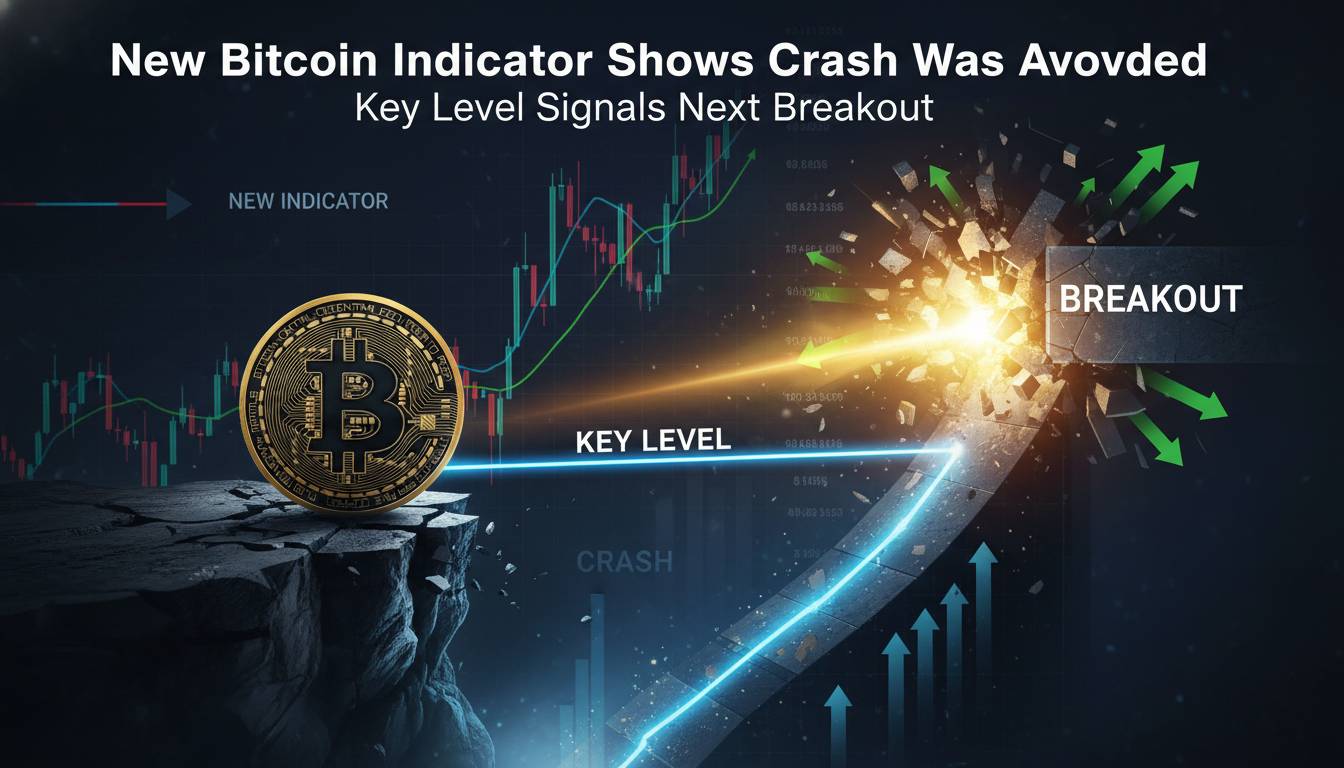
Bitcoin has steadied after a sharp bout of volatility, and a cluster of market indicators now suggests the cryptocurrency may have narrowly avoided a deeper breakdown. As of March 9, 2026, Bitcoin is trading near $68,953, after moving between an intraday low of $65,688 and a high of $69,397. That rebound has shifted attention from immediate downside risk to a more focused question: whether Bitcoin can clear the next major resistance zone and confirm a fresh breakout.
The latest market debate centers on a familiar but critical setup. Several analysts say Bitcoin has defended an important support band after weeks of consolidation and liquidation-driven selling. At the same time, on-chain and derivatives data indicate that one price level could now determine whether the market resumes its broader uptrend or slips back into another corrective phase.
Why the New Bitcoin Indicator Matters Now
The phrase “New Bitcoin indicator reveals we just avoided a major drop — but one level could decide the next breakout” reflects a broader shift in how traders are reading the market. Rather than relying on price alone, many are combining support-resistance analysis with liquidation maps, ETF flow data, and on-chain positioning to judge whether downside pressure is fading. Recent reporting from market analysts points to a constructive pattern: Bitcoin has held above a key support region even after a severe correction from earlier 2026 highs.
One of the clearest signals comes from the market’s ability to avoid a breakdown below the mid-$60,000 area. Several recent analyses identify roughly $65,000 to $66,000 as a major support zone, with $60,000 viewed as a deeper line of defense if selling intensifies. Holding above that first band matters because it reduces the risk of cascading liquidations and suggests buyers are still active on dips.
According to Jake Kennis, a research analyst at Nansen quoted by Forbes, Bitcoin has “successfully avoided a bear flag breakdown,” which he described as constructive, though not outright bullish. That distinction is important. Avoiding a crash is not the same as confirming a rally, but it does imply that the market has, at least for now, rejected a more severe bearish scenario.
The Support Zone That Helped Bitcoin Avoid a Major Drop
Bitcoin’s recent price action shows why support levels remain central to the outlook. The cryptocurrency fell into a zone that many traders had been watching for weeks, then rebounded before a decisive weekly collapse could take hold. Some market commentary in February pointed to a weekly close below the high-$60,000 area as a trigger for a deeper move toward $60,000 or even the mid-$50,000s. That scenario has not materialized so far.
This is where the “avoided a major drop” narrative gains credibility. The market did not simply bounce randomly. It stabilized in a region that multiple analysts had already identified as structurally important. That does not guarantee a bottom is in place, but it suggests the sell-off met meaningful demand rather than panic-driven abandonment.
Several factors appear to have supported that defense:
- Spot ETF inflows returned: Spot bitcoin exchange-traded funds attracted roughly $1.1 billion in net inflows across March 2 through March 4, according to data cited by The Block from trackers including Farside Investors and CoinGlass.
- Institutional demand improved: A separate March 2 data point showed about $458.2 million in daily net inflows into spot Bitcoin ETFs, signaling renewed appetite after a weaker stretch.
- Liquidation risk eased: Analysts tracking derivatives markets have argued that more balanced positioning lowers the odds of forced selling spirals.
Taken together, those signals suggest Bitcoin’s recent floor was not based on sentiment alone. Capital flows and positioning data both point to a market that found support before a larger breakdown could unfold.
New Bitcoin Indicator Reveals We Just Avoided a Major Drop — But One Level Could Decide the Next Breakout
If support helped Bitcoin avoid a sharper decline, resistance now defines the next test. Recent analyst commentary points to a relatively tight overhead band that must be reclaimed before bullish momentum can be considered restored. Forbes reported in January that the $94,000 to $95,000 area was viewed by one technical analyst as the upper boundary of the then-current range and a necessary breakout zone for renewed upside. More recent market commentary in early 2026 has shifted that focus lower, with several analysts highlighting the $70,000 to $73,500 region, and in some cases $78,000, as the immediate barrier that could determine the next directional move from current levels.
Given Bitcoin’s current price near $68,953, the near-term level appears to be the low-$70,000s. A sustained move above that zone would likely signal that buyers have absorbed nearby selling pressure and that the market is ready to challenge higher resistance levels. Failure there, by contrast, could keep Bitcoin trapped in a broad consolidation range and raise the risk of another retest of support.
This is why the “one level” matters so much. In practical terms, traders are watching whether Bitcoin can turn resistance into support. That transition often marks the difference between a temporary rebound and a genuine breakout.
What analysts are watching
Current market analysis broadly centers on these levels:
- $65,000–$66,000: First major support zone that helped prevent a deeper sell-off.
- $70,000–$73,500: Immediate resistance band that could confirm a stronger recovery if broken decisively.
- $78,000: A higher resistance target cited in some March 2026 market analysis as the next upside checkpoint after a breakout.
- $60,000: A major fallback support if the current rebound fails.
What This Means for Investors, Traders, and ETFs
For short-term traders, the current setup is relatively clear. Bitcoin has avoided the kind of breakdown that often leads to panic selling, but it has not yet delivered a confirmed breakout. That leaves the market in a transition phase where price action around resistance may matter more than broad narratives.
For longer-term investors, the picture is more nuanced. Renewed ETF inflows suggest institutional interest remains present even after a difficult correction. That matters because spot ETF demand has become one of the most visible sources of structural support in the Bitcoin market. Strong inflows do not eliminate volatility, but they can help absorb supply during periods of stress.
There is also a broader macro implication. Bitcoin’s ability to hold support despite sharp drawdowns may reinforce the view that the asset is maturing, with deeper pools of capital stepping in during weakness. At the same time, the market remains highly sensitive to leverage, sentiment, and liquidity conditions, which means any breakout attempt could still fail if broader risk appetite deteriorates. That is why analysts continue to frame the current moment as an inflection point rather than a confirmed trend reversal.
Risks That Could Still Change the Outlook
Even with the recent rebound, several risks remain. The first is straightforward: Bitcoin could fail to break resistance and drift back toward the support zone it just defended. Repeated tests of support often weaken it over time, especially if buying volume fades.
The second risk is that derivatives positioning could again amplify volatility. Liquidation clusters above and below the market can accelerate moves in either direction, creating sharp swings that are not always tied to fundamental developments. Analysts who track liquidation maps have warned that Bitcoin remains in a zone where leverage can still drive outsized price action.
The third is that institutional flows can reverse. While early March brought a notable rebound in ETF demand, those flows are not guaranteed to remain positive. If inflows slow or turn negative again, one of the market’s recent support pillars could weaken.
Conclusion
Bitcoin appears to have avoided a more severe breakdown, and the evidence behind that view is stronger than a simple price bounce. Support in the mid-$60,000 range held, ETF inflows improved, and analysts say the market sidestepped a bearish technical trigger that could have opened the door to a much deeper decline.
The next chapter now depends on resistance. If Bitcoin can decisively reclaim the low-$70,000s and build above that zone, the case for a broader breakout strengthens. If it cannot, the market may remain stuck in consolidation, with downside risks returning to the foreground. For now, the new Bitcoin indicator reveals we just avoided a major drop — but one level could still decide the next breakout.
Frequently Asked Questions
What is the key Bitcoin level traders are watching now?
The most immediate level is the low-$70,000s, with several recent analyses pointing to roughly $70,000 to $73,500 as the resistance band that could determine whether Bitcoin confirms a stronger breakout.
Did Bitcoin really avoid a major crash?
Current market evidence suggests Bitcoin avoided a deeper breakdown by holding above a major support zone near $65,000 to $66,000. Analysts had warned that losing that area could expose the market to a larger move toward $60,000 or lower.
What indicator is driving this outlook?
There is no single universal indicator behind the thesis. The outlook comes from a combination of technical support-resistance analysis, liquidation positioning, ETF flow data, and on-chain market structure signals.
Why do ETF inflows matter for Bitcoin price?
Spot Bitcoin ETF inflows matter because they represent direct institutional demand. Recent inflows of roughly $1.1 billion over three trading sessions in early March suggest buyers stepped in during a fragile period for the market.
What happens if Bitcoin fails to break resistance?
If Bitcoin cannot clear resistance, it may remain range-bound or retest support near the mid-$60,000s. A breakdown below that area could reopen the path toward $60,000, which many analysts still view as a major fallback level.




















Leave a comment