


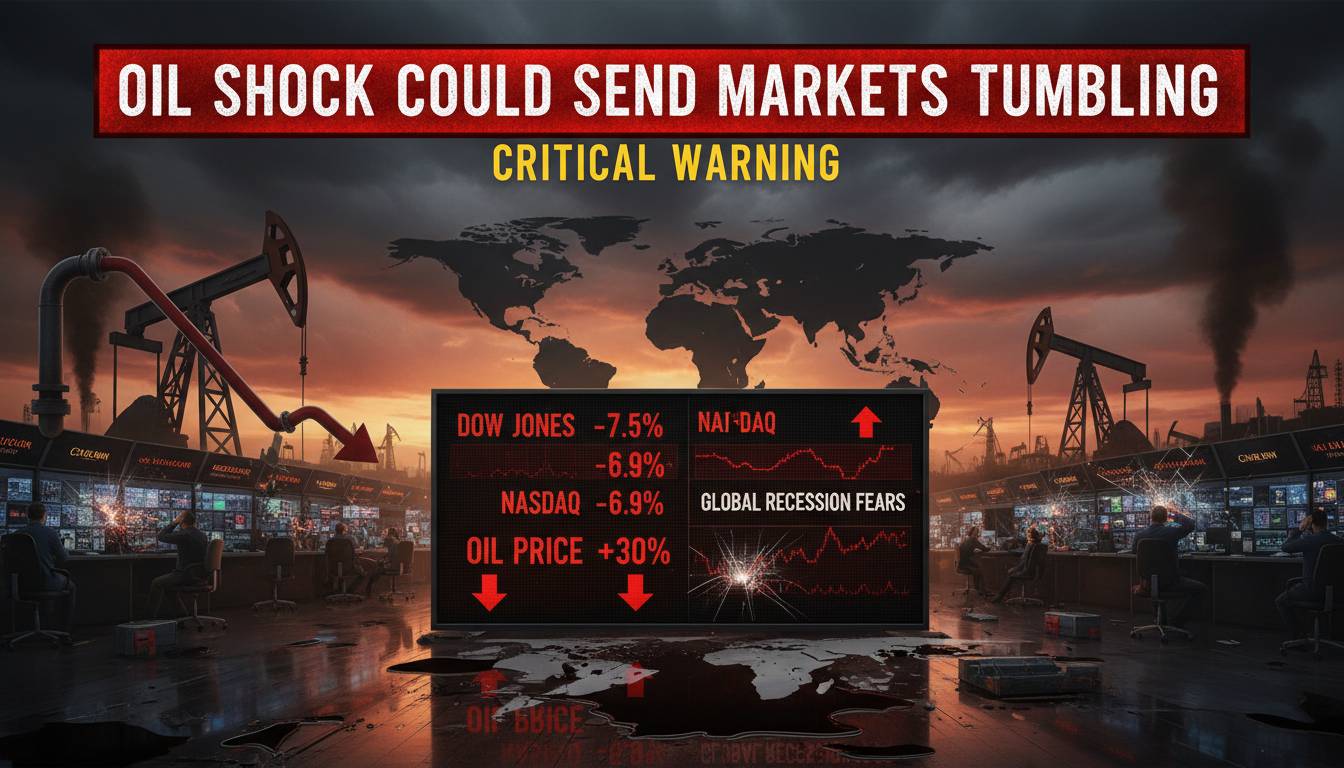
A fresh oil shock is back at the center of the market conversation in the United States as crude prices climb on escalating Middle East tensions and investors weigh the risk of slower growth alongside renewed inflation pressure. On March 6, 2026, U.S. stocks fell sharply after oil surged to its highest level in nearly two years, reviving fears that higher energy costs could hit consumers, corporate margins, and Federal Reserve policy all at once.
Why an oil shock could send markets lower
The latest warning for Wall Street is not simply about higher gasoline prices. It is about the broader macroeconomic mix that often follows an energy spike: weaker consumer spending, stickier inflation, and tighter financial conditions. That combination can pressure both stocks and bonds, especially when investors are already uneasy about growth.
The immediate catalyst is geopolitical risk tied to the Middle East and the possibility of supply disruption through the Strait of Hormuz, one of the world’s most important energy chokepoints. Recent reporting indicates that oil prices jumped as the conflict involving Iran intensified, with markets reacting to the prospect that a prolonged disruption could remove meaningful supply from global trade flows.
The International Energy Agency has still described the oil market through early 2026 as one with significant supply-and-demand monitoring needs, while OPEC+ had reconfirmed plans to maintain current production quotas through March, limiting the speed of any immediate supply response. That matters because when spare capacity is not mobilized quickly, geopolitical shocks tend to feed directly into prices.
For U.S. investors, the concern is straightforward. If oil remains elevated for weeks rather than days, the shock can spread beyond the energy complex and into transportation, manufacturing, retail, and household budgets. Markets often reprice quickly when they see a risk that inflation will stay high just as growth cools.
What happened in markets on March 6, 2026
The market reaction on Friday, March 6, offered a clear snapshot of investor anxiety. According to the Associated Press, the S&P 500 fell 1%, the Dow Jones Industrial Average dropped 570 points, and the Nasdaq Composite lost 0.8% by late morning in New York trading after oil prices spiked and labor-market data added to concerns about a slowing economy. The Dow had been down as much as 945 points earlier in the session before trimming losses.
That move reflects a classic “stagflation scare” trade. Investors tend to sell risk assets when they believe companies will face higher input costs while consumers pull back. Energy producers may benefit from higher crude prices, but most sectors do not. Airlines, logistics firms, chemical producers, and many consumer-facing businesses are especially exposed when fuel and transport costs rise quickly.
The warning is not limited to equities. Higher oil can also complicate the bond market outlook because inflation expectations may rise even as recession fears deepen. That creates uncertainty over whether the Federal Reserve can ease policy aggressively if price pressures reaccelerate. In practical terms, an oil shock could send markets tumbling because it narrows the room for policymakers to support growth without risking another inflation wave.
Supply risks and the Strait of Hormuz
The core issue is supply security. Roughly one-fifth of global oil and natural gas trade typically moves through the Strait of Hormuz, making any disruption there a major global event. While some market commentary around the current crisis remains fluid, multiple reports have pointed to fears that shipping interruptions or broader regional escalation could tighten supply and push crude significantly higher.
The World Bank warned in an earlier commodity outlook that a disruption of 3 million barrels per day involving one or more Middle East producers could lift oil to an average of about $102 a barrel. That estimate predates the current March 2026 market stress, but it remains relevant because it illustrates how quickly prices can move when a concentrated supply region is threatened.
According to the IEA’s February 2026 Oil Market Report, OPEC+ had reconfirmed its plan to maintain current production quotas through March. That means the market entered this latest geopolitical flare-up without an immediate policy shift large enough to fully offset a sudden supply loss.
Key channels through which the shock spreads
An oil spike usually reaches the U.S. economy through several paths:
- Higher gasoline and diesel prices for households and businesses
- Rising freight, airline, and shipping costs
- Increased input costs for manufacturers and agriculture
- Stronger inflation expectations, which can affect interest rates
- Lower consumer confidence and discretionary spending
Each of those channels can weigh on earnings forecasts and equity valuations, particularly if the shock lasts beyond a short-term headline event.
How exposed is the U.S. economy?
The U.S. is less vulnerable to oil shocks than it was in earlier decades because domestic shale production has transformed the country into a major producer and exporter. That structural shift can cushion the hit to national output compared with past crises, even if consumers still feel pain at the pump. Reporting this month noted that the economic damage from $100-plus oil may be smaller for the U.S. than in previous oil shocks because of that production base.
Still, “less vulnerable” does not mean immune. U.S. households remain highly sensitive to gasoline prices, and inflation psychology can change quickly when energy costs jump. If consumers expect broader prices to rise again, spending patterns can shift and businesses may become more cautious on hiring and investment.
There is also a distributional effect. Oil-producing states and energy companies may benefit from stronger crude prices, but many sectors outside energy face margin pressure. Lower-income households are often hit hardest because fuel and utility costs take up a larger share of their budgets. That can weaken demand in the broader economy even if headline GDP proves more resilient than in past oil crises.
What experts and institutions are signaling
Publicly available institutional analysis points to a market that was already delicately balanced before the latest geopolitical escalation. The IEA has continued to frame its monthly oil reports around supply, demand, inventories, and OPEC+ policy, underscoring how quickly sentiment can change when geopolitical risk collides with production discipline.
According to the World Bank’s commodity outlook, a meaningful Middle East supply disruption could reignite inflation and slow the global disinflation process. That warning has become more relevant as investors confront the possibility that energy prices may stay elevated longer than expected.
According to the Associated Press, Friday’s market sell-off reflected exactly that fear: a weakening economy paired with higher inflation. That is one of the most difficult scenarios for central banks and one of the least favorable for risk assets.
What comes next for investors and policymakers
The next phase depends on duration and scale. If the geopolitical shock eases quickly and shipping flows normalize, markets may recover some of the recent losses. If the disruption broadens or lasts for several weeks, investors are likely to focus on three variables:
- Crude price stability: Whether Brent and WTI hold near current highs or move toward $100.
- Policy response: Whether OPEC+ raises output or governments consider strategic reserve releases.
- Inflation pass-through: Whether higher energy costs begin to show up in broader consumer prices.
A coordinated release from strategic reserves remains one possible stabilizer, though its effectiveness depends on the size and duration of the disruption. OPEC+ production policy will also be critical, especially if the group decides that market stability requires faster supply additions.
Conclusion
The latest oil surge is more than a commodity story. It is a test of how resilient U.S. markets are to a renewed energy shock at a time when growth concerns are already building. An oil shock could send markets tumbling not only because fuel becomes more expensive, but because it threatens to revive inflation, squeeze consumers, and limit the Federal Reserve’s flexibility. For now, the warning is clear: if crude stays elevated and geopolitical tensions deepen, the pressure on Wall Street and the broader U.S. economy could intensify.
Frequently Asked Questions
What does “oil shock could send” mean in market terms?
It refers to the risk that a sudden jump in oil prices could send stock markets lower, inflation higher, and economic growth weaker, especially if the price spike lasts for more than a brief period.
Why are oil prices rising now?
Current price pressure is tied largely to escalating Middle East tensions and fears of supply disruption, particularly around the Strait of Hormuz.
Could oil really reach $100 a barrel?
Yes, that is within the range of plausible outcomes in a serious supply disruption scenario. The World Bank previously estimated that a 3 million barrel-per-day disruption could push average prices to about $102 a barrel.
Is the U.S. economy still vulnerable to an oil shock?
Yes, although less than in past decades because the U.S. is now a major oil producer. Consumers and many non-energy industries still face higher costs when crude rises sharply.
Which sectors are most at risk if oil stays high?
Transportation, airlines, logistics, chemicals, manufacturing, and consumer discretionary sectors are typically among the most exposed to sustained increases in energy costs.
What should investors watch next?
The most important signals are the duration of the geopolitical conflict, any disruption to shipping through Hormuz, OPEC+ production decisions, and whether inflation data begin to reflect higher energy costs.

















Leave a comment