


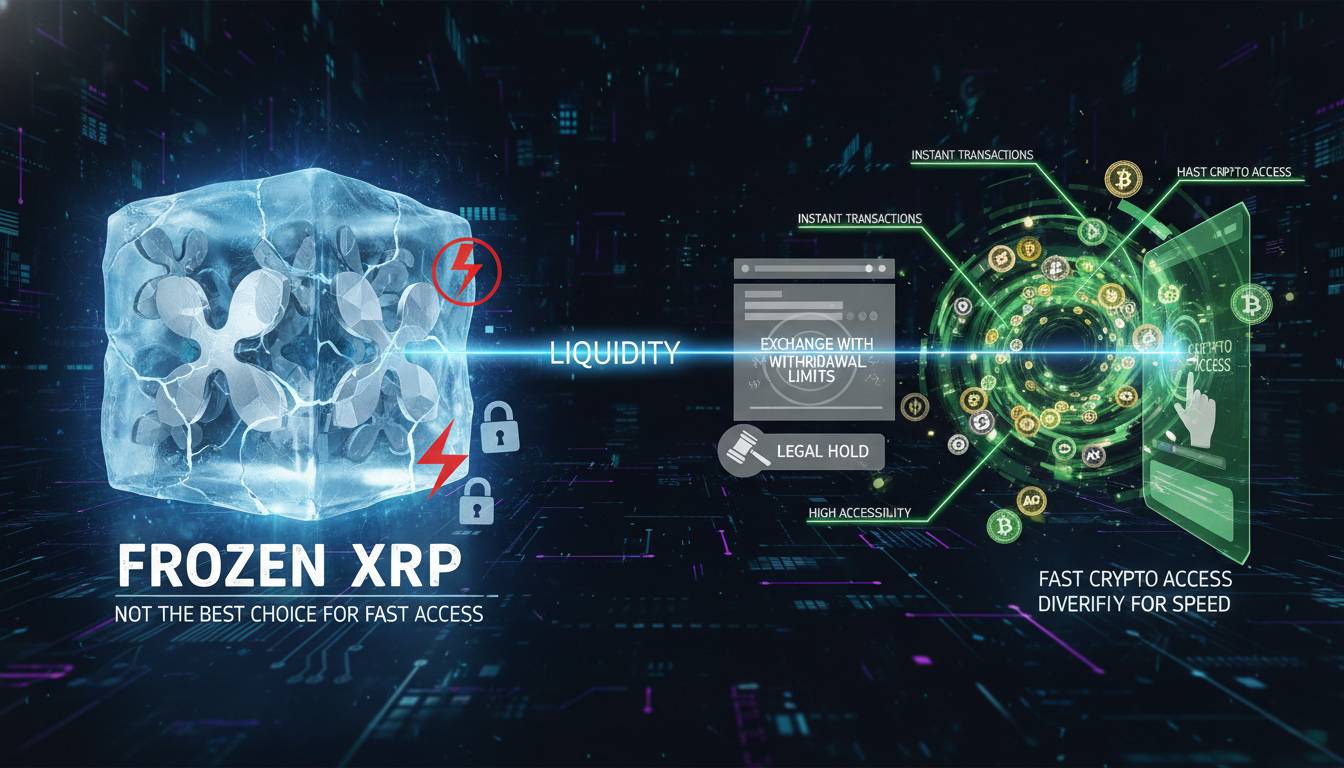
Investors looking for instant liquidity often assume all crypto assets offer the same speed and flexibility. In practice, that is not always true for XRP. The phrase frozen XRP not the best option for fast crypto access reflects a growing concern among users who discover that some XRP can be locked by wallet reserve rules, exchange withdrawal holds, escrow structures, or issuer controls tied to non-XRP tokens on the XRP Ledger. For U.S. users in particular, the distinction between liquid XRP and inaccessible balances matters more as trading, custody, and compliance standards evolve.
Why Frozen XRP Not the Same as Spendable XRP
A key issue in this market is that “frozen” can mean several different things. Native XRP itself is not frozen in the same way issuer-backed tokens can be frozen on the XRP Ledger, but XRP can still become unavailable for immediate use because part of an account balance is tied up in reserve requirements or because assets are held in escrow or on centralized platforms with withdrawal restrictions. That distinction is important for readers searching whether frozen XRP not the same as usable XRP in day-to-day transactions.
The XRP Ledger requires every funded account to maintain a base reserve. As of December 2, 2024, the base reserve is 1 XRP, down from 10 XRP, while the owner reserve is 0.2 XRP per ledger object. Those reserves are designed to prevent spam and excessive ledger growth. Users cannot freely send reserved XRP away unless they reduce ledger objects or delete the account under supported conditions.
That means a wallet showing a small XRP balance may not provide full immediate access to all of it. In practical terms, a user with only the minimum reserve cannot treat the entire balance as available cash. XRPL documentation states that the reserve can also affect the ability to trade if an account falls below required thresholds.
The Main Ways XRP Becomes Inaccessible
For U.S. readers, there are four main scenarios where XRP access can be limited:
- Ledger reserve requirements: A portion of XRP must remain in the account.
- Escrowed holdings: Ripple’s escrowed XRP is not available until scheduled monthly releases.
- Exchange controls: Centralized exchanges may delay withdrawals or place compliance holds.
- Token-level freezes: Issuer-backed assets on XRPL can be frozen, though native XRP itself works differently.
Ripple’s own market reporting states that XRP held in escrow is not accessible to Ripple until monthly releases occur. That is different from a retail wallet reserve, but it reinforces the broader point that not every XRP balance is immediately liquid at all times. In SEC filings tied to XRP-related exchange-traded product proposals, regulators also describe locked tokens being periodically unlocked through monthly escrows.
On exchanges, access can be slowed for reasons unrelated to the blockchain itself. U.S. platforms may impose security reviews, anti-money-laundering checks, or temporary withdrawal restrictions after suspicious activity, password resets, or large transfers. In those cases, the issue is not XRP settlement speed on-chain, but custody and platform risk. That is one reason some traders argue that frozen XRP not the ideal vehicle when immediate self-custodied access is the priority.
Frozen XRP Not the Best Fit for Emergency Liquidity
XRP is widely known for fast settlement and low transaction costs, but those strengths do not automatically solve access problems. The base transaction cost on XRPL remains 10 drops, according to XRPL documentation, and the network’s reserve reduction in late 2024 lowered the entry barrier for users. Even so, speed on the ledger does not help if funds are trapped by reserve mechanics, escrow schedules, or exchange controls.
This is where the phrase frozen XRP not the best choice for fast crypto access gains relevance. For emergency liquidity, users generally need three things at once:
- Immediate control of private keys or account access
- No platform withdrawal hold
- A balance above reserve and fee requirements
If any of those conditions is missing, practical access slows down. A user may technically own XRP but still be unable to move the full amount instantly. That is a different risk profile from simply asking whether XRP transactions settle quickly.
According to XRPL documentation, reserve settings can change through validator fee voting. That means accessibility rules tied to minimum balances are not static forever, even if current levels are lower than in prior years. For investors and businesses, that creates an operational consideration: liquidity planning should account for protocol rules, not just market price.
What This Means for U.S. Investors and Businesses
For U.S. users, the implications are practical rather than theoretical. XRP may still be useful for payments, transfers, and trading, but it is not always the cleanest option for people who need guaranteed instant access to every unit they hold. Small-balance users are especially affected because reserve requirements consume a larger share of their holdings. Businesses managing many ledger objects, offers, or token-related activity can also see more XRP tied up in owner reserves.
The issue also matters for product design. Wallet providers, exchanges, and fintech firms serving U.S. customers need to explain clearly how much XRP is spendable, how much is reserved, and under what conditions withdrawals may be delayed. Better disclosure could reduce confusion among users who assume a displayed balance equals an available balance.
There is also a regulatory angle. SEC documents in 2025 discussing XRP-related products referenced escrow mechanics and custody arrangements, showing that access, control, and release schedules remain central to how XRP is evaluated in financial products. That does not mean XRP is uniquely flawed, but it does mean liquidity claims should be assessed carefully.
Market Significance and the Broader Debate
The broader debate is not whether XRP works as a blockchain asset. It does. The more precise question is whether all XRP is equally available at the moment a holder needs it. The evidence suggests the answer is no. Reserve requirements, escrow structures, and custodial controls all create situations where some XRP is functionally less liquid than headline transaction-speed claims might imply.
Supporters of XRP argue that the late-2024 reserve reduction materially improved usability by cutting the base reserve from 10 XRP to 1 XRP and the owner reserve from 2 XRP to 0.2 XRP. That is a meaningful change and lowers the amount of XRP effectively locked in ordinary accounts. Critics respond that any mandatory reserve still reduces flexibility for users who want every token to remain instantly deployable. Both views can be true at the same time.
Another point of debate involves terminology. In strict technical terms, native XRP is different from issuer-frozen tokens on XRPL. Still, from a consumer perspective, inaccessible is inaccessible. If a user cannot move funds because of reserves, escrow, or exchange restrictions, the practical outcome is delayed access. That is why the phrase frozen XRP not the best choice for fast crypto access continues to resonate in search and market commentary.
Conclusion
XRP remains one of the best-known digital assets for low-cost, fast settlement, but speed alone does not guarantee immediate liquidity. In the U.S. market, users must distinguish between XRP that is visible in an account and XRP that is actually available to move without delay. Reserve rules on the XRP Ledger, Ripple’s escrow structure, and exchange-level controls all show why frozen XRP not the best choice for fast crypto access in every situation. For investors, the lesson is straightforward: evaluate liquidity based on custody, reserve requirements, and withdrawal conditions, not just blockchain performance.
Frequently Asked Questions
What does “frozen XRP” usually mean?
It can refer to XRP that is not immediately accessible because of wallet reserve requirements, escrow schedules, or exchange withdrawal holds. Native XRP is different from issuer-backed tokens that can be frozen directly on XRPL.
Can native XRP be frozen on the XRP Ledger?
Native XRP is not frozen in the same way issued tokens can be. However, some XRP can still be unavailable for spending because accounts must maintain reserve balances.
What is the current XRP Ledger reserve?
Since December 2, 2024, the base reserve is 1 XRP per account and the owner reserve is 0.2 XRP per ledger object. These values can change through validator fee voting.
Why might an exchange delay XRP withdrawals?
Exchanges may impose temporary holds for security reviews, compliance checks, suspicious activity, or account recovery procedures. That is a platform issue rather than a blockchain settlement issue.
Is XRP still useful for payments?
Yes. XRP remains known for low fees and fast settlement. The main issue is that not every XRP balance is instantly available under all custody and account conditions.
Is frozen XRP not the best option for emergency access to funds?
In many cases, yes. If immediate access is the top priority, users should confirm that their XRP is above reserve requirements, held in self-custody where possible, and not subject to exchange restrictions.



















Leave a comment