


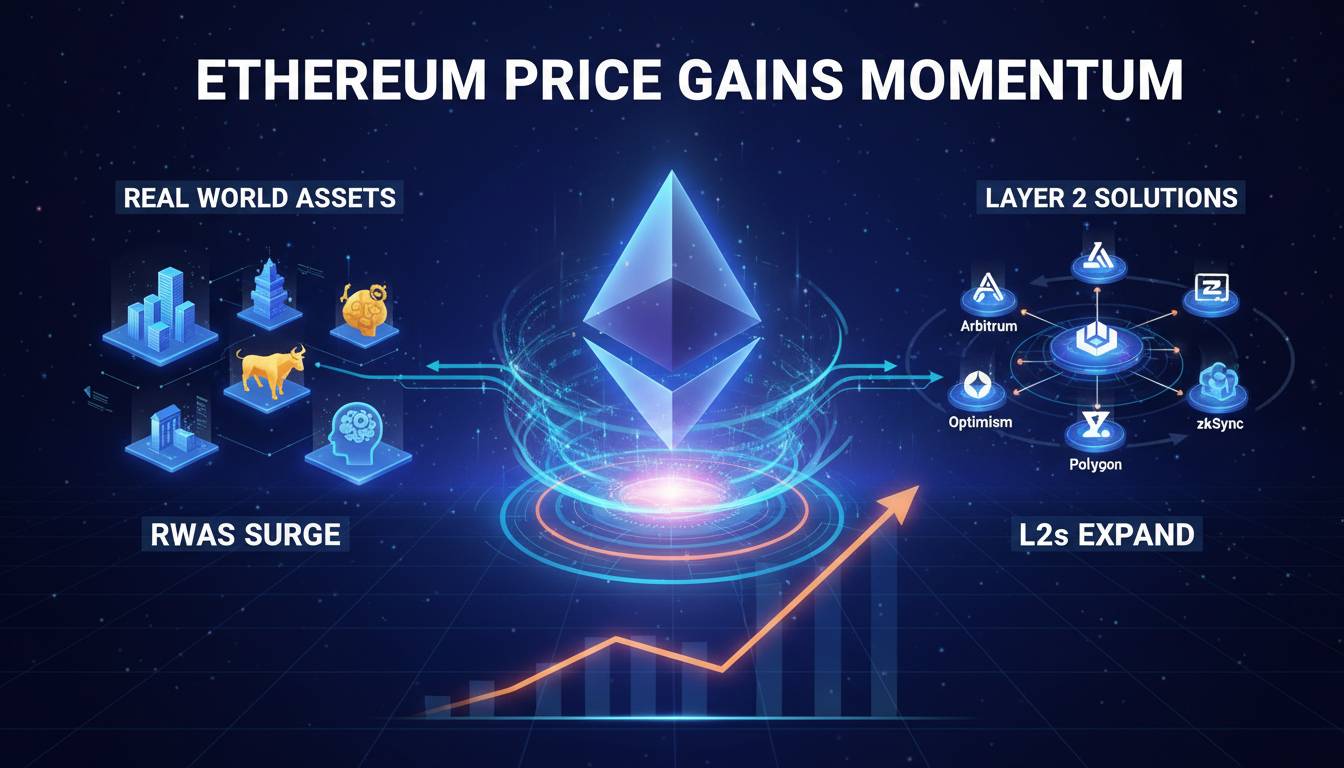
Ethereum is showing signs of quiet resilience as investors look beyond short-term price swings and focus on structural growth across the network. The latest data points to two important trends: tokenized real-world assets, or RWAs, continue to expand on Ethereum, and the layer-2 ecosystem remains one of the chain’s strongest long-term growth engines. Together, those developments are helping support the view that Ethereum’s market position is being reinforced by utility, institutional interest, and scaling progress rather than speculation alone.
Ethereum Price Builds Quiet Strength as RWAs Hit $20.4B and L2 Ecosystem Expands
The preferred market narrative around Ethereum in early 2026 is shifting from simple price action to network fundamentals. While ETH has traded well below its prior cycle highs, market participants are increasingly watching on-chain adoption metrics, tokenization activity, and the growth of Ethereum-linked scaling networks. Historical price data indexed by CoinGecko shows ETH trading near $1,973.66 on February 21, 2026, illustrating that the asset remains in a rebuilding phase rather than a breakout phase.
At the same time, Ethereum continues to dominate the tokenized asset market. Data surfaced through RWA.xyz shows Ethereum holding about $14.7 billion in tokenized real-world assets and roughly 58.7% market share in the segment as of the latest available snapshot indexed by search results. That means Ethereum remains the primary settlement and issuance layer for a large share of on-chain private credit, Treasury-linked products, and other tokenized financial instruments.
The broader RWA market has been reported in recent industry research at levels above $20 billion, depending on methodology and whether stablecoins are excluded. That distinction matters. Some analytics providers count only non-stablecoin tokenized assets, while others use a wider definition of on-chain real-world value. As a result, the headline figure of $20.4 billion should be understood as part of a broader market estimate rather than a directly confirmed Ethereum-only total from the latest primary dashboard snapshot.
RWA Growth Is Strengthening Ethereum’s Institutional Case
Real-world assets have become one of the most closely watched themes in digital assets because they connect blockchain infrastructure to traditional finance. Tokenized Treasurys, private credit, and other yield-bearing instruments are increasingly viewed as practical use cases with clearer revenue models than many earlier crypto experiments. Ethereum’s lead in this area is important because it suggests that institutions still prefer its security, tooling, and liquidity depth when bringing regulated or semi-regulated assets on-chain.
A February 2026 market intelligence report citing rwa.xyz data said Ethereum’s RWA market had surpassed $14.7 billion and represented 58.4% of the global tokenized asset market. The same report described year-over-year growth of about 200%, underlining how quickly the segment has expanded. Even allowing for differences in classification across data providers, the direction of travel is clear: tokenized assets are growing, and Ethereum remains at the center of that expansion.
This matters for ETH because tokenization tends to create sticky demand for blockspace, settlement, and interoperability. Institutions that issue assets on Ethereum or Ethereum-linked environments often need predictable security guarantees, broad wallet and custody support, and access to deep DeFi liquidity. Those are areas where Ethereum still holds a strong competitive position.
According to the RWA.xyz dashboard snapshot indexed in recent search results, Ethereum hosts 483 tokenized asset projects and nearly 850,000 asset holders. Those figures suggest the market is no longer limited to a handful of pilot programs and is instead developing into a broader ecosystem with multiple issuers and user bases.
Layer-2 Expansion Remains a Core Ethereum Growth Driver
Ethereum’s second major support pillar is its layer-2 ecosystem. Rollups and other scaling networks continue to handle a growing share of user activity, helping reduce transaction costs and improve throughput while still relying on Ethereum for settlement and security. L2BEAT’s indexed overview describes rollups as networks that periodically post state commitments to Ethereum, reinforcing the base chain’s role as the trust anchor for the broader ecosystem.
Recent market commentary citing L2BEAT data has placed total value secured across Ethereum layer-2 networks in the roughly $40 billion to $44 billion range, though exact figures vary by date and methodology. That remains a substantial pool of capital and signals that Ethereum scaling is no longer a niche experiment. Instead, it is a central part of how users access decentralized finance, payments, social applications, and consumer-facing crypto products.
The significance of L2 growth goes beyond raw value. It changes how Ethereum should be evaluated. Rather than measuring the network only by activity on the base layer, analysts increasingly assess Ethereum as a settlement ecosystem made up of the main chain plus a growing family of execution environments. That model can support more users and applications without requiring every transaction to happen directly on layer 1.
Several trends are reinforcing that shift:
- Lower transaction costs on rollups after Ethereum’s scaling upgrades.
- Rising developer activity across major L2 networks.
- More consumer and institutional applications launching on Ethereum-linked chains.
- Continued use of ETH as a core asset within the broader ecosystem.
Why ETH Price May Be Responding More Slowly Than Fundamentals
Despite these constructive signals, Ethereum’s price response has been measured rather than explosive. That is not unusual in periods when macroeconomic concerns, risk appetite, and crypto-specific sentiment remain mixed. A recent market summary from Fortune noted that Ethereum had faced pressure in early 2026 amid recession fears, showing that broader financial conditions still influence digital assets heavily.
There is also an ongoing debate over how much value layer-2 growth should return directly to ETH holders. Some analysts argue that if activity migrates away from the base layer, Ethereum may capture less fee revenue than expected. Others counter that Ethereum’s role as the settlement and data-availability layer becomes more valuable as the ecosystem scales, even if user interactions increasingly happen elsewhere. That debate remains central to Ethereum’s valuation story.
What appears clearer is that Ethereum’s investment case is becoming more infrastructure-driven. Instead of relying only on narrative cycles, ETH is increasingly tied to measurable trends such as tokenized asset issuance, scaling adoption, and network usage. That does not eliminate volatility, but it does provide a stronger fundamental base for long-term market confidence.
What This Means for Investors, Builders, and Institutions
For investors, the current setup suggests Ethereum may be building support through adoption rather than hype. If RWA issuance continues to grow and L2 networks keep attracting users and capital, ETH could benefit from a stronger perception as the core infrastructure asset of on-chain finance. That does not guarantee near-term upside, but it does improve the quality of the underlying thesis.
For developers and startups, Ethereum’s expanding L2 stack offers more flexibility. Teams can choose environments optimized for lower fees, faster execution, or specific application types while still remaining connected to Ethereum’s broader liquidity and security model. That makes the ecosystem more adaptable than it was in earlier cycles.
For institutions, the rise of RWAs is perhaps the most important signal. Tokenization is moving from concept to implementation, and Ethereum remains the main venue for that transition. If that trend continues, Ethereum’s role in capital markets infrastructure could deepen further over the next several years.
Conclusion
Ethereum’s latest strength is not being driven by a single headline or a sudden speculative rush. It is being built more quietly through expanding tokenized real-world assets, a still-growing layer-2 ecosystem, and a market structure that increasingly treats Ethereum as financial infrastructure. The exact size of the RWA market varies depending on methodology, but the broader trend is unmistakable: tokenization is growing, and Ethereum remains its leading platform. Combined with continued L2 expansion, that gives ETH a stronger fundamental backdrop than price action alone may suggest.
Frequently Asked Questions
What are RWAs in crypto?
RWAs, or real-world assets, are blockchain-based representations of assets such as U.S. Treasurys, private credit, real estate-linked products, or other traditional financial instruments. They are designed to bring off-chain value on-chain for trading, settlement, or collateral use.
Why is Ethereum important for RWAs?
Ethereum is important because it remains the leading network for tokenized asset issuance by total value and market share in the latest available data indexed from RWA.xyz. Its security, developer ecosystem, and liquidity make it a preferred platform for many issuers.
What are layer-2 networks?
Layer-2 networks are scaling solutions built on top of Ethereum that process transactions more efficiently and then anchor results back to Ethereum. L2BEAT describes rollups as systems that periodically post state commitments to Ethereum.
Does L2 growth help ETH price?
It can, but the relationship is debated. Supporters argue that L2 growth strengthens Ethereum’s role as the settlement layer and expands the overall ecosystem. Critics argue that some activity moving off the base layer may reduce direct fee capture.
Is the $20.4 billion RWA figure Ethereum-only?
Not necessarily. Available indexed data from RWA.xyz search results shows Ethereum at about $14.7 billion in tokenized assets, while broader industry commentary places the wider RWA market above $20 billion depending on definitions and whether stablecoins are excluded.
What should investors watch next?
Key indicators include Ethereum’s share of the tokenized asset market, total value secured on major L2 networks, developer activity, and whether institutional tokenization projects continue launching on Ethereum-linked infrastructure.


















Leave a comment