


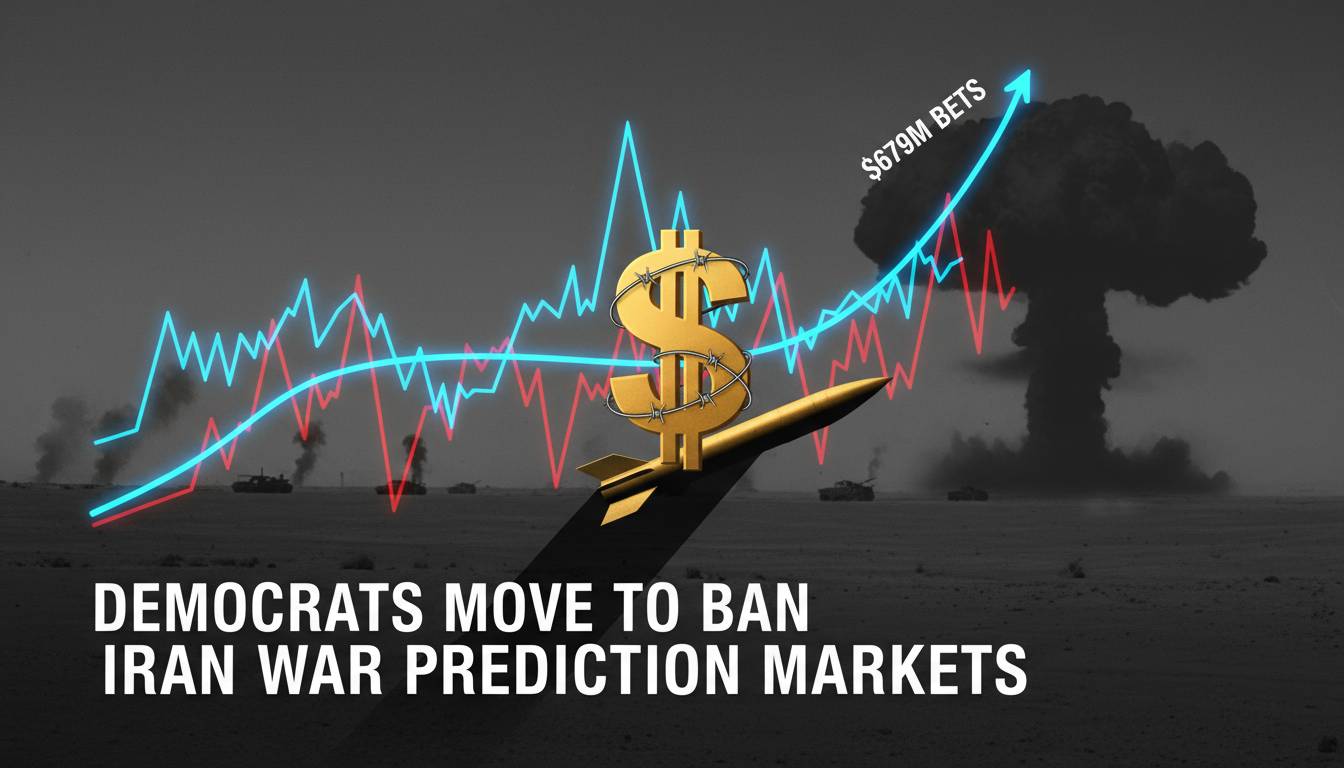
A surge of betting tied to possible military action against Iran is now driving a new push in Washington to tighten the rules on prediction markets. Democratic lawmakers are drafting legislation after markets linked to Iran-related conflict drew hundreds of millions of dollars in volume and raised fresh concerns about insider trading, market integrity, and whether people with advance knowledge of military decisions could profit from war. The debate now reaches beyond crypto betting sites and into the broader regulation of event contracts in the United States.
A New Political Flashpoint for Prediction Markets
Democrats move to ban Iran war prediction markets after $679M bets at a moment when prediction platforms are already under intense scrutiny. The immediate trigger is a wave of unusually timed trades placed ahead of U.S.-Israeli strikes on Iran, followed by reports that some traders made outsized gains after buying contracts shortly before military developments became public. Reuters reported that Representative Mike Levin and Senator Chris Murphy are working on legislation to rein in these markets after the Iran-related bets intensified legal and ethical concerns.
The issue is not limited to one contract or one platform. In recent weeks, public reporting has highlighted contracts tied to whether the United States would strike Iran, whether Iran’s leadership would be removed, and other outcomes closely linked to war or death. Those markets drew heavy trading activity, and some of the most controversial contracts appeared to blur the line between forecasting and wagering on violence.
The $679 million figure in the political debate reflects the scale of trading that lawmakers and critics say shows how large the market for conflict-linked contracts has become. Even where exact totals vary by platform or contract set, the broader point is clear: war-related prediction activity is no longer niche. It has become large enough to attract congressional attention, regulatory pressure, and public backlash.
Why Lawmakers Say Existing Rules Are Not Enough
At the center of the dispute is the Commodity Exchange Act and the CFTC’s authority over event contracts. Federal law already allows the Commodity Futures Trading Commission to prohibit contracts that involve war, terrorism, assassination, unlawful activity, or other matters deemed contrary to the public interest. The CFTC also proposed rule changes in 2024 that would explicitly reinforce the view that contracts involving war, terrorism, and assassination are contrary to the public interest.
Yet Democratic lawmakers argue that the current framework leaves too much room for interpretation and too much time for questionable contracts to trade before regulators intervene. According to Reuters, Levin said it was “absolutely illegal” if anyone used prior knowledge of military action for financial gain, while also arguing that current law does not go far enough. That position reflects a broader concern that enforcement after the fact may not be enough when the underlying event is a military strike or a death-linked outcome.
Senator Adam Schiff also recently urged the CFTC to uphold existing law and prohibit prediction markets that incentivize physical injury, death, or war. In his letter, Schiff pointed directly to the statutory categories of war, terrorism, and assassination, arguing that contracts resolving on or closely correlating to death should be barred.
The legal gap lawmakers want to close
The proposed Democratic response appears aimed at government-action contracts more broadly, not only explicit war bets. Public reporting indicates Murphy’s draft would target markets tied to official government actions, including military operations, while preserving room for some financial-event contracts such as those related to interest rates. That distinction matters because lawmakers are trying to separate public-interest forecasting from contracts that may create incentives around secret state action.
Insider Trading Fears Intensify the Debate
The strongest political argument for new legislation is the possibility of insider profiteering. Blockchain analytics firm Bubblemaps reported that six accounts made about $1.2 million in profit from Polymarket bets tied to the removal of Iran’s Supreme Leader shortly before he was killed in airstrikes, according to Reuters and other reports. Separate reporting also described one trader turning roughly $87,000 into more than half a million dollars after placing a wager shortly before news of a strike became public.
That concern is not theoretical. In February 2026, Israeli authorities charged two individuals with using classified military information to place bets on future military operations on Polymarket. The Associated Press reported that one of the suspects was a reservist accused of using access to sensitive information, and authorities described the conduct as a serious security risk.
According to Amanda Fischer, policy director at Better Markets and a former chief of staff at the Securities and Exchange Commission, these contracts illustrate how problematic the business can become when markets are tied to death or military action. Her comments, cited in recent coverage, have been used by critics to argue that these products can distort incentives and undermine trust in both markets and government.
Platforms, Regulators, and the Industry Response
The controversy has also exposed differences between regulated and offshore platforms. Kalshi, a CFTC-regulated exchange, has argued in public reporting that some disputed contracts were not directly framed as bets on death, even as it froze a market tied to the status of Iran’s Supreme Leader after the underlying event occurred. The Washington Post reported that the frozen market had attracted $54 million in trading.
Polymarket, by contrast, has been at the center of much of the recent scrutiny because of the Iran-related trades and the blockchain trail that allowed analysts to flag suspicious timing. Critics say decentralized or offshore structures can make oversight harder, especially when U.S. users may still find ways to access the markets. Schiff’s recent letter to the CFTC highlighted that concern directly as Polymarket prepares for a possible return to the U.S. market through a regulated pathway.
Not everyone in Washington supports a sweeping crackdown. A bipartisan bill introduced by Representatives Blake Moore and Salud Carbajal on March 6, 2026, would strengthen the CFTC’s enforcement authority over prohibited event contracts rather than ban broad categories of prediction markets outright. That suggests Congress may ultimately split between those who want tighter policing and those who want categorical prohibitions on war-linked contracts.
What This Means for Investors, Platforms, and Washington
For traders, the message is that political and military event contracts are becoming a major regulatory risk. Markets that once appeared to sit in a gray zone are now drawing direct attention from lawmakers, regulators, and law enforcement. If Congress acts, platforms may have to delist a wider range of contracts tied to military action, intelligence-sensitive events, or decisions by public officials.
For platforms, the stakes are even higher:
- Compliance costs could rise as exchanges face stricter review of event contracts.
- Product offerings could narrow if contracts linked to war, death, or official acts are banned.
- Enforcement exposure could increase where suspicious trading patterns suggest access to nonpublic information.
For Washington, the issue cuts across several debates at once: war powers, financial regulation, crypto oversight, and political ethics. The failed House effort on March 5, 2026, to advance legislation restricting further military action against Iran shows how politically charged the broader Iran debate has become. In that environment, betting on military outcomes is likely to remain a potent target for lawmakers seeking a visible response.
Conclusion
The push to restrict prediction markets after $679 million in Iran war bets marks a turning point in the regulation of event contracts in the United States. Democrats argue that markets tied to military action create unacceptable risks, especially when traders may profit from advance knowledge of secret government decisions. Supporters of prediction markets say these platforms can aggregate information, but the current controversy has shifted the focus from forecasting value to public-interest harm. What happens next will likely depend on whether Congress chooses a narrow enforcement fix or a broader ban on contracts linked to war, death, and official state action.
Frequently Asked Questions
What are prediction markets?
Prediction markets are platforms where users trade contracts based on whether a future event will happen. Prices move with trader expectations and are often interpreted as implied probabilities.
Why are Democrats targeting Iran war-related bets?
Lawmakers say contracts tied to military action may allow people with advance knowledge of government decisions to profit and may also incentivize harmful behavior around war or death.
Are war-related event contracts already illegal?
Federal law gives the CFTC authority to prohibit contracts involving war, terrorism, assassination, unlawful activity, or matters contrary to the public interest. The current dispute is partly about whether that authority is being applied strongly enough.
Which platforms are under scrutiny?
Recent reporting has focused heavily on Polymarket and Kalshi, though the regulatory issues differ because Kalshi is CFTC-regulated and Polymarket has operated offshore.
What triggered the latest backlash?
The backlash followed suspiciously timed Iran-related trades, reports of roughly $1.2 million in profits by a cluster of accounts, and earlier criminal charges in Israel involving bets allegedly placed with classified military information.
What could happen next?
Congress could pass a targeted bill banning contracts tied to military or other government actions, or it could instead strengthen the CFTC’s enforcement powers over prohibited event contracts. Either path would likely tighten oversight of prediction markets in the U.S.
















Leave a comment