


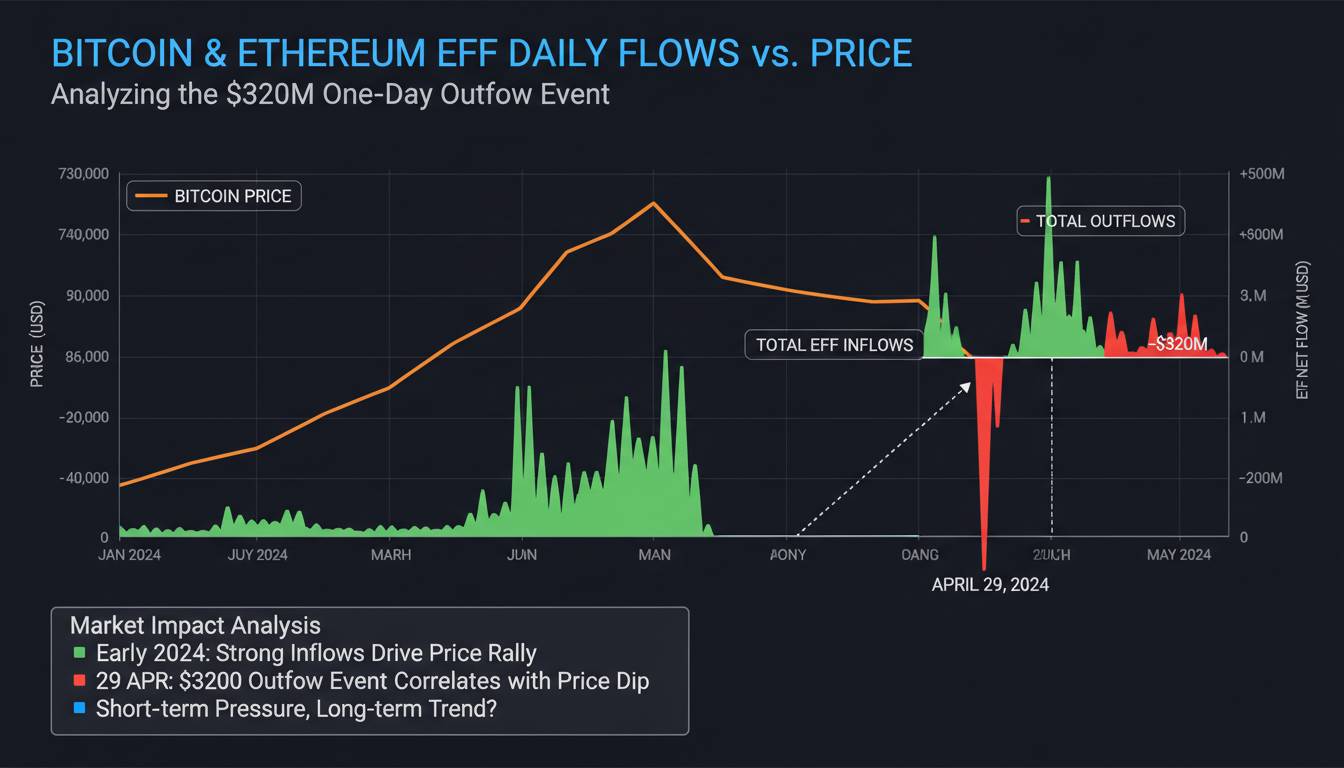
An abrupt $320 million in combined outflows from U.S. spot Bitcoin and Ethereum ETFs has rattled markets, signaling growing investor caution amid macroeconomic uncertainty. This article examines the causes, implications, and potential future developments of this significant shift in capital flows.
ETF Outflows Unsettle Crypto Markets
On a recent trading day, U.S. spot Bitcoin and Ethereum ETFs recorded a combined net outflow of approximately $320 million. While precise breakdowns between the two asset classes were not disclosed, this level of redemptions underscores mounting investor anxiety. Comparable events—such as a $797 million outflow in November 2025—have previously triggered sharp market reactions .
This latest exodus comes amid broader macroeconomic headwinds, including tightening liquidity, geopolitical tensions, and rising interest rates. These factors have collectively dampened appetite for risk assets, including crypto ETFs.
What Drove the $320M Exodus?
Institutional Risk-Off Sentiment
According to Vincent Liu, chief investment officer at Kronos Research, ETF outflows often reflect institutional caution amid global macro pressures. He cites factors such as U.S.–EU trade tensions and Japanese bond market volatility as key drivers . These dynamics are prompting investors to reduce exposure to volatile assets like Bitcoin and Ethereum.
Market Volatility and Liquidity Concerns
Crypto markets have been volatile, with Bitcoin dipping below $89,000 and Ethereum trading under $3,000 in recent sessions . ETF outflows often exacerbate price swings, as large redemptions force asset sales, further pressuring valuations.
Historical Precedents
This is not the first time ETFs have seen such dramatic outflows. In November 2025, spot Bitcoin and Ethereum ETFs posted a combined $797 million in withdrawals during a market downturn . Similarly, in late 2025, Bitcoin ETFs alone saw $151 million in outflows amid institutional rotation toward altcoin ETFs . These patterns suggest that ETF flows remain highly sensitive to macroeconomic shifts.
Stakeholder Impact
Investors and Fund Managers
For investors, large ETF outflows can trigger forced liquidations, leading to further price declines. Fund managers may face redemption pressure, potentially impacting liquidity and fund operations.
Broader Crypto Market
ETF outflows can ripple through the broader crypto ecosystem. Reduced demand from institutional channels may lead to lower trading volumes and heightened volatility across spot and derivatives markets.
Regulatory and Institutional Confidence
Sustained outflows may raise concerns among regulators and institutional players about the stability and maturity of crypto ETFs. This could influence future product approvals and institutional adoption.
Broader Context and Market Trends
ETF Market Growth and Resilience
Despite episodic outflows, crypto ETFs have seen substantial inflows over time. For instance, U.S. spot Ethereum ETFs accumulated $2.68 billion in net inflows since their July 2024 launch, with BlackRock’s ETHA and Fidelity’s FETH leading the charge . Spot Bitcoin ETFs have also attracted significant capital, with weekly inflows reaching $1.96 billion in January 2025 .
Regulatory Milestones
The SEC’s approval of spot Ethereum ETFs in May 2024 marked a turning point for crypto investment products in the U.S. . This regulatory clarity enabled major asset managers—such as BlackRock, Fidelity, and VanEck—to launch Ethereum ETFs, broadening investor access .
Market Maturation
Academic research highlights how ETF approval has integrated crypto into traditional finance, enhancing hedging properties and institutional adoption . However, outflows like the recent $320 million underscore that the market remains vulnerable to macro shocks.
Analysis and Outlook
Short-Term Implications
- Price Pressure: ETF outflows often coincide with downward price pressure, as funds liquidate holdings to meet redemptions.
- Volatility Spike: Reduced liquidity may amplify price swings, particularly in Ethereum, which has historically seen more volatile ETF flows.
- Investor Sentiment: Continued redemptions may erode confidence, prompting further withdrawals and a feedback loop of negative sentiment.
Medium- to Long-Term Prospects
- Return of Inflows: If macro conditions stabilize, inflows may resume. Past patterns show that ETF flows can reverse sharply once sentiment improves.
- Diversification Trends: Investors may shift toward altcoin ETFs or diversified crypto products, as seen in November 2025 when capital rotated toward Solana and XRP ETFs .
- Regulatory Evolution: Sustained volatility may prompt regulators to revisit ETF frameworks, potentially tightening oversight or encouraging product innovation.
Balanced Perspective
While the $320 million outflow is significant, it must be viewed within the broader context of crypto ETF growth and market cycles. Institutional interest remains strong, and regulatory progress continues to support long-term adoption. Market participants should monitor macro indicators, ETF flow data, and regulatory developments closely.
Conclusion
The $320 million one-day outflow from U.S. Bitcoin and Ethereum ETFs reflects heightened investor caution amid macroeconomic uncertainty. While such redemptions can intensify market volatility and pressure prices, they also underscore the evolving nature of crypto as an institutional asset class. Looking ahead, a return to inflows is possible if economic conditions improve. Meanwhile, diversification and regulatory clarity will be key to sustaining long-term confidence in crypto ETFs.
Frequently Asked Questions
What triggered the $320 million outflow from Bitcoin and Ethereum ETFs?
Institutional caution amid macroeconomic pressures—such as trade tensions and global liquidity tightening—prompted large redemptions. Market volatility and risk-off sentiment also played key roles .
How does this outflow compare to past ETF flow events?
This outflow is sizable but not unprecedented. In November 2025, combined outflows reached $797 million in a single day . Other notable events include $151 million in Bitcoin ETF outflows amid rotation to altcoins .
Could ETF outflows lead to broader crypto market instability?
Yes. ETF redemptions can force asset sales, reducing liquidity and amplifying volatility. This can impact prices and investor sentiment across the crypto ecosystem.
What might reverse the outflow trend?
Improved macroeconomic conditions, renewed investor confidence, and positive regulatory developments could restore inflows. Diversification into altcoin ETFs may also attract capital back into the market.
Are crypto ETFs still growing despite outflows?
Yes. Spot Ethereum ETFs have seen billions in cumulative inflows since launch , and Bitcoin ETFs have similarly attracted substantial capital .
What should investors watch going forward?
Key indicators include ETF flow data, macroeconomic trends, regulatory announcements, and shifts in investor sentiment. Monitoring these factors can help anticipate future market movements.





















Leave a comment