


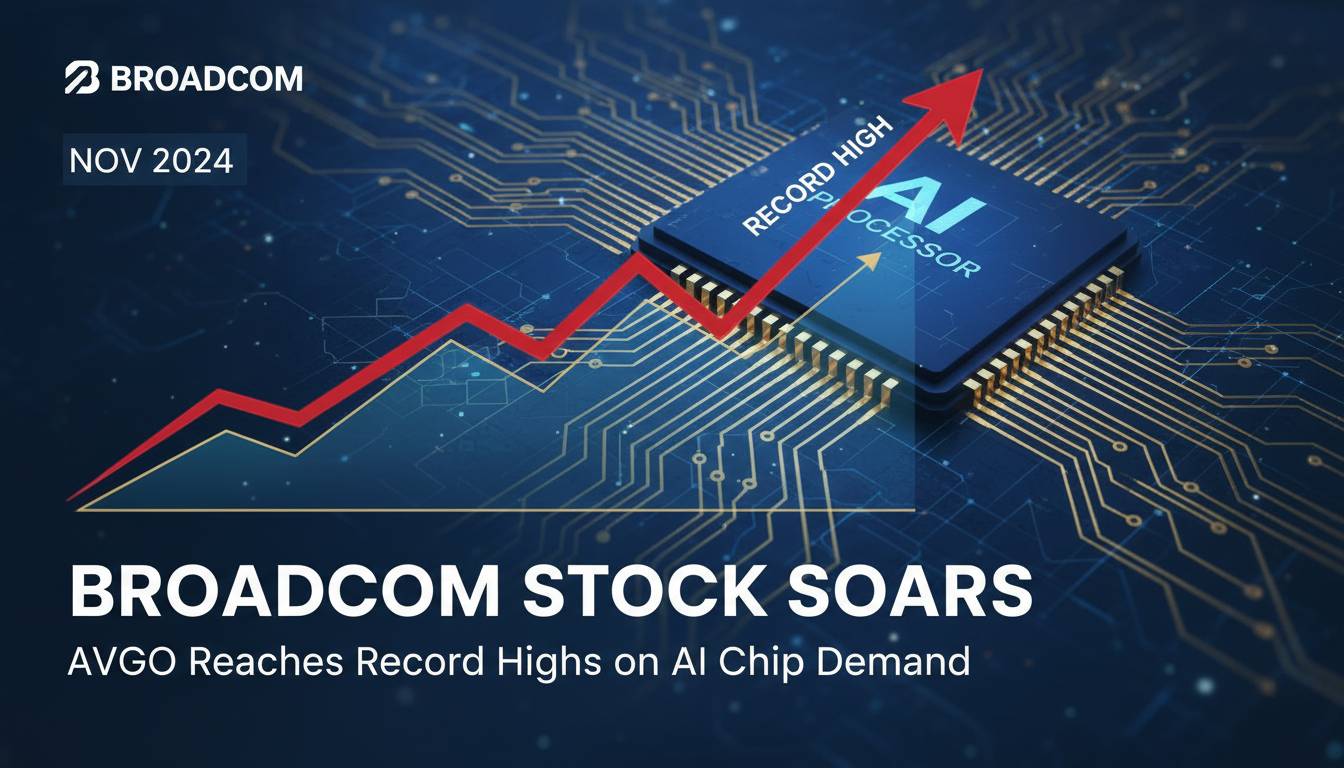
Understanding Broadcom’s AI-Driven Rally
The semiconductor landscape has undergone a seismic shift, and Broadcom sits at the epicenter of this transformation. Unlike pure-play AI chip makers, Broadcom’s diversified portfolio spans networking, broadband, wireless, and storage solutions – all critical components of the AI infrastructure boom.
What’s really driving this rally isn’t just hype. The company reported AI revenue of $3.7 billion in its most recent quarter, representing a staggering sequential growth rate that caught even bullish analysts off guard. This isn’t speculative enthusiasm; it’s real revenue hitting the books right now.
The market’s reaction reflects a fundamental revaluation of Broadcom’s growth trajectory. Previously viewed as a mature, dividend-paying tech stalwart, the company has transformed into a high-growth AI play without abandoning its cash-generation prowess.
Key Catalysts Behind AVGO’s Record Performance
AI Infrastructure Demand Explosion
The AI gold rush has created insatiable demand for data center infrastructure. Every large language model, every AI application, every machine learning workload requires massive computational resources – and Broadcom supplies the critical networking components that make these systems work.
Think about it this way: while everyone focuses on the GPUs doing the calculations, someone needs to connect those GPUs, move data between them at blazing speeds, and ensure the entire system operates efficiently. That’s where Broadcom comes in. Their ethernet switching solutions and custom ASIC chips have become indispensable.
Major cloud providers can’t build AI clusters fast enough. Microsoft, Google, Amazon – they’re all racing to expand capacity, and Broadcom benefits from every single buildout. The company’s XPU (accelerated processing unit) revenue alone is projected to hit $11 billion by 2024, up from essentially zero just two years ago.
VMware Acquisition Synergies
The $69 billion VMware acquisition, initially met with skepticism, now looks prescient. Broadcom’s aggressive cost-cutting and strategic refocusing of VMware’s product portfolio has exceeded expectations, with the software division contributing meaningfully to margins.
Integration challenges that typically plague mega-mergers haven’t materialized. Instead, Broadcom has methodically streamlined VMware’s operations, eliminated redundancies, and focused on high-value enterprise customers. The result? Software revenues that complement the hardware business and provide recurring revenue streams.
“Broadcom’s execution on the VMware integration has been nothing short of remarkable. They’ve managed to maintain customer relationships while dramatically improving profitability – a balance many acquirers fail to achieve.”
Supply Chain Positioning
While competitors struggle with allocation and supply constraints, Broadcom’s long-term agreements and manufacturing partnerships have positioned them perfectly. They’ve secured capacity at TSMC’s most advanced nodes, ensuring they can meet the surging demand.
The company’s fabless model, once seen as a vulnerability, has become a strategic advantage. By maintaining close relationships with multiple foundries and assembly partners, Broadcom can flex production quickly without the capital burden of owning fabs.
Technical Analysis and Price Targets
Current Trading Patterns
AVGO’s chart tells a story of sustained momentum with healthy consolidation periods. The stock has respected its 50-day moving average throughout the rally, using brief pullbacks to digest gains before pushing higher.
Trading volume has notably increased on breakout days, suggesting institutional accumulation rather than retail-driven speculation. The relative strength index occasionally touches overbought levels but quickly resets, indicating strong underlying demand.
Recent price action shows a classic ascending triangle pattern, with resistance at $225 being tested multiple times. Each test brings higher lows, suggesting an eventual breakout above this psychological level.
Wall Street Consensus
Analyst sentiment has shifted dramatically. Just six months ago, the average price target sat around $165. Today, that figure has ballooned to $240, with several prominent firms setting targets above $250.
The most bullish calls come from those who believe Broadcom’s AI opportunity remains underappreciated. They point to design win pipelines, customer commitments, and the multi-year nature of AI infrastructure buildouts as reasons for continued upside.
Even the bears – and there aren’t many left – acknowledge the company’s strong positioning. Their concerns focus more on valuation multiples than fundamental weakness, arguing the stock has simply come too far, too fast.
Risk Factors to Monitor
Despite the optimism, several risk factors warrant attention. Geopolitical tensions, particularly between the U.S. and China, could impact Broadcom’s significant Asian revenue streams. Any semiconductor export restrictions could crimp growth.
Customer concentration presents another concern. A handful of hyperscale cloud providers drive the majority of AI-related revenue. If any major customer pulls back spending or shifts to internal solutions, Broadcom could feel the impact disproportionately.
Competition isn’t standing still either. Nvidia’s networking ambitions, AMD’s growing presence, and potential new entrants all threaten to erode Broadcom’s market share over time. The company must continue innovating to maintain its competitive moat.
Investment Implications and Strategy
For Growth Investors
Broadcom offers a rare combination: exposure to the highest-growth segments of technology with the financial stability of an established player. The company generates massive free cash flow, maintains a growing dividend, and buys back shares aggressively.
Position sizing matters here. While the long-term thesis remains intact, the stock’s parabolic rise suggests volatility ahead. Dollar-cost averaging or waiting for pullbacks might provide better entry points than chasing momentum.
Consider AVGO as a core holding rather than a trade. The AI infrastructure buildout will last years, not quarters. Patient investors who can weather short-term volatility stand to benefit from a multi-year growth story.
For Income Investors
Here’s something interesting – despite the growth stock valuation, Broadcom hasn’t abandoned dividend investors. The company recently announced a 10-for-1 stock split and maintained its commitment to returning cash to shareholders.
The dividend yield has compressed due to share price appreciation, but the absolute dollar amount continues growing. Management targets returning 50% of free cash flow to shareholders through dividends and buybacks, providing a cushion for income-focused portfolios.
Timing Considerations
Technical indicators suggest we’re in the middle innings of this rally, not the end. However, prudent investors should prepare for volatility. Earnings releases, AI spending updates from major customers, and broader market conditions will create trading opportunities.
Watch for dips toward the 50-day moving average as potential entry points. These pullbacks have proven temporary throughout the current rally, offering attractive risk-reward setups for those who missed the initial move.
The Competitive Landscape
Broadcom doesn’t operate in a vacuum. Understanding the competitive dynamics helps contextualize the company’s position and potential threats to its market share.
Nvidia remains the most obvious competitor, though the companies often serve complementary roles in AI infrastructure. Where Nvidia dominates training accelerators, Broadcom excels in networking and custom silicon. Some overlap exists, but there’s room for multiple winners.
Marvell Technology presents a more direct competitive threat, particularly in ethernet switching and custom ASICs. However, Broadcom’s scale advantages and deeper customer relationships provide significant barriers to share shifts.
Intel’s struggles have actually benefited Broadcom. As the former giant stumbles, customers seek alternatives for various semiconductor needs. Broadcom has captured share in several segments where Intel previously dominated.
Looking Ahead: What Could Drive AVGO Higher
Several catalysts could propel Broadcom’s stock to new heights. First, any acceleration in AI infrastructure spending would directly benefit the company. Early indications suggest 2025 budgets remain robust.
Second, successful penetration of new AI-adjacent markets represents untapped potential. Edge AI, autonomous vehicles, and industrial automation all require sophisticated semiconductor solutions where Broadcom could compete.
Third, margin expansion opportunities abound. As AI products typically command premium pricing, the mix shift toward these high-value solutions should drive profitability higher even if revenue growth moderates.
International expansion, particularly in emerging markets building their own AI capabilities, offers another growth avenue. Countries seeking technological sovereignty need semiconductor suppliers, and Broadcom’s broad portfolio positions them well.
Conclusion
Broadcom’s record-breaking stock performance reflects more than momentum trading or AI hype. The company has positioned itself as an essential supplier to the AI revolution, with real revenues and profits validating the market’s enthusiasm. While valuations appear stretched by historical standards, the structural growth drivers supporting AVGO remain firmly intact.
Investors must balance the compelling long-term opportunity against near-term volatility risks. Those with conviction in the AI infrastructure thesis and tolerance for potential drawdowns may find Broadcom offers one of the best risk-adjusted ways to play this generational technology shift. The journey to new highs likely won’t be linear, but the destination appears increasingly probable as AI adoption accelerates globally.


















Leave a comment