


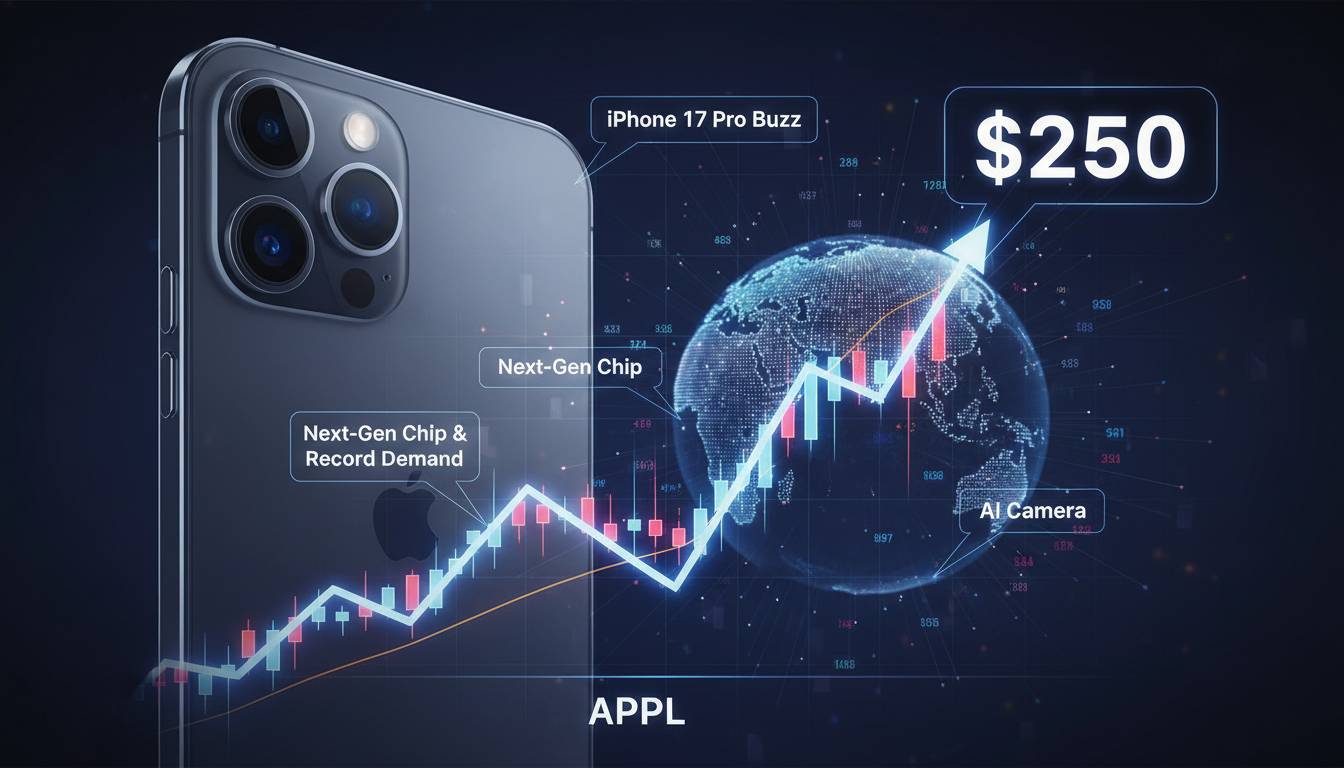
Current Technical Analysis and Price Action
The technical picture for AAPL shows a clear uptrend formation on the daily charts. The stock recently broke above the critical $235 resistance level with above-average volume, signaling institutional buying interest. This breakout came after a period of consolidation between $220 and $235 that lasted nearly six weeks.
Key support levels now sit at $235 (previous resistance turned support), $228, and the 50-day moving average around $225. The relative strength index (RSI) reads 68, approaching overbought territory but still leaving room for upward momentum. The MACD indicator shows a bullish crossover that occurred two weeks ago, confirming the positive trend.
Trading volume has increased substantially, averaging 65 million shares daily compared to the three-month average of 52 million. This volume expansion typically validates price movements and suggests genuine buying interest rather than a technical bounce.
iPhone 17 Pro Speculation Driving Sentiment
Market sentiment has shifted notably positive following leaked reports about revolutionary features planned for the iPhone 17 Pro. Industry insiders suggest Apple is developing a completely redesigned camera system with advanced AI capabilities that could revolutionize mobile photography. These rumors, while unconfirmed, have captured investor attention.
The speculation includes mentions of a new display technology that could dramatically improve battery life while enhancing visual quality. Supply chain sources indicate Apple has already begun early prototype testing, unusual for a product still 18 months from launch. This aggressive timeline suggests Apple views the iPhone 17 as a major strategic release.
“The iPhone 17 cycle could represent the most significant upgrade since the iPhone X. If these leaked specifications prove accurate, we’re looking at a potential super-cycle that could drive record unit sales and ASPs.”
Analyst expectations have risen accordingly, with several firms raising their price targets based on the iPhone 17’s potential impact on Apple’s revenue growth trajectory.
Fundamental Factors Supporting the Rally
Beyond product speculation, Apple’s fundamentals remain robust. The company reported services revenue growth of 12% year-over-year in its latest quarter, demonstrating the strength of its ecosystem strategy. The services segment now generates over $90 billion annually, providing stable, high-margin revenue streams.
Apple’s installed base continues expanding, recently surpassing 2 billion active devices globally. This growing ecosystem creates multiple monetization opportunities through services, accessories, and upgrade cycles. Each new iPhone buyer typically spends an additional 30-40% on services and accessories over the device’s lifetime.
The company’s capital allocation strategy also supports the stock price. Apple returned over $25 billion to shareholders through dividends and buybacks last quarter. The board authorized an additional $90 billion for share repurchases, signaling confidence in future cash generation.
International expansion, particularly in India and Southeast Asia, presents significant growth opportunities. Apple’s market share in India doubled over the past two years, albeit from a small base, as the company invests in local manufacturing and retail presence.
Risk Factors and Technical Resistance Levels
While the bullish case appears strong, investors should monitor several risk factors. The $250 price target faces technical resistance from previous highs and psychological levels. Historical data shows AAPL often consolidates after 20-25% rallies before attempting new highs.
Geopolitical tensions, particularly regarding China, remain a concern. China represents approximately 20% of Apple’s revenue, and any escalation in trade disputes could impact both sales and supply chain operations. Recent diplomatic meetings have eased some concerns, but the situation requires ongoing monitoring.
Competition in the premium smartphone market continues intensifying. Samsung’s latest Galaxy series and Google’s Pixel phones offer increasingly compelling alternatives. While Apple maintains strong brand loyalty, market share erosion in certain segments could pressure average selling prices.
Macroeconomic factors also warrant consideration. Interest rate uncertainties and consumer spending patterns could affect demand for premium devices. Although Apple’s customer base tends to be more resilient during economic downturns, a severe recession would likely impact sales.
Trading Strategy and Price Targets
For traders considering AAPL positions, the current setup offers several strategic approaches. Conservative investors might wait for a pullback to the $235-238 range before entering long positions. This level represents previous resistance and should now act as support if the bullish trend remains intact.
More aggressive traders could consider buying on any intraday weakness, using a stop-loss below $232 to manage risk. The risk-reward ratio appears favorable with upside targets at $245 initially, then $250 if momentum continues. Options traders might consider bull call spreads to limit capital exposure while maintaining upside participation.
Short-term traders should watch for a potential consolidation phase if AAPL reaches $245-248. This area represents a 25% gain from recent lows and could trigger profit-taking. Volume analysis during any pullback will provide clues about whether institutions are accumulating or distributing shares.
Analyst Consensus and Forward Outlook
Wall Street analysts maintain an overwhelmingly positive view on Apple stock. The consensus price target recently increased to $252, with several firms raising targets above $260 based on iPhone 17 expectations. Of 42 analysts covering the stock, 35 rate it as “buy” or “strong buy.”
Revenue projections for fiscal 2025 assume mid-single-digit growth, potentially accelerating to high single digits if the iPhone 17 drives a significant upgrade cycle. Margin expansion from services growth and operational efficiencies could boost earnings per share growth above revenue growth rates.
Long-term investors focus on Apple’s ability to monetize its ecosystem through new services and products. The rumored Apple Car project, while pushed back, represents a potential massive addressable market. Augmented reality initiatives and health-focused products offer additional growth vectors beyond traditional hardware cycles.
Conclusion
Apple’s march toward $250 appears technically and fundamentally supported, with iPhone 17 Pro speculation adding momentum to an already strong investment thesis. The combination of robust services growth, ecosystem expansion, and shareholder-friendly capital allocation creates multiple paths to value creation. While risks exist, particularly around geopolitical tensions and valuation levels, the overall setup favors continued upside. Investors should monitor key support levels and volume patterns while positioning for potential volatility around product announcements and earnings releases. The $250 target seems achievable within the next 3-6 months if current trends persist.
FAQs
What technical indicators suggest AAPL can reach $250?
The stock broke above $235 resistance with strong volume, the MACD shows a bullish crossover, and the uptrend remains intact with higher highs and higher lows pattern formation.
How significant could the iPhone 17 Pro be for Apple’s stock price?
Industry speculation suggests it could trigger a super-cycle similar to the iPhone X launch, potentially driving record sales and justifying higher valuation multiples.
What are the main risks to the $250 price target?
Key risks include China-related geopolitical tensions, increasing competition in premium smartphones, potential recession impacts on consumer spending, and technical resistance at psychological levels.
Should investors buy AAPL now or wait for a pullback?
Conservative investors might wait for a retest of $235-238 support, while aggressive traders could buy weakness with stops below $232, depending on individual risk tolerance.
What’s driving analyst optimism beyond iPhone speculation?
Services revenue growing at 12% annually, expanding gross margins, aggressive share buybacks, and growth potential in emerging markets support bullish analyst perspectives.
How does current valuation compare to historical levels?
AAPL trades at approximately 28x forward earnings, slightly above its 5-year average but justified by improving fundamentals and growth prospects according to most analysts.



















Leave a comment