


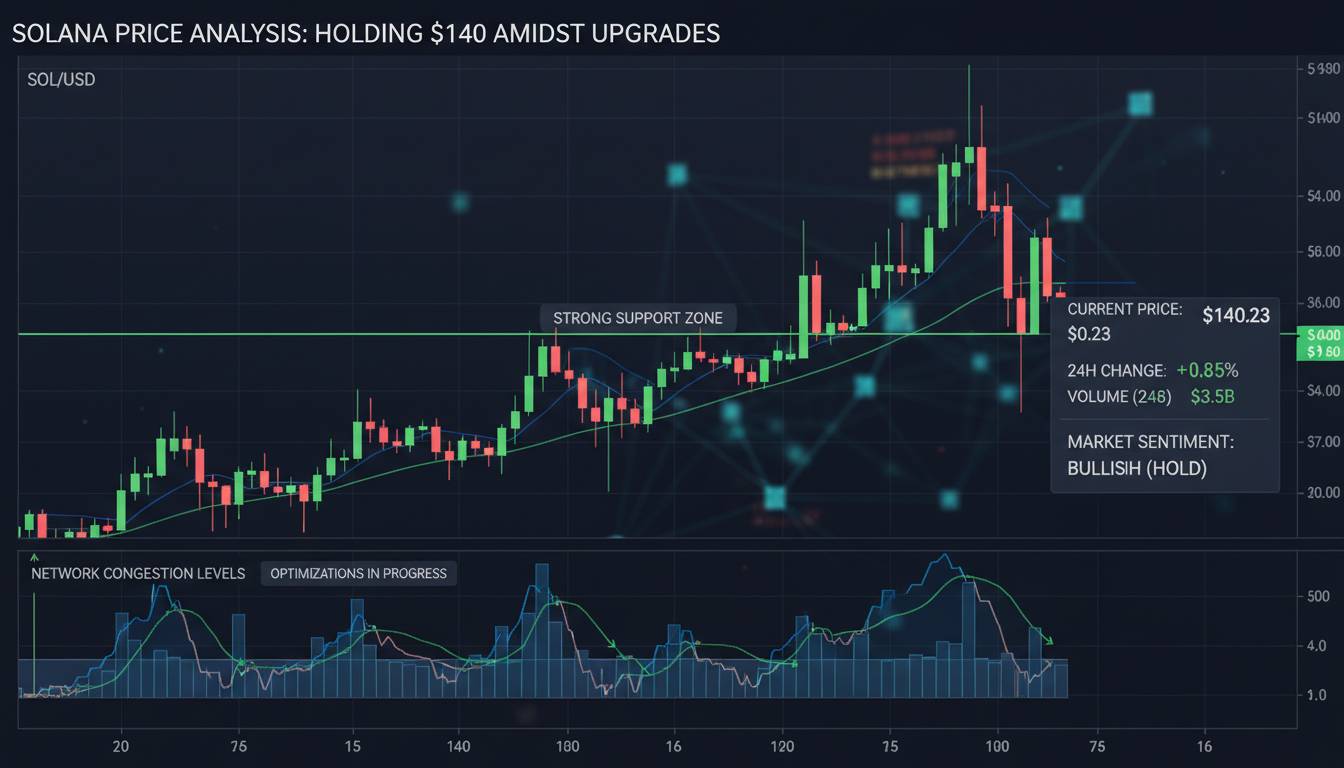
Solana (SOL) remains stable around the $140 mark, showing resilience amid intermittent network congestion. Recent technical upgrades and investor sentiment help it maintain this level, even as usability hiccups and capacity strains raise concerns.
Technical Outlook: Support at $140 and Growth Catalysts
SOL’s recent stability at around $140 reflects a firm base of investor confidence and rising momentum. After a substantial 52% retracement from early 2025 highs near $294, Solana appears to have found short-term footing at this level.
The upcoming Alpenglow upgrade plays a key role here. Set to reduce block finalization time to 150 milliseconds, it promises faster settlements and could boost institutional interest in derivatives and DeFi use cases.
Technically, SOL has formed an ascending triangle pattern, with support at $134 and overhead resistance around $145–$148. A breakthrough above that could pave the way to $150–$155, and possibly beyond if momentum persists. Analysts project that a successful Alpenglow rollout paired with favorable macro factors could even propel SOL toward $210.
Network Congestion: User Frustration Meets Structural Resilience
Solana’s hallmark is high throughput and fast transactions—yet congestion episodes still occur. Bot spamming, meme coin frenzy, and concentrated validator loads have periodically created bottlenecks.
These surges often cause delays, failed transactions, and frustrating user experience. Forum reports and on-chain metrics highlight ping times of 20–40 seconds, plus transaction failure rates between 30–80%. That said, developers have refreshed fee mechanisms and weighting systems. Implementations like stake-weighted QoS and priority tips help improve throughput.
While these upgrades don’t eliminate congestion, they reduce its impact. SOL’s price appears to shrug off these productivity issues more quickly than in the past.
Sentiment & Ecosystem: Confidence Holds Water
Despite congestion chatter, investor sentiment around Solana remains generally upbeat. Analysts point to robust ETF inflows and protocol proposals such as SIMD‑0411—designed to accelerate disinflation and tighten token supply—as key support factors.
Indeed, as of November 2025, SOL edged close to $140 amid renewed crypto market momentum and strong ETF subscription demand.
At the same time, systemic risks—like validator centralization and client dependencies—have not gone unnoticed. Technical flaws, past outages, and stalled upgrades have fueled caution among some institutional investors.
Still, Solana’s quick bounce back to the $140 level suggests that investor confidence remains resilient where progress outweighs setbacks.
Summary Snapshot
- SOL holds firm around $140, buoyed by technical consolidation and investor support structures.
- Alpenglow upgrade and disinflation proposals give bullish momentum potential.
- Network congestion remains an issue, but recent fee optimizations help mitigate disruptions.
- Sentiment remains cautiously positive—balancing optimism with technical scrutiny.
Conclusion
Solana’s current hold at $140 isn’t simply a product of motionless markets. It’s a nuanced reflection of technical resilience, ongoing upgrades, and investor confidence—despite occasional network slowdowns. Alpenglow’s rollout, evolving deflationary mechanics, and ETF demand suggest a favorable near-term outlook. At the same time, congestion risks remind stakeholders that user experience and reliability remain key.
Strategically, keeping an eye on the Alpenglow upgrade’s performance and macro triggers like Fed policy will be critical. Investors should look for volume surges or technical breakouts above $145 for more clarity on momentum continuation.
FAQs
How does network congestion affect SOL’s price?
Congestion often triggers short-term sell-offs due to negative sentiment and failed transactions. However, timely updates like priority tips and QoS tend to soften the impact and help SOL bounce back quickly.
Why is $140 such an important price level?
$140 serves as a strong technical support, forming the base of an ascending triangle. Breaking above $145–$150 could pave the way for further gains, while a slip below $130 raises downside risk.
What is the Alpenglow upgrade and why does it matter?
Alpenglow is a performance update aimed at speeding up transaction finality to around 150ms. It could significantly improve SOL’s appeal in high-frequency and decentralized financial use cases.
Are congestion issues resolved on Solana?
Not entirely. While tools like stake-weighted QoS and priority tips help manage traffic surges, congestion still occurs during high-demand events. Continued infrastructure improvements are essential.
What macro factors support future SOL gains?
Monetary policy easing—like a Federal Reserve rate cut—combined with steady ETF inflows and positive protocol changes, supports bullish momentum for Solana.
Should investors worry about validator centralization?
It’s a valid concern. While recent upgrades reduce single-client reliance, validator concentration still poses systemic risks. Monitoring decentralization metrics remains wise for long-term investors.





















Leave a comment