


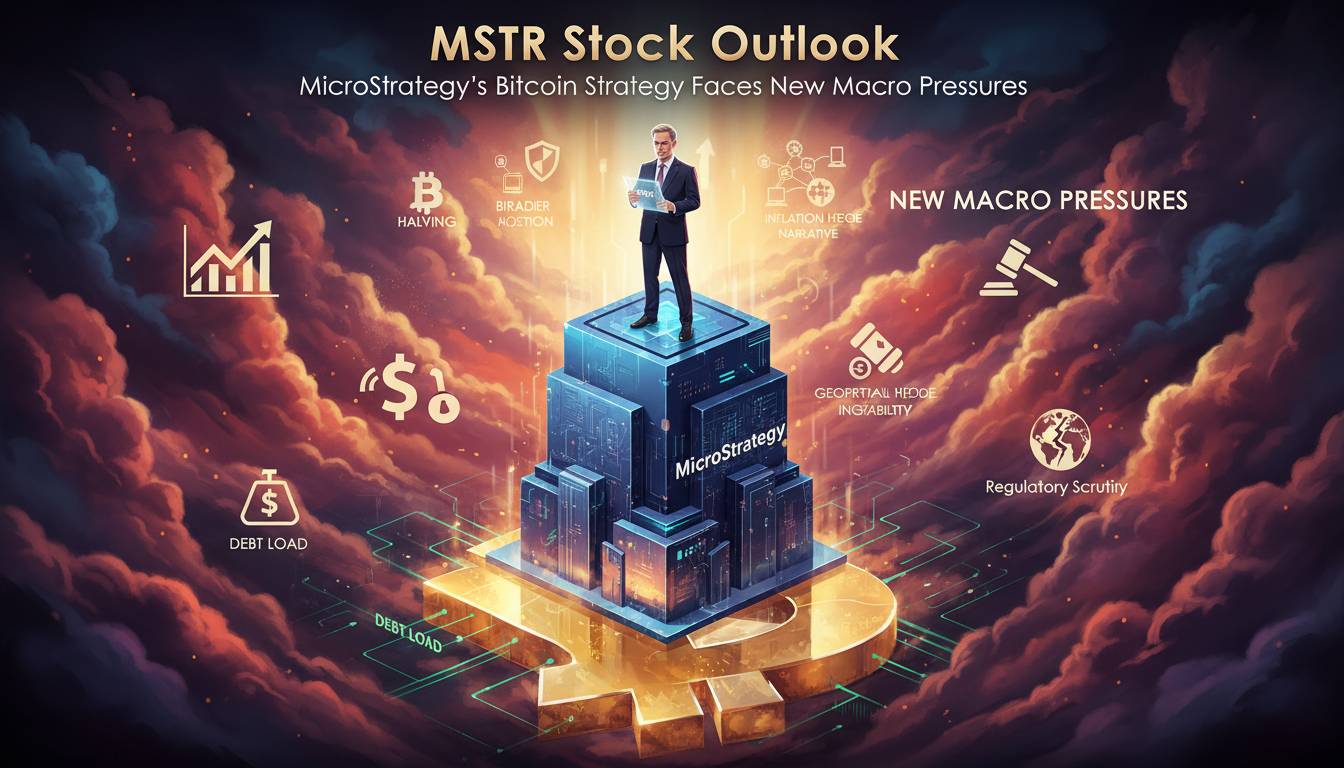
MicroStrategy—now rebranded as Strategy—continues to lean heavily into its Bitcoin-backed business model, and that means macroeconomic pressures are creating a tighter squeeze on its outlook.
The Core of the Matter: Immediate Answer
The MSTR stock outlook is clouded by rising macro pressures—Bitcoin’s recent pullback, mounting short interest, rising funding costs, and looming debt maturities. Yet, strong cash reserves, innovative capital structures, and investor confidence in Michael Saylor’s long-view strategy keep the company afloat—though its fate hinges on how Bitcoin behaves next.
Macroeconomic Pressures Amplifying Volatility
Bitcoin Decline and Market Sentiment
Bitcoin’s fall from its all-time highs has rattled Strategy. Its average Bitcoin purchase sits between about $76,000 and $78,000—$9,000 to $10,000 above current trading levels . This valuation gap has led to significant unrealized losses—over $12 billion recorded in Q4 2025 .
Rising short interest also signals investor skepticism: around 30.5 million shares, or 10% of the float, are now shorted—a jump of 40% since September 2025 .
Funding Costs and Liquidity Risks
Strategy is navigating higher interest costs on its preferred stock—up to 10.75%—while raising capital to ensure liquidity through a period dubbed “bitcoin winter.” It generated $1.4 billion in proceeds from share issuance, intended to support obligations for nearly 21 months .
Yet the longer-term pressure looms from $6.6 billion in convertible debt due in 2027–2028. If stock prices remain depressed, the company may face demanding liquidity calls or forced repayments .
Index Risk and Market Structure Overhang
An ongoing concern stems from MSCI’s pending reclassification decision (due mid-January 2026), which could trigger forced selling of over $2–9 billion in stock from passive funds . This technical risk adds short-term volatility to an already fragile equity structure.
Strategic Resilience: Strengths Amid Headwinds
Strong Liquidity Cushion
Despite structural risks, Strategy holds a sizable buffer. Its cash reserves—boosted to roughly $2.2–2.3 billion—can cover about 2.5 years of obligations without touching its Bitcoin holdings .
It transitioned from convertible debt to preferred equity, achieving conservative net leverage levels (~10–13%) while raising more than $25 billion in 2025 for Bitcoin acquisitions . This approach has kept capital markets open even amid deep crypto volatility.
Analyst Perspective: Mixed but Occasionally Bullish
- TD Cowen (Lance Vitanza) remains bullish, citing strong reserves and setting a price target of $440—about 4× from the then-current $107 .
- Cantor Fitzgerald trimmed its target from $560 to $229 but still maintains a Buy rating, calling the crypto pullback a healthy correction .
- Forbes’ Peter Cohan suggests if Bitcoin trades between $100,000 and $150,000, MSTR could reach $450–$474. If BTC falls below $80,000, the stock could dip under $100 .
- Macro analyst Fred Krueger praises the flexible capital model and long-term focus, noting the company’s ability to issue equity or debt as needed offers a safety net not common in similar firms .
Operational Diversification – Tiny but Present
The company’s old software unit—now AI-enhanced—the MicroStrategy ONE platform, still contributes a sliver of revenue. It’s modest (~2% of enterprise value), but it underscores that Strategy isn’t a one-note story .
Taking Stock: How Macro Trends Shape the Outlook
If Bitcoin Recovers…
A renewed rally in Bitcoin could significantly boost MSTR, thanks to its leveraged exposure and investor sentiment linked to Saylor’s long-game narrative . Analyst targets between $400 and $700 hinge on such a scenario .
If Crypto Markets Stay Weak…
Persistently low Bitcoin levels, high interest obligations, and issuance needs could stress liquidity—even with strong buffers. An investor-run panic or forced selling amplifies downside risk .
Technical and Structural Vulnerabilities
Near-term catalysts like MSCI decisions or index reclassifications could trigger massive outflows. Rising short interest and bearish options positioning further accentuate negative sentiment .
“The volatility is the strategy, not a bug.” This sums up Strategy’s model: embracing crypto swings, backed by capital ingenuity and a patient investor base, while staying exposed to macro shifts.
Conclusion: High-Risk, High-Conviction Play
Short version: MSTR remains an outsized, speculative centerpiece for Bitcoin believers—but it is not without peril. Macro pressures from falling crypto markets, funding structure shifts, and index risks amplify volatility. Still, robust liquidity, flexible capital tools, and confident leadership keep it positioned to ride out the storm. For investors aligned with Bitcoin’s long-term logic, potential upside is massive—and equally matched by downside if conditions worsen.
FAQs
What makes Strategy (MSTR) sensitive to Bitcoin’s price?
MSTR’s business model revolves around Bitcoin as its treasury asset. Every fluctuation in BTC value directly impacts its unrealized gains or losses, making stock performance tightly correlated with crypto movements.
Can Strategy handle debt and dividend obligations without selling Bitcoin?
As of late 2025, yes. Cash reserves and new capital raises support about 2–2.5 years of obligations without needing to liquidate Bitcoin. But if crypto stays weak or funding dries up, pressure may mount.
How are analysts viewing the stock right now?
Opinions diverge based on macro expectations. Some foresee a rebound to $400–$700 if Bitcoin rebounds; others warn the stock could tumble below $100 if crypto remains weak or funding becomes costlier.
How does Strategy raise capital without constant dilution?
The company prefers issuing high-yield preferred equity over convertible debt. This allows liquidity access while controlling dilution, and net leverage remains relatively low compared to traditional expectations.
What are the short-term risks facing MSTR stock?
Key risks include forced selling from index reclassification, high short interest, and bearish options bets. Additionally, rising debt service costs and macroeconomic volatility could erode investor confidence.
This nuanced volatility is part of the DNA of Strategy’s model—it’s not for the faint-hearted, but for those who get it, it’s precisely why the story remains compelling.




















Leave a comment