


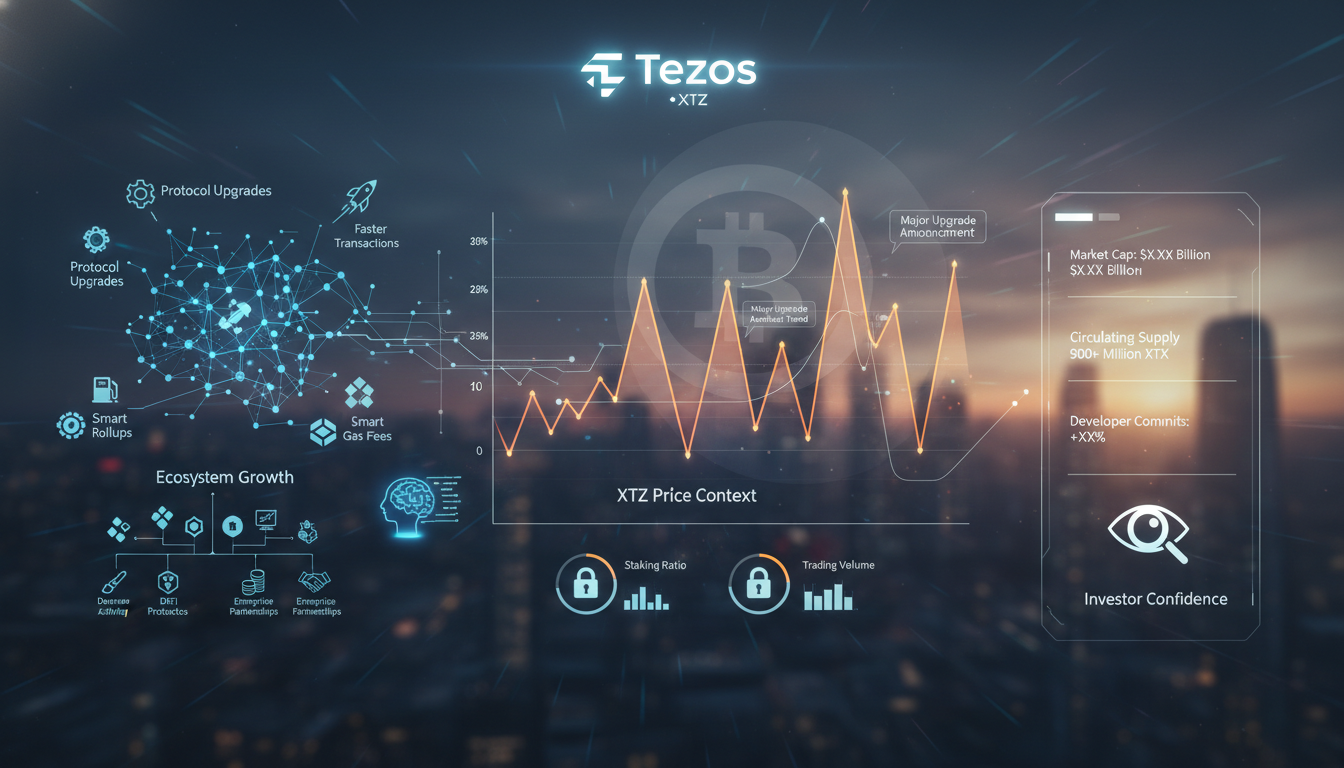
Tezos Market View: Development Insights and Price Context offers a snapshot of both the active enhancements in the Tezos ecosystem and how those upgrades are shaping XTZ’s price action in early 2026.
Development Momentum Driving Tezos Forward
The Tezos blockchain continues to evolve with a string of meaningful upgrades and bold technical agendas.
Rio Upgrade: Layer-2 Scalability Step
In May 2025, Tezos activated its 18th protocol upgrade—Rio—bringing three-day network cycles down to one day. It also directed 10% of staking rewards to the Data Availability Layer (DAL), boosting transaction throughput for Layer-2 protocols like Etherlink. The upgrade tightened baker inactivity thresholds to enhance network resilience .
Upcoming Scaling: Tezos X Vision
Beyond Rio, Tezos is rolling toward its broader Tezos X roadmap. A Canonical Rollup is planned—expected around 2026—which will unify smart contract execution across multiple languages and chains in a single efficient rollup. Tezos also aims for ultra-high throughput: achieving up to one million transactions per second with parallel execution and exploring efficient runtimes like RISC‑V alongside WASM .
Ecosystem Growth and Community Governance
Tezos thrives on its on-chain governance model, with community proposals made and voted upon by bakers and developers. Innovation continues via key contributors such as Nomadic Labs, TriliTech, Tarides, and Functori . Events like TezDev 2026 are on the horizon, promising to rally community builders, creators, and developers in Cannes this March .
“This upgrade reaffirms the Tezos ecosystem’s commitment to achieving unmatched L2 scalability.” — Yann Régis‑Gianas, Head of Engineering at Nomadic Labs
Price Context: XTZ in Early 2026
Tezos’ technical improvements are unfolding alongside diverse market dynamics for XTZ pricing.
Recent Price Moves and Volatility
As of February 3, 2026, XTZ saw a daily high of around $0.4789—up slightly from $0.4631 the day before but still nearly half below its price a year earlier .
Tallinn Upgrade: Scalability Incentive
On January 26, 2026, Tezos activated the “Tallinn” upgrade. This slashed block times to six seconds and lowered application storage costs by 100 times using an Address Indexing Registry. These enhancements boost scalability and lower costs for developers and institutional users. Improved finality (as fast as 12 seconds) adds further efficiency for Layer‑2 solutions like Etherlink .
Institutional Adoption Signals
TenX Protocol acquired roughly 5.5 million XTZ (~$3.25 million) in early 2026 to support staking operations. Meanwhile, Ledger integrated native support for Etherlink, allowing secured DeFi access for institutional users . These moves suggest growing confidence from institutional players in the Tezos ecosystem.
Market Sentiment: Cautious Yet Watchful
Despite these technical and institutional catalysts, broader sentiment remains conservative. The Crypto Fear & Greed Index sits near “Extreme Fear,” and altcoins continue to underperform as Bitcoin dominance persists . Technical sentiment leans bearish—CoinCodex reports more indicators pointing downward than upward, with RSI around 35, indicating a neutral but potentially oversold market .
Forecasts: Mixed Signals Ahead
Price projections vary widely:
- CoinCodex anticipates a trading range of $0.42 to $0.61 for XTZ during 2026, suggesting a potential 28% upside if high targets are reached .
- CoinMarketCap AI emphasizes the bullish impact of upgrades and institutional interest, but notes sentiment and macro risks as headwinds .
- Changelly offers a bolder estimate: an average 2026 price of around $0.706, with highs nearing $0.84—implying strong upside if the bullish scenario unfolds .
- Other platforms like DigitalCoinPrice foresee a rise up to $0.93 by late 2027, though with caution due to current bearish indicators . On the conservative side, 30rates projects declines through mid‑2026 before modest recovery .
Summary: Development Catalysts & Price Realities
Tezos stands on solid footing development-wise. Protocol enhancements like Rio and Tallinn pave a path toward significant scalability. Layer‑2 adoption, community governance, and institutional interest strengthen fundamentals.
Price-wise, XTZ remains modest—hovering under $0.50—but shows potential. Technical upgrades and staking demand offer upside. Still, uneven sentiment and broader crypto trends temper expectations. Forecasts span widely—from modest gains to high optimism—so outcomes hinge on macro momentum and ecosystem execution.
FAQs
What makes the Rio and Tallinn upgrades important for Tezos?
Rio accelerated staking cycles and supported L2 scaling via the DAL, while Tallinn slashed block times and storage costs. Together, they make Tezos faster, cheaper, and more developer-ready.
How significant is institutional demand for XTZ?
TenX’s acquisition of over 5 million XTZ and Ledger’s Etherlink integration point to growing institutional appetite, reducing potential selling pressure and signaling confidence in Tezos.
Why is the market sentiment still muted despite upgrades?
Broader caution toward altcoins, dominated by Bitcoin and low “Altcoin Season” sentiment, means that improvements in Tezos alone may not be enough to spark immediate rallies.
Are price forecasts for XTZ realistic?
Forecasts span a wide range—from stable mid‑$0.40s up to high‑$0.80s—reflecting different assumptions. They’re speculative; meaningful gains depend on adoption, broader crypto trends, and ongoing ecosystem execution.
Tezos continues to build—layer by layer. It’s not flashy overnight, but the trajectory is clear. Watch for the technical signals, developer traction, and whether sentiment finally turns in its favor.















Leave a comment