


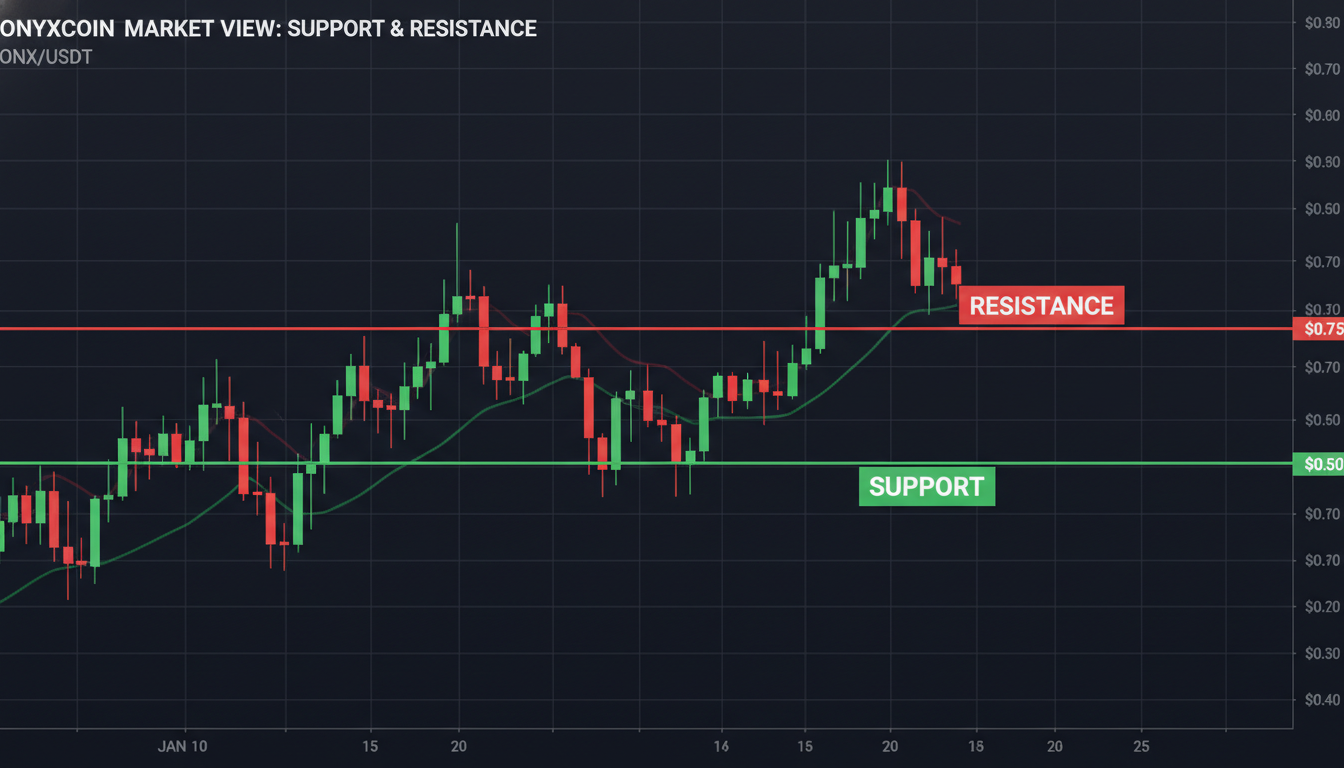
Onyxcoin Market View: Price Structure Explained lays out how Onyxcoin’s value moves and why those shifts matter. It’s about spotting patterns in price moves—like support zones or breakout points—so traders and enthusiasts can make smarter choices. Let’s dig in.
Understanding Onyxcoin’s Price Framework
Onyxcoin price structure refers to the layers of highs, lows, trendlines, and key levels that guide how the market moves. Think of it like a building: each floor (high or low) supports the next. When those supports break, things shift fast. You can see repeating patterns that hint at whether price will push higher, reverse, or just hang around.
Why It Matters
Understanding this structure helps in:
- Pinpointing when a bounce might happen
- Seeing where buyers or sellers step in
- Deciding where to place stop-losses or entry points
Without this, you’d just guess.
Mapping Key Levels in Onyxcoin Price
Swing Highs and Swing Lows
First step: mark the clear peaks (highs) and troughs (lows) on a chart. These are anchor points for analyzing future moves. Say Onyxcoin rallied from $10 to $15, then dipped back to $12—that $15 and $12 become your talking points.
Support and Resistance Zones
Support is where price tends to stop falling, often due to buying pressure. Resistance is where rally hits a ceiling. If Onyxcoin hits a $16 zone multiple times but stalls, that becomes a resistance. Same for support: repeated bounces at $12 make it a safe buy zone for many.
Trendlines and Channels
Draw lines that connect at least two swing highs or lows. They reveal whether the market is in an uptrend, downtrend, or range. An upward sloping trendline along Onyxcoin’s lows signals bullish tone. Price riding inside a parallel channel gives clues when it might reverse.
Patterns That Shape Onyxcoin Moves
Breakouts and Fakeouts
A breakout is when price pushes beyond a key level—like leaping past $16 with volume above usual. That’s often followed by fast moves. But beware fakeouts—price slips above briefly, then collapses. You’ll spot those with candle shapes and volume patterns.
Higher Highs / Higher Lows vs Lower Highs / Lower Lows
These sequences show trend direction. If Onyxcoin makes higher highs and higher lows, bulls rule. Drops forming lower highs and lower lows point to sellers. When this flips, trend reversals may be in play.
Consolidation Areas
Sometimes price just drifts within a range—not up, not down. Those zones are boring, but they pack energy. Once released, price tends to swing sharply, giving traders chances to get in early.
Real-World Example: Onyxcoin Structure in Practice
Let’s say during January Onyxcoin rose from $8 to $14, then pulled back to $11. That $11 zone became support. It then rallied again to $16, hesitated, dipped to $13, and bounced. Now you’ve got:
- Support: $11–12
- Resistance: $16
- Higher low at $13
If the coin breaks above $16 cleanly, that’s breakout territory, with potential to head into $18–20. If it drops below $11, you might eyeball $9 as next area of interest.
Expert Insight
“Observing price structure isn’t just about charts—it’s about psychology. When Onyxcoin breaks a trendline with conviction, it shows shifts in confidence.”
This reminds us that chart levels reflect collective trader behavior and sentiment.
Strategy: Bringing It All Together
Here’s a streamlined approach to using Onyxcoin price structure:
- Identify swings – mark the recent clear highs/lows
- Draw support/resistance – based on clusters of price action
- Add trendlines or channels – to see direction
- Watch for breakouts – confirm with volume/spikes
- Plan entries and exits – e.g., buy near breakout, use stop just below support
- Adapt as structure changes – don’t hold onto old levels that slip
This keeps you flexible and in tune with real-time shifts.
Common Pitfalls and How to Avoid Them
- Overcrowding the chart with zones: Too many levels just confuse. Stick to key areas.
- Ignoring volume: Price moves without volume often fail.
- Chasing price: Waiting for a breakout is fine; but jumping in late increases risk. Better to wait for pullback or confirmation.
Conclusion
Onyxcoin market view and price structure is essentially a roadmap. Spot swing points, draw zones, watch for trend shifts, and align with sentiment. When structure holds, price moves have order—when it breaks, they can be sharp. Combine this with volume and timing, and you’ve got a powerful edge.
FAQs
What is price structure in Onyxcoin?
It’s a layout of highs, lows, trendlines, and zones that guide likely moves. You’re tracking the market’s skeleton, pointing to potential reversals or continuation.
How do I spot key levels?
Look for where price stalls or reverses repeatedly. Mark swing highs and lows. These clusters often become support or resistance.
Why are fakeouts dangerous?
They bait traders with a false breakout, then reverse hard. Without volume confirmation, they’re often traps.
Should I use other signals alongside structure?
Yes. Volume, momentum indicators, and candle patterns help confirm moves. They add weight to structure-based decisions.
How often should I redraw trendlines or zones?
Whenever price clearly breaks out or reverses. Old levels can lose relevance quickly—just like shifting tides.
Hope this helps you see Onyxcoin moves more clearly—and navigate them with confidence.
















Leave a comment